

Experiencing the magic at Daniel's Den
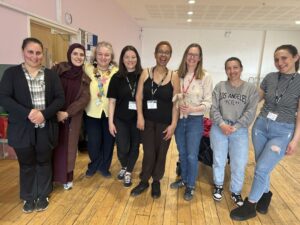
On 15 April, I was lucky enough to visit 4in10 member Daniel’s Den. I was welcomed to their regular Wednesday morning play group at Chalkhill Community Centre in Wembley Park, Brent.
When I arrived, the session was in full swing, in a lovely bright room, full of mums, dads and their small children playing happily. I met new mums with very small babies being warmly welcomed to their first session alongside mums who told me that they had come to Daniel’s Den with older siblings and couldn’t wait to return with new additions to their families.
The session was led by the indefatigable Hermina, who effortlessly balanced registering new families, mixing playdough, and explaining to me how the group operates—all without missing a beat. She was supported by a dedicated team of volunteers, many of whom had attended the group themselves when their children were younger, and who now offer invaluable peer support to those attending.
Many families at Daniel’s Den have direct experience of child poverty. Some are single-parent families; others are migrants with no recourse to public funds. Some are young mothers, some are living in temporary accommodation, and others have experienced domestic violence. Whatever their circumstances, the atmosphere in the room was one of safety, warmth and mutual support, a place where families could spend relaxed, fun time with their children, fostering learning, play and connection. After a healthy snack for the children and tea and coffee for the adults, the session ended with a singing, watching the children bounce along to “Sleeping Bunnies” was undoubtedly a highlight of my visit.
After the session I had the chance to catch up with Jo Gordon, CEO and founder of Daniel’s Den. She told me about how she set up Daniel’s Den over thirty years ago when she had her own son, and how it has grown from that one initial weekly group to tweleve groups running each week across eleven venues. On top of this Jo also now coordinates a network of Parent and Toddler Groups across London and has recently been working in partnership with Brent Council on the ‘Brent Babies’ project to make sure that the services being offered to families through the new Family Well-being Centres are made accessible to all families in the borough, including those supported by Daniel’s Den.
Services such as those offered by Daniel’s Den and other voluntary and community sector groups are the absolute bedrock of the early years eco-system in our city. I often sit in rooms with policy makers and professionals who grapple with the question of how to how to better engage families in early years provision and family support. The answers I believe, lie firmly in spaces such as those created by Daniel’s Den, where staff, volunteers and fellow parents and carers are able to build trust and relationships that can act as a bridge into other parts of the eco-system, where families may initially be more hesitant to go.
The problem is not everyone in our city has access to these amazing groups - one mum had walked over an hour across the borough to come to the session I attended, as she could not afford the bus fare. And many of the groups that do exist are already beyond stretched. They could offer twice as many places, if they had more funding, and would still have to turn people away. It is not possible to expect the jam to be spread ever thinner and for those who run these organisations to give their time and knowledge to help develop services such as the new Family Hubs, without recognising their invaluable contributions and supporting it with long-term sustainable funding.
The Opportunities Mission which is led by the Greater London Authority and London Councils supported by key partners including the VCSE (which I help to represent on the board) aims to ensure all children in London begin year 1 at primary school ready to learn and thrive – aligning with the Government’s own Opportunity Mission and Best Start in Life Strategy. The Mission represents a chance for us to make the case for groups such as Daniel’s Den and put them at the heart of delivering the mission.
There is a sort of magic taking place at Daniel’s Den, not a flashy, whizzy type of magic but the more everyday kind that is created in communities, when people come together in tough times to support one another without judgement and with love and care. And it is the people, Jo and her team that make it happen – we need to get behind them (and all the others I know doing similar work in local organisations across the 4in10 Network) if we are to truly improve the lives of the 800,000 children living in poverty in London.
Katherine visited Daniel's Den on 15 April 2026.

Spotlight Interview with MB Community CIC
MB Community CIC
Comments from Omari the Director of MB Community CIC
- How are you helping to tackle child poverty in London?
We tackle child poverty by removing cost barriers and creating free, local opportunities for children and families in areas with high deprivation. Our work focuses on free sports sessions, holiday activities, youth programmes and community events that improve physical health, confidence and social connection. We also work closely with schools, councils and early help teams to reach families who may be struggling financially or socially, ensuring support is delivered in familiar, trusted spaces such as parks, schools and community hubs.
- Tell us something you are excited about.
We are excited about developing community-led spaces and programmes that bring families together consistently, not just for one-off activities. In particular, growing our work around community hubs and youth forums feels important, as it gives young people and families a voice in shaping what happens in their local area.
- Share something positive about your organisation’s achievement or service.
One of our proudest achievements is building strong engagement with young people who may not otherwise access structured activities. We consistently see improvements in confidence, attendance and behaviour, and we are trusted by parents, schools and partners to deliver safe, inclusive and welcoming sessions. Our ability to engage families as well as young people is a key strength.
- What can other network members learn from you or find out more about through you?
Other members can learn about practical, grassroots delivery – what genuinely works when engaging children, young people and families facing financial pressure. We are happy to share learning around outreach, building trust locally, partnership working with councils and schools, and delivering impactful programmes on limited budgets.
- What would most help you achieve your goals?
Flexible funding and longer-term support would help us plan sustainably and deepen our impact. Strong partnerships, shared learning across the network, and opportunities to collaborate rather than duplicate work would also make a significant difference.
- Why did you join 4in10? What do you enjoy about being part of the network?
We joined 4in10 because tackling child poverty requires collaboration, not isolated working. We value being part of a network that shares knowledge, amplifies lived experience and advocates for systemic change. Being part of 4in10 helps us stay connected, informed and motivated, while ensuring the voices of the communities we work with are reflected in wider conversations.

Spotlight Interview with Healing Homes West
Healing Homes West

Comments from Laura Hickman, Co/Founder, Social Worker & Therapeutic Lead
1. How are you helping to tackle child poverty in London?
‘Healing Homes West’ is a small women-led community project transforming unsafe housing into healing spaces for children and single parent families living in poverty in West London.
At Healing Homes West, we believe that every child has the right to grow up in a safe and comfortable home. Trauma recovery is not possible without the safe foundations. We provide trauma informed makeovers, working alongside families, supporting participation throughout the process. We furnish bedrooms and whole homes, by offering hands-on, compassionate support to create welcoming, uplifting spaces for families who need it most. We work alongside families and referrers taking into account the individual needs of the family and providing a practical solution that can support wider parenting or mental health concerns.
Our referrals are mainly from social workers and local partners where poor housing conditions are negatively impacting on the child’s and family’s wellbeing.
Too often we feel powerless to address the practical aspects of poor housing. While we cannot change the housing system, we can work together to alleviate some of the immediate challenges. Our makeovers not only provide fast, practical relief, but can also open the door to stronger engagement with support services that lead to better outcomes for children and families.
We rely on the kindness of volunteers, good quality second-hand donations, new donations from brands that would otherwise go into landfill, we use amazon wish lists and privately fundraise.
2. Tell us something you are excited about?
Healing Homes West has been developing slowly over the last 18 months and we still have much to learn but are totally committed. We have established a strong identity for Healing Homes West and created a model that we believe is compassionate, effective and empowering.
We are excited by our achievements so far, we have helped over 60 people including 14 bespoke bedrooms as well as refurbishing 6 whole flats, since July 24. We have also refurbished two refuges for women and children escaping domestic abuse to create welcoming, calming shared spaces that would support connection and recovery.
The feedback we have received from carers, children, and referrers has been overwhelmingly positive, clearly demonstrating the transformative power of improving home conditions. Not only do these changes create safer and more comfortable environments, but they also have a wider ripple effect, enhancing overall wellbeing for families.
We are excited for when our charity is officially registered as this will allow us to support many more children and families, experience the far-reaching benefits of a healing home.
3. Share with our members something positive about your organisation’s achievement or service?
Our most recent makeover was creating a bedroom for a courageous 14-year-old girl. She has had a really tough time and as a young carer, has faced isolation and loneliness. Following the makeover, she expressed her gratitude by sending us a beautiful poem, which she has kindly allowed me to share with you.
My Pink Room
I’m only fourteen, but I feel so much older, the world put its weight on my tiny shoulders.
I make tea for nan when she cries or screams, and whisper to silence my broken dreams.
we used to sit and watch tv together but now even being in the same room with her makes my body shiver, some days her words cut deep like glass, but i smile even though I’m holding back tears, I can feel my breathe start to shake and my throat start to ache, there was no place I could call my own, no space to breathe no “me” just “home” just walls that echoed, cold and grey where laughter faded long away.
then one day they build me a room,
the first time I opened that white door I cried, I cried because I’ve never had a room that was just “mine” soft green walls that harmonized with the pink everything was just perfect. outside my door the shouting stays, but in my room the hurt decays, and maybe that’s all I needed to bloom a little pink hope, in my little pink room.
Thank you Healing Homes West
Dxx
4. What can other network members learn from you or find out more about through you?
We work alongside families and professionals as part of a wider intervention that can lead to change. Our team consists of women with different experiences and skills that complement each other and include interior design, social work and trauma recovery. We are passionate about sharing what we do and are keen to work in collaboration with anyone working to support children and families living in poverty. Our dream is for our Healing Homes model to be adopted and established in other parts of London and the UK.
5. What would most help you achieve your goals?
Achieving charity status – have social media and admin support, find sponsorship, increase our partnerships, identify funding, have a van and one day a healing community space where families can come and connect with one another.
6. Why did you join 4in10? What do you enjoy about being part of the 4in10 network?
The experiences of children and families living in poverty are so often invisible and ignored. In London its especially striking to see extreme wealth and deprivation existing side by side, yet so many people don’t grasp the reality of what it means for the lives of people affected. We joined 4 in 10 to be part of a collective voice, we are passionate about improving outcomes for children living in poverty and your network really helps give a voice to those who need it and brings other organisations together helping towards shaping change.



Spotlight Interview with The Mayor’s Fund for London
The Mayor’s Fund for London

Comments from Jade Harris, Director of Strategic Partnerships and Delivery
Mayor’s Fund for London is a charity that champions opportunities for young Londoners facing the biggest barriers.
- How are you helping to tackle child poverty in London?
The Mayor’s Fund for London tackles child poverty through a joined-up approach: providing food as a foundation, skills as a springboard, and power through our platform. We support young Londoners facing inequality by providing front-line support and long-term opportunity. Kitchen Social is our flagship food and community programme and the largest citywide provider of holiday food and activities. Through it, we ensure families have access to nutritious meals and opportunities to thrive during the school holidays. Alongside this, our employability programme Access Aspiration connects young people to employers and professional leaders. Giving underrepresented young Londoners careers insight they otherwise wouldn’t have access to, helping to remove the hidden barriers to employment and open pathways to good jobs.
- Tell us something you are excited about?
We’re excited about our ever-growing youth engagement work, creating more space for young Londoners to influence the decisions that affect their lives. By connecting young people and power in London, we help shift that power to young Londoners, so they have a bigger say in the city’s future. Through youth-led initiatives like our recent Young Londoners Summit and upcoming Westminster roundtable, we’re ensuring young people can both access opportunities and shape the systems around them. This work is expanding alongside our programmes, which continue to evolve to deliver impact for young people day to day and influence policy and strategy. Kitchen Social is delivering support during every school holiday, providing meals and access to positive opportunities from sports sessions and cooking classes to driving lessons and mental health workshops. Meanwhile, Access Aspiration is deepening its partnerships with employers across key growth sectors, giving more young people from underrepresented backgrounds direct access to real-world careers insight, work experience, and building key skills.
- Share with our members something positive about your organisation’s achievement or service?
In 2024, we supported over 89,000 young Londoners across all 32 boroughs. Through our Food and Communities programmes, we delivered more than 400,000 meals and 23,000 opportunities. At the same time, our Employability and Skills work provided over 16,000 skills development activities. Our model supports the whole journey: from healthy meals to hands-on career development, we help young people feel supported, skilled, and seen.
And we’re proud that the young people we work with report this back to us. Samiya, a member of our Youth Board, reflected on our work, saying: “Through the Mayor’s Fund for London’s initiatives, we begin to shape a world where diversity is celebrated, and individuals feel valued and safe in their communities. MFL fosters dialogue, promotes education, and empowers marginalised voices. These efforts work to address systemic inequalities and create a more compassionate society for future generations.”
- What can other network members learn from you or find out more about through you?
We’d love to share learning on how to design integrated models that meet urgent needs and unlock long-term systems change. With Kitchen Social and Access Aspiration, we’ve created programmes that deliver practical support, whilst influencing local systems, employer practice, and policy conversations. We also bring strong experience in cross-sector convening and youth-led co-design. We are always keen to collaborate with others exploring these approaches.
- What would most help you achieve your goals?
We’re focused on sustainable growth, ensuring we can meet growing need while continuing to influence the bigger picture. What would help most is multi-year investment and joined-up policy that enables us to deepen our impact, led by young Londoners. This kind of support will underpin our vision and mission for long-term, positive change. We want every young Londoner to be prepared for the future, not just with food and education, but with the confidence, networks, and skills to thrive in good careers.
- Why did you join 4in10? What do you enjoy about being part of the 4in10 network?
We joined 4in10 to be part of a collective, working to challenge the root causes of poverty in London. The network provides vital opportunities to share learning, amplify advocacy, and stand together for long-term change. It also enables us to work together with partners on big events such as the upcoming Child Poverty Summit with 4in10 and The Childhood Trust. Last year, we linked up with the Food Foundation on an episode of our youth-led podcast The Intersect, discussing food poverty and the power of youth voice in influencing policymakers.
Spotlight Interview with Daughters of Charity Services
Daughters of Charity Services

Comments from Mark Corea, Research and Policy Officer at Daughters of Charity Services
Daughter of Charity Services is a charity that works with people and the media to inspire content and communication that changes hearts and minds.
1. How are you helping to tackle child poverty in London?
One of the projects in our family, St Vincent’s Family Centre, provides a range of services to families in need, particularly in the Westminster area. The services include a drop in and creche service, classes and therapy for families, as well as a food bank service. We also have projects serving people in need in Manchester and Glasgow.
At a head office level, tackling child and family poverty is one of the five priorities in our 2024–2027 strategy. We work in partnership with other charities, including members of the Catholic Social Action Network (CSAN), to raise awareness and influence policy through co-signing letters, policy papers, and working on campaigns together.
Later this year, we will also be launching a research project focusing on the lived experiences of families affected by poverty in London, based on the experiences of our projects and other data that we’ll gather.
2. Tell us something you are excited about?
We have many things to be excited about at the Daughters of Charity Services. We recently launched our ‘Emerging Poverties Briefing’ through which we collate stories and updates on poverty in London and across the country and goes out to about 150 subscribers.
We are also excited to launch our paper on poverty among Asylum Seekers and Refugees, which discusses policy papers and other literature on this topic, to understand the causes and solutions to this poverty. Later in the year, we’ll be launching a large research project on child and family poverty in the UK, as well as a smaller project on social care in Scotland.
3. Share with our members something positive about your organisation’s achievement or service?
Our member projects are diverse and span across the UK. Our Westminster-based social care service, Vincentian Care Plus, provides domiciliary care for Westminster City Council. For two years running, 2024 and 2025, they have won a High Commendation at the Homecare Awards for their work supporting people affected by homelessness at Edward Alsop Court in the London Borough of Westminster. The model of enablement they run is inspiring and we are extremely proud of their achievement and recognition for supporting vulnerable Londoners.
4. What can other network members learn from you or find out more about through you?
Other networks can learn about the Vincentian approach to serving the people most in need and the history of the Daughters of Charity in Britain. They are a truly unique group of women who have dedicated their whole lives to serving people in poverty, and we exist to continue their legacy. Our Vincentian Values ensure that all of our staff live this legacy out.
We run a variety of services throughout the UK, ranging from supporting vulnerable families and older people in Westminster to supporting Roma families in Glasgow and families of prisoners in Manchester.
Other Vincentian charities include Depaul UK, the Passage, and the St Vincent de Paul Society. These charities share the same ethos as us, and they all carry out great work in London and throughout the UK.
5. What would most help you achieve your goals?
As a small charity more collaboration with other charities would help us achieve our goals. We are proud to be part of some great networks, including 4in10, NCVO and the No Child Left Behind campaign, and Caritas Social Action Network. By joining up messaging and working together on campaigns with other charities of all sizes, it strengthens our voice as a small charity and we believe a united voice strengthens the message of our advocacy and campaigning.
6. Why did you join 4in10? What do you enjoy about being part of the 4in10 network?
We joined 4 in 10 as it is a large network of like-minded charities who are all keen to serve the most vulnerable in our society, which is our fundamental purpose. The events and the newsletter service are particularly helpful, as it makes it easy to network with charities across the city that serve people in need.

The emotional toll of poverty on children, young people and families
This blog is adapted from a LinkedIn post published by our Strategic Programme Manager, Katherine Hill to mark Mental Health Awareness Week 2025
“I feel anxious all the time, like I’m riding a rollercoaster…”
That’s how one parent in London recently described life with young children.
But it wasn’t sleepless nights or toddler tantrums they were talking about — it was poverty.

This Mental Health Awareness Week, I want to highlight two powerful reports published recently by members of 4in10 London's Child Poverty Network that make something crystal clear: poverty doesn’t just affect bank balances — it affects mental health, emotional resilience, and how people experience the world around them.
Last week, Home-Start London released new research based on interviews with families supported by local Home-Starts across the city. The picture they paint is tough.
- Nearly 9 in 10 families (86%) say that money worries are making parenting harder.
- 81% feel anxious or stressed because of financial pressure.
- And 6 in 10 say it increases their sense of isolation.
“Rent is always our priority, then bills. But in London, the price of everything is going up. It’s been a challenge — we’ve had to go to our local food bank.”
Parent interview
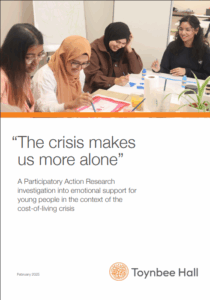 Earlier this year, Toynbee Hall published “The crisis makes us more alone”, a report led by 12 brilliant young peer researchers from low-income backgrounds in Tower Hamlets. Their work explores how the cost-of-living crisis is affecting young people’s mental health. The findings are just as powerful and just as worrying:
- Over half of the young people surveyed had experienced rising stress within their immediate families.
- Nearly half said their own mental health was getting worse.
- These issues are compounded by financial insecurity, overcrowded housing, and insufficient mental health services, creating a web of challenges that many struggle to navigate.
These two reports, focusing on different stages of young lives, tell the same story: poverty and poor mental health are deeply intertwined.
Struggling to make ends meet doesn’t just fray people’s nerves, it isolates them and makes it harder to access help.
But there is hope - and it lives in our communities. Both pieces of research show the crucial role voluntary and community organisations play in offering support, connection, and understanding. These are the safety nets too often missing or even undermined from national policy.
We don’t need any more proof that poverty damages lives. What we need is action. We need policies that recognise that mental health isn’t just about individual resilience - it’s about the social and economic conditions we create.

Spotlight Interview with Heard.
Heard
Comments from Becka Kellaway, anti-poverty campaigner and Aishah Siddiqa, senior programme manager at Heard
Heard is a charity that works with people and the media to inspire content and communication that changes hearts and minds. On a fundamental level, good communication means being heard and feeling heard. Using insights from research and our 15 years experience of supporting communicators, we help storytellers build their confidence, land their message and engage audiences. Our work has reached millions of people in their living rooms and on their newsfeeds.
- How are you helping to tackle child poverty in London?
Heard has been supporting organisations and campaigners working on a range of social issues including child poverty. We do this through our consultancy and training offers for sector partners andcampaigners with first hand experience, and through our bespoke workshops for the TV and entertainment industry. Our mission is to create conversations about social issues that change minds and develop the conditions for lasting social change. The long-term effects are two-fold: a public that is more receptive to and approving of policy change, and a new generation of individuals who feel inspired to act on our most urgent issues.
Becka – I hope I help by campaigning and raising awareness. I am more than happy to speak out about things that I see are unjust and I don’t mind sharing my personal experiences. I think others can feel silenced by stigma and shame so I believe it’s important to shine a light and make a difference where you can.
- Tell us something you are excited about?
Becka – I’m excited that there are more conversations happening around child poverty and ways to tackle it and I’m really very hopeful for the future.
Heard has also recently started a new piece of work exploring how a narrative change approach, informed by lived experience, can shift cultural perceptions of our economy. Often messages about economic change delivered by academics and people with economic privilege are limited in effectiveness. The majority of the country will relate more to people who share in their lived experiences of financial hardship and other forms of economic injustice. These are the people who should lead a new story about what our economy could be, and the systemic changes that need to happen to bring that change about. We’re looking for lived experience consultants to help us explore this and create a set of framing recommendations about the economy to share with other campaigners, partners and organisations in the ecosystem. If you’re interested in finding out more, please email aishah on aishah@heard.org.uk
- Share with our members something positive about your organisation’s achievement or service?
Becka – the best thing about this organisation is that it empowers people to tell their story bravely and it supports them throughout the process and helps to frame the narrative so we all feel safe in our work.

Together with other lived experience consultants, we co-designed the digital version of Heard’s poverty focussed ‘Communication That Works’ course. The course itself is a blend of self-directed learning on an online platform with live workshops running over several weeks covering ways to effectively frame communications on poverty and tools to keep safe when sharing stories in interviews and beyond. We ran a successful pilot at the end of last year with Becka brilliantly facilitating our live workshops. We’ll be making final tweaks before going live this summer.
“This Heard Training course has been profoundly informative and impactful, not only in reshaping my approach as a communications professional but also in influencing how I think about and discuss social issues in all areas of my life. The trainers were knowledgeable, confident and excellent facilitators. The video content was clear, easily digestible and engaging. Overall, the program was truly transformative.” – Fern Bain Smith, Marylebone Project
- What can other network members learn from you or find out more about through you?
Becka- They can learn from Heard’s example how to be a champion for people with lived experience
Becka is an amazing, energetic and thoughtful facilitator – reach out if you require someone sensitive and engaging!
- What would most help you achieve your goals?
Becka – Funding, opportunities, awareness, more people fighting the good fight and they can start by attending the training and being mindful and empowered advocates.
- Why did you join 4in10? What do you enjoy about being part of the 4in10 network?
Narrative change requires joined-up approaches – and we love being able to work with 4in10 and its members. The Challenge Poverty Weeks were great examples of this in action! If anyone would like to connect and chat about how we can collaborate, please do =D
Guest Blog with Z2K on the damaging impact of London's temporary accommodation crisis
 Photo by Cyrus Crossan on Unsplash
Hear from Louise* and Miracle, two peer researchers with lived experience of temporary accommodation (TA) who co-produced Z2K’s research report ‘Frozen in Time’. The researchers interviewed people living in TA in Westminster about the issues they face and the impact that living in TA is having on peoples’ lives. The research was launched last month at an event in Parliament hosted by Rachel Blake, MP for Cities of London and Westminster.
Miracle: My first experience of homelessness and temporary accommodation was in London during my late teens for about two years. For a young man with the ambition to hopefully do well in the world and succeed through education, those two years for me were really traumatizing (fighting forces of derailment with a strong will and focus to triumph through). The overall experience I had during that period of time involved living in bad housing conditions (mould, damp and pests) causing health issues, as well as the impact of burglaries. However, I went through adversity those two years and conquered it with cheerful spirits of hope for a better day someday. Since this time, I have had a nomadic existence because I had nowhere that I could call home in the UK. I moved from TA to a mixture of student accommodation and privately rented accommodation. More recently, I have found myself back in TA, placed in a hotel ‘out-of-borough’.
Louise: I lived in TA as a single parent placed out-of-borough. It felt like screaming in a sound-proofed room, hoping someone might hear. I felt exhausted from fighting to pin down who was responsible for the infestations and damp in the property. For my child, living in TA meant having a stressed mother whose spare time was spent chasing the council, growing up in an environment which did not allow pictures on the wall, pets, or any self-expression or personalisation – and no playdates due to the damp and disrepair.
Miracle: It has been a rewarding experience being a peer researcher on the Z2K temporary accommodation project. Working on the project and meeting like minds with shared experiences was for me a great opportunity to help dig into the heart of the TA experiences which many in Westminster are currently having. It has been satisfying to try to bring this reality closer to the eyes of decision-makers at Westminster City Council.
Louise: Interviewing people who had been placed in TA by Westminster City Council as part of the research project was the first time I had spoken to anyone else in TA about their experience, and the interviews immediately made me feel less isolated and more human again. I found it validating and cathartic to speak to others facing similar difficulties.
Miracle: It is clear to see from the findings that people living in Westminster TA desire more empathy and understanding.
Louise: In temporary accommodation you are always on the verge, on tenterhooks, never knowing when you’ll get told to leave. I felt helpless living out-of-borough, unable even to vote for the Westminster councillors who held my housing future in their hands. Then there is the stigma you fear if you share this with schools or GPs; the assumption you must have done something wrong to be in TA to begin with.
Miracle: There are a number of areas where change is needed, such as in the council’s engagement and communication with people.
Louise: All Westminster schools and GPs should read this report so they understand how TA affects their service users. Similar to my own experience, the vast majority of people I interviewed did not feel that their needs were met or understood. Whether it was complaints about damp and mould adversely exacerbating their health problems, or traumatised survivors of domestic abuse being placed in unsuitable accommodation, the common problem was the lack of communication and engagement on the part of the council. This left the interviewees, mostly women, feeling forgotten and as if they don’t matter.
Miracle: We need to see a change in the way in which people living in TA are often seen and treated.
Louise: The uncertainty and the worry of not knowing where or when they might be moved on caused families stress and insomnia, which affected their mental and physical health. This in turn affected school or work outcomes, despite trying their utmost to do well and succeed. Households needing temporary accommodation appear to be looked down on.
Miracle: For so many, living in TA is not temporary. Therefore, improving TA standards is surely an area where change is vital. I believe that the report will help to bring a dose of reality to the current understanding of temporary accommodation at Westminster City Council, so that there can be a different tomorrow.
Louise: I believe that if the council staff had carried out the interviews we did, and experienced the resilience and tenacity of these people, then they would treat them with more respect, inclusion and engagement. Meaningful dialogue, not stonewalling, is what is needed to free people living in temporary accommodation from the state of limbo that they find themselves in.
*Not her real name

Spotlight Interview with Give. Help. Share.
Give. Help. Share
Give. Help. Share. work to tackle food poverty in London.
- How are you helping to tackle child poverty in London?
At Give. Help. Share., we tackle child poverty in London by addressing two key issues: food insecurity and a lack of nutritional education. We provide free nourishing food bags to children and families in disadvantaged communities via a school distribution network across Greater London and Herts. In parallel, we also run hands-on healthy eating workshops in primary schools, empowering children to make better food choices and become ‘food change champions’ in their homes. Our lessons are designed to be accessible and impactful, helping to improve long-term dietary behaviours and break the cycle of poor nutrition linked to poverty.
- Tell us something you are excited about?
We’re really excited about the growing interest from corporate partners who want to support our mission. More businesses are now recognising the importance of tackling child poverty, and we’re running more corporate volunteering days where teams help pack and deliver nutritious food bags for disadvantaged families. These sessions don’t just provide vital hands-on support – they also open people’s eyes to the realities of food insecurity in their own communities. It’s been powerful to see whole teams get involved, learn more about the issue and leave feeling inspired to do more.
- Share with our members something positive about your organisation’s achievement or service.
One of the things we’re most proud of at Give. Help. Share. is that we’re a grassroots charity founded and run by qualified teachers who also hold Master’s degrees in Public Health and Health Promotion. This unique combination means we not only understand how to engage children in schools, but we’re also fully equipped to design and deliver evidence-based interventions that genuinely improve health outcomes.Thanks to this expertise, we’ve developed a six-week food education programme that’s already been delivered in over 100 primary schools. These engaging, hands-on sessions are helping children learn how to make healthier food choices and take that knowledge back to their families. It’s a sustainable, empowering approach that we hope will make a real difference in the fight against child poverty.
- What can other network members learn from you or find out more about through you?
Other members can learn from our experience in developing and delivering engaging, low-cost nutrition education, with a particular focus on how to reach children in disadvantaged areas in a meaningful, age-appropriate way. We’re also happy to share insights on mobilising volunteers, running corporate engagement days and building sustainable food support models that empower, not just provide. We’re always happy to collaborate, share resources and work with other organisations to amplify our overall impact on child health and poverty.
- What would most help you achieve your goals?
One of the biggest barriers we see is the rising cost of healthy food – it’s simply not accessible for all families, especially those already facing hardship. To truly tackle child poverty, we need systemic change, so to achieve our goals, we’d benefit most from:
- Sustainable funding to continue delivering food and education to the communities that need it most
- Government support and lobbying contacts to campaign for long-term solutions
- Policy change including making food education statutory in all primary schools, so every child learns essential skills for lifelong health, regardless of background
- Why did you join 4in10? What do you enjoy about being part of the 4in10 network?
We joined 4in10 because we wanted to be part of a collective voice challenging child poverty in London. As a small but growing charity, it’s important for us to connect with others who share our mission and values.We’re new to the network but it feels like a brilliant space to exchange ideas, raise awareness of the work we’re doing, and stay informed about policy developments that affect the families we support. Thank you!

The tragic relationship between child poverty and homelessness in London

Photo by Pedro Ramos on Unsplash
The threat of homelessness is an extremely visceral fear. The lack of a safe place to sleep, eat, shelter from poor weather and gather with those closest to us should be a basic right that every individual sees realised. However, for thousands of children their home is just a hope. In the meantime, they might sleep in mouldy, cold rooms, while sometimes sharing a hotel bed with several siblings with nowhere to play or do homework.
At the end of February this year, the government released new statistics for July to September 2024 showing that 70,450 households in London are in Temporary Accommodation. Focusing exclusively on all households with children across the country in TA, 58% are in London alone. As Shelter, recently highlighted, 164,040 children are currently in TA and 92,850 or nearly 3 in 5 children in TA are in London. These children are not well captured in HBAI data, which is used to create child poverty statistics for the country. That could mean that nearly tens of thousands of children are missing from the estimated 700,000 children believed to be in poverty across the capital. We also know that children are being moved outside of their local borough or even outside of the city entirely, but we don’t know how many.
With the equivalent of one child in every classroom in London currently living in temporary accommodation, and 14,885 young people presenting as homeless to their local council across the city in 2023-24 figures, it is clear that all levels of government across London must take the intersection of the housing crisis and child poverty very seriously.
Gathered evidence shows that child poverty can be a predictor for adult homelessness and is almost always a co-existing reality for families facing the threat of homelessness.
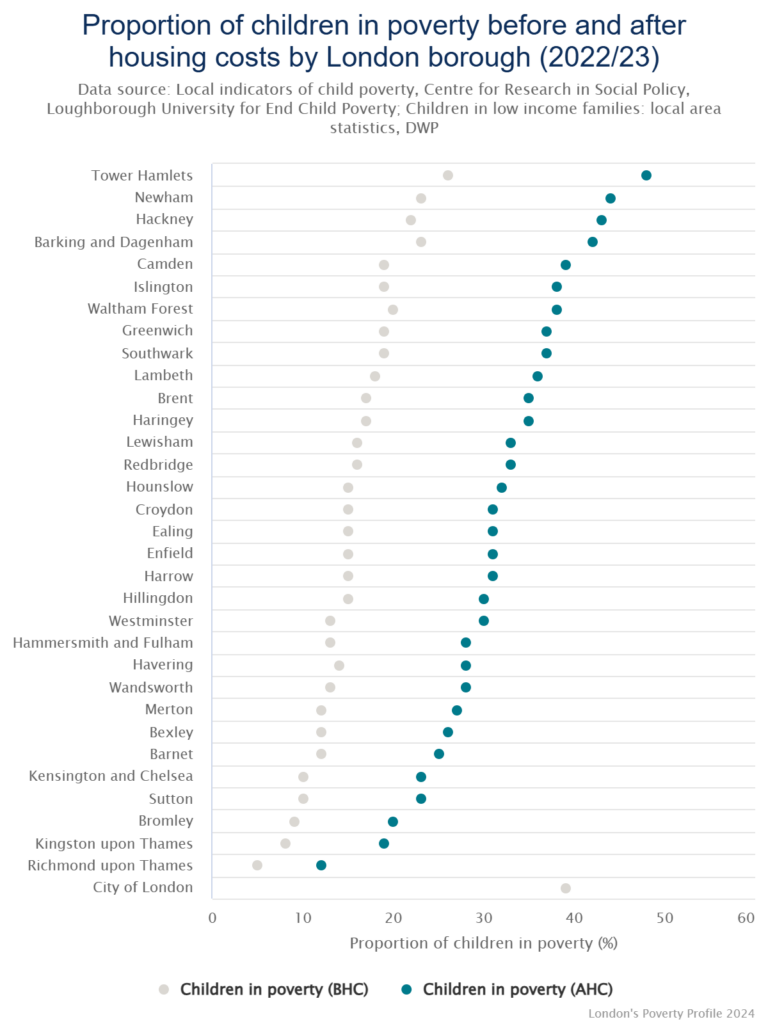
Trust for London’s 2022/23 data on child poverty rates after housing costs show significant jumps when housing costs are accounted for as the chart below shows. The affordable housing crisis in London and the hundreds of thousands of children experiencing poverty must be viewed in tandem. If we want to seriously prevent child poverty from causing long-term harm to children, we need to build appropriate, truly affordable homes fit for families who live in our community urgently.
The challenge though to quickly improve the lives of families is to provide the services they need when the threat of homelessness first looms. There are particular groups who face specific barriers when navigating personal crisis. For a parent who is threatened with domestic violence or a single parent with threats from debt collectors or joblessness due to unpaid caring responsibilities, holistic support is needed to help prevent and reduce the likelihood that they are unable to stay or move into a permanent home quickly. Other families are essentially forced into homelessness after their application for asylum is approved and they’re granted refugee status. These families often have little to no social and financial capital. Those still in a visa application process also face costly fees and limited social security support should they need it. And if a person has grown up in poverty and either loses their home or must leave their current place as a young person, their age may limit both their eligibility for support and prioritisation for what little help they can request.
Effective interventions must tackle both the broad supply challenges as well as the specific individual circumstances of Londoners. If change isn’t built on understanding of individual needs, it will fail to create systemic change.
Certainly, the evidence is clear that building more truly affordable social housing is the cure. At the same time, we also need to inoculate ourselves against the disease of child homelessness in London urgently. This is a public health crisis and a moral indictment.
We are currently leading a project focusing on the key moments when homelessness should and could be prevented. We believe that some crucial conversations need to be had about protecting families from homelessness and providing appropriate support to shorten or prevent experiences of homelessness. The issues are complex, but inaction is costly. Children have significant health, academic and social risks if we do not act quickly. We’re privileged to be working with Cardinal Hume Centre and New Horizon Youth on this project. Together we’re gaining insight from three particular groups to understand what policies need to be put in place while the houses are still being built.
We’re currently interviewing young people with experience of homelessness as a minor or young adult, migrant families and single parent, women led families. We are holding these interviews across March and April. If you know of someone who might like to take part, please do get in touch.
We aim to share our findings in summer 2025 and invite political leaders and civil servants to engage in important conversations about how we can support families to reduce the backlog of cases where families are living in unacceptable circumstances and children are growing up without a home.

Spotlight Interview with Cash Perks
Cash Perks
Cash Perks way to get cash immediately to beneficiaries for hardship grants and other welfare payments.
- How are you helping to tackle child poverty in London?
Cash Perks is transforming the way hardship funds reach vulnerable families by providing instant, cash-first support. Our innovative payment solution allows councils, housing associations, charities and community organisations to instantly send emergency funds directly via SMS, which can be withdrawn 24/7 for free at thousands of ATMs nationwide without the need for a bank account or card. This ensures families in crisis can access essential financial support quickly and with dignity, reducing the stress and stigma often associated with traditional aid like food parcels or shopping vouchers.
- Tell us something you are excited about?
We’re excited about the growing adoption of Cash Perks by almost 50 organisations of all shapes and sizes across the capital. In London that includes leading councils such as; Barking and Dagenham, Camden, Haringey, RBKC and Lambeth through to diverse frontline charities such; Z2K, Wimbledon Guild, CAB Kensington and Chelsea, North Paddington Food Bank and Solace Women’s Aid.
Hearing the real -life benefit of our service—families getting the immediate support they need without unnecessary delays—is incredibly rewarding. When clients collect their money, we often embed surveys that help measure the impact and gain valuable insights and feedback such as this from someone receiving their funds – “Brilliant experience eternally grateful for the help escaping domestic violence & accessing help to move to a safe home. Really appreciated!”
- Share with our members something positive about your organisation’s achievement or service?
Within the next few weeks, we will reach a huge milestone of disbursing over £10 million of hardship funds directly to struggling families. It’s been an amazing journey from recognising there must be a better way of getting emergency financial support to people – especially those that are unbanked or in vulnerable circumstances to reaching this important landmark. We were also hugely honoured last year to win two awards, recognised by The Big Issue as one of their Changemakers 2024 and as the best Financial Inclusion Innovation at the nation Pay360 Awards.
- What can other network members learn from you or find out more about through you?
Like an increasing number of civil society organisations, we advocate for a cash-first approach to poverty relief, which research shows is the most effective way to support people in crisis. We’re happy to share our experiences with organisations looking to transition to cash-based support, helping them navigate concerns around security, fraud, and administration, while also reducing time and delivery costs and most importantly maximising the impact of their funds through engagement in longer-term holistic support.
- What would most help you achieve your goals?
Greater collaboration! The more organisations that embrace cash-first support, the bigger the impact we can have on tackling poverty. We’d love to connect with more charities, councils, and funders who are interested in partnership. Advocacy for direct cash assistance at policy levels would also help ensure more families receive the support they need in the most effective way possible.
- Why did you join 4in10? What do you enjoy about being part of the 4in10 network?
We joined 4in10 because we share its commitment to addressing child poverty in London. We hope that being part of the network allows us to collaborate with like-minded organisations, learn from others’ experiences, and advocate for systemic change. We love the sense of collective action and the opportunity to share insights on how cash-first solutions can play a key role in reducing financial hardship for families.
Visit to Restorative Justice for All
One of the best parts of the role of community outreach officer for 4in10 is the privilege of being able to visit our extraordinary members and this has led to some truly fantastic experiences.
Whether it is being part of the series of campaign events put together by Southall Community Alliance, watching the presentation of new bleed control kits, donated by anti-knife crime charity Bin Knives, Save Lives or being part of community information events run by Poplar Harca housing association, this job continues to give me the chance to really experience the hard work of our incredible membership and has given me a real sense of hope.
Given this I thought it would be good to write about one of these events to give you a flavour of the experience.
A couple of weeks ago I was lucky enough to visit Restorative Justice for All (RJ4All)’s Rotherhithe Community Centre whilst they were doing their Wellbeing Circle.
RJ4All is a charitable international institute with a mission to address power abuse, conflict, and poverty through the use of restorative justice values and practices. The RJ4All Rotherhithe Community Centre serves as a vital hub for community empowerment and social connection at the local level.
As RJ4All’s Community Centre is always doing events, so for me it was originally more the date I was available to go than what activity I was going to be part of, but I was so glad I chose that day!
When I arrived, I was instantly made to feel completely welcome and shown around their centre. This was a very friendly building made up of a few side rooms, an office, a small kitchen and a small meeting room with sofas, tables, chairs and toys for children.
I was the first visitor to join but the session quickly filled up and by the time we were ready to go there were maybe 10 of us (all women). It was only at this point that I was grew to understand the nature of the event.
Our team leader explained to us that the idea was that each week the wellbeing circle explored a thought-provoking topic with the leader posing questions within it. She then apologised as it was her first week – not that you would have known she was brilliant.
I would not say I was cynical about the model – group therapy has been shown to do some amazing things but I was unsure how I would find it with not knowing anyone or indeed anything about the event but any anxieties I had were soon to be proved wrong.
The topic under discussion was ‘forgiveness’. First we were asked to explain in turn what we understood forgiveness to mean and then went on to explore times where we had each grappled with forgiveness.
As we went round the circle the comments of my fellow participants began to really touch something in me and as the evening went on I found myself talking about things and feeling emotions that I would never have thought about. And this, plus being with others while they explored sometimes very personal things profoundly touched me.
I came away from that extraordinary event feeling incredible, refreshed and if possible lighter; like I had been on a big therapy session. I would recommend this experience to anyone!
RJ4All’s Wellbeing Circles promote its overall vision of building the world’s first restorative justice postcode by providing a first line of mental wellness support to the community, strengthening relationships within the area, and fostering community cohesion in SE16.If anyone else would like to learn more about RJ4All you can go to their website here [I’ll include a link when it goes live].
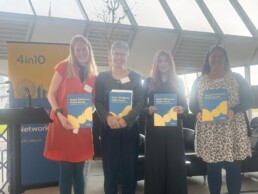
'Make Childcare Make Sense' conference at City Hall (21 January 2025)
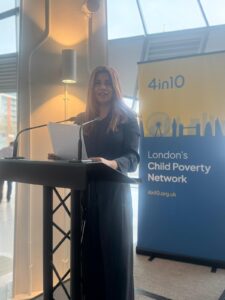 Last week, we were thrilled to host our ‘Make Childcare Make Sense’ conference at City Hall, generously hosted by London Assembly Member Marina Ahmad. This event marked the culmination of two years of dedicated work, focused on the challenges families on low incomes in London face when trying to access affordable childcare.
Our work was driven by an urgent and growing concern—raised both within and beyond our network—that the soaring cost of childcare is a key driver of child poverty in London, rivalled only by housing costs. In response, we partnered with our network members to investigate these experiences in depth. The findings are detailed in our report, Make Childcare Make Sense for Families on Low Incomes in London, published in March 2024.
The report revealed that the current childcare system is failing families. Many funding entitlements are inaccessible due to required ‘top-ups,’ inflexible policies that don’t accommodate diverse circumstances, and a lack of inclusivity for all children. Parents deeply value childcare, but they find the system frustratingly complex and overwhelmingly expensive.
These findings align closely with other key reports published around the same time, including the London Assembly Economy Committee’s Early Years Childcare in London and Business LDN’s No Kidding: How Transforming Childcare Can Boost the Economy. 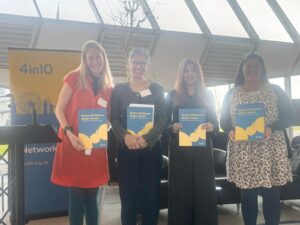
Our event last week, which was attended by a wide range of stakeholders, took stock of the situation nearly a year on. We heard powerful contributions from members of the Childcare for All campaign group about their lived experiences of childcare when you have no recourse to public funds, from Single Parents Rights Network and KIDS, who support families with disabled children to access childcare. All had clear and very pragmatic suggestions about how the system could do much better to support the groups they represent.
Rosa Schling from On the Record delivered a fascinating presentation on historical childcare campaigns, including the National Child Care Campaign of 1985, which called for “comprehensive, flexible, free, and democratically controlled childcare facilities funded by the state.” It’s striking how closely this aligns with what the parents we spoke to today still need and want.
We also heard from Sarah Ronan of the Early Education and Childcare Coalition and June O’Sullivan from LEYF, both of whom made a compelling case for an urgent policy shift. They emphasized that while the Government is making significant investments in early years education, these investments are failing to reach the most disadvantaged children. Failing to address this is an untenable position for a government that is committed to both reducing child poverty and improving early childhood development.
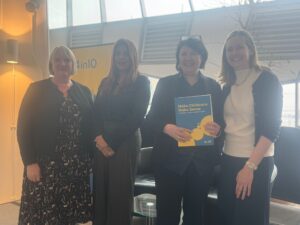
Finally, we were delighted that Joanne McCartney, Deputy Mayor for Children and Families was able to attend and address the conference; to hear directly from families, practitioners and researchers about the current challenges and we look forward to continued dialogue with her and the Mayor about what the GLA can be doing to both support the childcare sector and families and children to benefit from it.
If you couldn’t join us last week, we truly missed you—and we can confidently say you missed out too! But don’t worry—you can still be part of the conversation. Watch our campaign film, where parents dare to dream of a future where childcare is accessible to all children, free and on an equal basis: https://4in10.org.uk/make-childcare-make-sense-a-4in10-film/.

Jobs from latest newsletter (24/01/25)
The latest jobs from our brilliant 4in10 members.
|

Spotlight Interview with Be Enriched
Be Enriched
Be Enriched provides meals to families especially during school holidays.
-
- How are you helping to tackle child poverty in London?
Be Enriched addresses child poverty by ensuring that children and their families have access to nutritious, affordable food, especially during the school holidays when free school meal programs are unavailable. Through initiatives like the Food Bus, which serves groceries at reduced costs, and Kids Clubs providing meals and activities, we bring stability and joy to low-income families. Already this year, the Food Bus has served: 1,300 customers! That means we’ll serve over 7000 people over the next 3 years.
- Tell us something you are excited about?
We are thrilled to share our “Gifts That Give Back Christmas Appeal” campaign. This initiative will bring food, companionship, and holiday cheer to over 300 people during the festive season. Through community meals, The Food Bus Project, and special kids’ activities, we will ensure no one feels forgotten this Christmas. We are particularly excited about hosting three weekly community meals throughout December and January, spreading warmth and joy in the midst of challenging times.
- Share with our members something positive about your organisation’s achievement or service?
This year alone, we’ve already served 2,265 guests and provided 6,795 nutritious meals at our community canteens, as well as saving 2,159 kg of food from landfill. Last year, Be Enriched made a remarkable impact, serving nearly 10,000 meals and preventing over 6 tonnes of food waste. This year, 800 volunteers contributed over 4,800 hours to our community projects, showcasing the power of collaboration and shared purpose.
- What can other network members learn from you or find out more about through you?
Network members can learn about innovative ways to reduce food waste while addressing food insecurity and social isolation. Our Food Bus Project, which brings affordable groceries and community space to areas in need, and our Community Canteens, where volunteers create meals from surplus food, are models of sustainability and fostering community resilience. We are always eager to share insights into creating inclusive, sustainable initiatives that foster long-term connections and tangible change.
- What would most help you achieve your goals?
This Christmas, 1 in 5 Families will choose between heating and eating, and 1 in 10 Pensioners are set to spend the holiday in isolation. So, we’re calling on supporters to join our Gifts That Give Back Christmas Appeal.
The Gifts That Give Back Christmas appeal will help combat the rising levels of hunger and loneliness affecting vulnerable people in South London this holiday season.
Be Enriched will be hosting three community meals per week from December, right through January, providing 300+ people with a safe space, food, companionship and gifts this Christmas.
This vital crowdfunding campaign will ensure that no one spends the holiday season hungry, alone, or forgotten.
- Why did you join 4in10? What do you enjoy about being part of the 4in10 network?
We joined 4in10 because of its unwavering commitment to addressing child poverty in London. Being part of this network provides invaluable opportunities to connect, collaborate, and learn from like-minded organisations. It’s inspiring to be among peers working toward a common goal, and we appreciate the platform to amplify our voice and share our impact.
Some more information about their Christmas campaign can be found here and the link to their crowdfunder is here.



Spotlight Interview with Family Fund
Family Fund
Family Fund deliver grants for families raising a disabled or seriously ill child or young people on a low income across the UK.
- How are you helping to tackle child poverty in London?
Family Fund helps families across the UK who are raising disabled and seriously ill children and young people on low incomes, with grants, tailored information and support about financial issues, and benefits checks. We have grants for families with a child or young person aged up to 17, and for families with a young person living at home aged 18 to 24. Find out about our grants and services on our website.
- Tell us something you are excited about?
Right now we’re really excited about the growth of our information and support services. We’ve just launched our new Discover more support tool on our website. The tool is a searchable online database full of over 145 organisations who can support families raising disabled and seriously ill children on a low income. We are also running more free managing finances workshops online, and we’re exploring partnerships to deliver more free online support such as our iPad accessibility workshops with Guide Dogs. To keep up to date, find us on Facebook @familyfund
- Share with our members something positive about your organisation’s achievement or service?
We get lovely feedback about our online workshops.
“Education isn’t a one-size-fits-all, and we’ve found it hard to find activities that work with Joshua’s dyslexia. It feels like everything is either too academic or centred around sports. The workshop allowed Joshua to learn a new skill, use his creativity and have fun. It was perfectly catered to his interests, and as his parents, it was a huge relief for us to find something that he’d enjoy, that didn’t cost a penny.” Helen, mum of Joshua who attended our creative workshops over the summer holidays.
“I learnt a lot of new things, and the information provided was straightforward. I was taught how to use an online benefits calculator, where you input your details, and it tells you which benefits you’re entitled to. As a result, I discovered I was missing out on the Child Tax Credit element of my benefits. It’s through the Family Fund workshop that I realised that I’m entitled to more money.” Hilda, mum of Kalani, who attended our Checking your benefits online workshop.
- What can other network members learn from you or find out more about through you?
We always want to talk to organisations that support families on low incomes who are raising disabled or seriously ill children or young people. As a UK-wide pan-disability organisation working in all the nations of the UK we’re really well connected, involved in partnerships and coalitions working for change and representing families’ issues at a high level. So we can be a great networking resource for smaller, or regional and local-focussed organisations. We’ve been going 50 years, and we’re very careful in our partnership work, so families really trust the information we share with them.
- What would most help you achieve your goals?
Apart from more funding to be able to provide more grants, or better still an end to poverty and inequality, what would help us most would be being in touch with regional and local organisations so we can reach the families you work with.
- Why did you join 4in10? What do you enjoy about being part of the 4in10 network?
It’s great to be part of a network of organisations working in really practical ways to tackle the injustice of poverty that families in London face. It’s great to be part of the movement to make a difference.
If you would like to find out more about Family Fund please visit their website.
Spotlight Interview with Acts 435
Acts 435
Acts 435 is an online national charity that connects those that want to help with those that have a need, by resourcing local churches and charities throughout the UK to meet the specific needs of their community.
How are you helping to tackle child poverty in London?
Acts 435 has 116 partners within Greater London, and whilst all of them are undertaking different work, many of these churches and organisations will be utilising Acts 435 to meet the needs of children and their families. One of those partners is Lewisham Foodbank who continually support individuals, families and their children. One recent request was for Annette* who now has legal guardianship of her two grandchildren, and needed to purchase clothing for them. On receiving the money towards the clothing, Annette said, “Can you please extend my gratitude to the people who have helped me to be able to purchase school clothing, and clothing in general, for my two grandchildren. I am overwhelmed with their generosity, which has come at a time when I am most in need of assistance. Again, I thank you all from the bottom of my heart.”
Annette also told the local Acts 435 Advocate that, whilst friends and family have passed on some useful second-hand items, it meant so much to two teenage girls to be able to help choose some new clothes, and help to give them dignity in their time of need.
Tell us something you are excited about?
As a charity we’re continually excited about the fact that 100% of the requests that get posted onto our website by our partners are all met quickly, in comparison to a lot of other application processes. As we rely on individual donors going onto our website to give towards the needs, the amount of time for a request to be crowdfunded fluctuates, but generally all requests are met within a maximum of two weeks. Also, because of this funding model, we can also offer our resource to churches/charities for FREE!
Share with our members something positive about your organisation’s achievement or service?
Acts 435 was founded 14 years ago, and since then we have been able to resource over 700 churches and organisations to meet the specific needs of individuals. During that time we have helped over 52,000 individuals with over £6,000,000, which all goes directly to meet their need. We can also guarantee that 100% of every donation is given to the recipient, as all our charity’s costs are covered by GIft Aid reclaimed on applicable donations.
What can other network members learn from you or find out more about through you?
Our vision is to meet the needs of as many people as possible, all over the UK. However, we’re very aware that many cities, like London, have a huge amount of deprivation. We would love to resource more churches and charities in London with Acts 435 to be able to directly help their communities and those that they may already be supporting through our work. It would be fantastic if we could let as many churches/charities know about us as possible. If you’re not already partnered with us, you may like to attend one of our online coffee mornings to find out more: https://guestlist.co/u/acts435
What would most help you achieve your goals?
As we’re a small charity, with only four paid staff members, we don’t have a fundraising budget and can’t attend all the large events and conferences that many other charities can. Therefore, people spreading the word, and talking about our work, is the most effective way for new churches and charities to hear about us. We would love to equip more people with the knowledge about our work, so that they can then let other churches/charities know about the fantastic resource through Acts 435.
Why did you join 4in10? What do you enjoy about being part of the 4in10 network?
We are quite new to the 4in10 network, and have really appreciated the support from the team. We have also enjoyed sharing our work at a recent online meeting. We joined because we know that there must be many more churches and charities who are seeking to alleviate child poverty within London, and we want to resource them to meet the needs that they are seeing in their areas of Greater London.
If you would like to find out more about Acts 435 and how your church or organisation could get involved, please visit: acts435.org.uk/partner

Spotlight Interview with Lee Dema from St Matthews Project
Lee Dema from St Matthews Project
-
- How are you helping to tackle child poverty in London?
The majority of our participants live in the Brixton Rush Common and Coldharbour wards of Lambeth which are within the top 10% Deprivation Deciles nationally for crime and living environment.68% of our participants are entitled to free school meals. At the heart of what we do is a desire to make sure that no child in our community is left behind. To help us realise that aim, we do a number of things. All of our activities are free, which is very important as the vast majority of the young people we work with cannot otherwise afford to make use of the limited sporting facilities available within the local area. To help those who cannot afford proper football boots, we have a scheme where people can donate second-hand boots in good condition to us. We run holiday programmes, which combine access to free high quality sporting activities with a nutritional meal, as well as free after-school snacks twice a week at our estate-based cage football sessions. Some children often take these snacks home for parents. We also hand out take and make boxes, to ensure that our participants are not going hungry, and provide feminine hygiene products to those who need them. We have recently secured some digital inclusion funding enabling us to buy equipment, so that we can support young people with their school work. During the lockdowns, we were able to provide free laptops and dongles to some of our families to ensure that they could fully participate in homeschooling.
- Tell us something you are excited about?
We have seen a marked upturn in the number of young people accessing our services in recent years, particularly in the wake of the pandemic and the ongoing cost of living crisis. We now regularly work with over 350 young people each week and have been expanding the range of programmes we offer. For example, we are now delivering innovative programmes focused on improving young people’s mental health and wellbeing in school and community settings. Word of these programmes has spread beyond the project and we are now receiving increasing recognition from local councilors and other organisations for the quality of work we are doing in this area.
- Share with our members something positive about your organisation’s achievement or service?
Football is a powerful hook for young people in our area and experience has shown us that it is the best means to deliver support and guidance. Due to the relationships we have built up with young people and their families over a long period of time, we have earned a legitimacy to advise and help them in a way that other organisations cannot. Young people turn to St Matthew’s because our consistent approach to working with the community provides them with a sense of stability in increasingly uncertain times. As a result, we can maintain relationships with young people who are on the fringes of our community when they have cut themselves off from most or all of the other positive influences in their lives. Equally, it means that their families feel able to come to us for support when they are often reluctant to engage with statutory services. Our coaches are recruited from within the local community and include people who have been St. Matthew’s members who can then act as inspiring and positive role models to the participants. We find that using former participants, including ex-gang members, as coaches not only has a knock-on effect for that particular individual, but also on the young people they are working with, who begin to see what they could do in the future. Through our partnerships with local education providers, residents’ associations and community groups, we know that we are unique in the area in the type of sport and training programmes we deliver. Staff, parents, the police and young people all say that they think our activities offer something positive and can help deter young people from getting involved in more negative activities.
- What can other network members learn from you or find out more about through you?
We are a good example of the importance of being firmly rooted in your local community. Being ‘hyper’ local can actually be an advantage, as it affords you the opportunity to really build up trust and credibility. It isn’t always about trying to expand your geographical reach.
- What would most help you achieve your goals?
Just like any other voluntary organisation, long-term funding is crucial to helping us achieve our goals. We currently have a very small staff team, comparative to the amount of services we are delivering to such a large number of young people. We need to look to increase our size in line with the demand for our programmes. In addition, help with reporting and data analysis would be goo
- Why did you join 4in10? What do you enjoy about being part of the 4in10 network?
We joined the network to ensure that we are as well informed about child poverty issues as possible. It’s useful for us to be part of a group of organisations who understand the issue and challenges we face.
Childcare reform and tackling child poverty must go hand in hand
Early education and childcare has not been at the forefront of the last few elections but notably this time around it is a hot topic. All the main political parties seem to recognise, albeit from differing perspectives perhaps, that there is much to be gained from better supporting and investing in children in their earliest years. The Conservatives have re-emphasised their commitment to rolling out 30 hours of childcare a week to working parents with children from nine months old to when they start school by September 2025. The Labour Party have also pledged to deliver this same commitment and plan to open an additional 3,000 nurseries through upgrading space in primary schools to help them do so. The Liberal Democrats for their part say they would close the attainment gap by giving disadvantaged children aged 3 and 4 an extra five hours free a week and tripling the Early Years Pupil Premium to £1,000 a year.
The question we, as London’s Child Poverty Network are asking of all these offerings is whether they will benefit children and families experiencing poverty who at the moment are benefiting less from the system than their wealthier peers. Back in March we published a research report ‘Make Childcare Make Sense for families on low incomes in London’. In it we looked through the eyes of parents of young children living on low incomes in London and found that the current childcare system makes little sense to them. The funding entitlements were often not accessible as they couldn’t be used without having to pay ‘top ups’; they were not flexible enough to meet their individual circumstances; and were not inclusive for their children, those with special educational needs and disabilities and those whose families have no recourse to public funds being especially likely to be excluded. One single mum of a three-year-old told us:
‘You know, you’re kind of making lots and lots of sacrifices to afford what essentially is a basic need to help our economy keep moving. Yeah, [the childcare system] just shuts people out of work.’
Sadly, the Government’s expansion of funding entitlements which began to be rolled out shortly after our report was published in April this year, will do little to improve the situation for these families. Just 1 in 5 (or 20%) of families earning less than £20,000 a year will have access to the planned expansion of funded places for one- and two-year-olds in some working families, compared to 80% of those with household incomes over £45,000.[1] This matters to us because access to affordable, high-quality childcare and tackling child poverty are inextricably linked.
Sky high childcare costs in London are one driver of our high child poverty rate; including childcare costs in the Social Metric Commission’s measure of poverty increases the poverty rate among families with children by 0.4 percentage points.[2] So, at the most straightforward level, bringing down childcare costs, for those that already incur them, has the potential to reduce levels of child poverty. Beyond this, affordable and accessible childcare can contribute to poverty alleviation by supporting parents and carers to access paid work if they do not already or to increase their hours, and so increase their household income. Lastly but certainly not least, we know that high quality early education is critical to a child’s development and later educational achievement.[3]
For all these reasons, it is imperative that whoever forms the next Government deliver an early education and childcare system that benefits all children. We believe that the best way to make sure this happens is for childcare reform to be at the heart of a strategy to address child poverty. The Labour Party has made a very welcome commitment in its manifesto to putting in place a Child Poverty Strategy, it must make sure that its policy on childcare in a key plank of this. If it doesn’t and this synergy isn’t realised is a very real risk that childcare policy rather than reducing inequality, could increase it.
[1] Drayton, E. et al. (2023). Childcare reforms create a new branch of the welfare state – but also huge risks to the market. Institute for Fiscal Studies. Available at: https://ifs.org.uk/ news/childcare-reforms-createnew-branch-welfare-state-alsohuge-risks-market
[2] Poverty Strategy Commission (September 2023) Interim Report: A new strategy for tackling poverty
[3] Melhuish, E. and Gardiner, J. (2023). Equal hours? Sutton Trust

A young person speaks: the Local Child Poverty Statistics 2024
By Layla, aged 19 from London (name changed to protect her identity)
I respond to this news not just as a young person, but as someone who has personally experienced the harsh realities of poverty. The recent findings from Loughborough University for the End Child Poverty Coalition resonate deeply with me, and seeing that over 30% of children across the UK are living in poverty, with two-thirds of new constituencies having at least a quarter of children facing this struggle, brings back vivid memories of my own childhood and the beginning of my own adulthood.
Growing up in poverty meant constant uncertainty and anxiety, and meant watching my care giver struggle to make ends meet, sometimes having to choose between paying bills or buying food. It meant missing out on school trips, new clothes, and being pointed out as the free school meals kid. What I’m trying to say is that these are not just statistics; they represent real lives, real struggles, and real futures at risk.
Hearing the call from the End Child Poverty Coalition for political parties to prioritise this issue fills me with a sense of urgency as it would not just be a policy change, but a lifeline for many families.
The disparities highlighted, especially in areas like the North East, London, and the North West, show that this issue is widespread and deeply rooted. It isn’t enough to just acknowledge the problem; we must act.
As someone who has walked this path, I urge our leaders to listen and to act. the upcoming election is a chance to commit to real, meaningful change, and ensuring that no child has to grow up feeling the weight of poverty, and having the opportunity to thrive is something every party should aim to include in their campaign.

Can a national child poverty strategy be all things to all children?
Well, just as we were drawing breath after the London elections, we find ourselves back in election mode once more. And once again we will be straining every sinew to ensure that child poverty is a central issue of the campaign and one that all the political parties are held to account on. In particular we will be making the case for all parties to pledge to a child poverty strategy that not only makes firm and time-bound commitments about reducing and ultimately eradicating child poverty but also recognises that achieving this aim will require different approaches in different parts of the country.
Of course, some of the key policies that we, along with over 100 other members of the End Child Poverty Coalition, want to see front and centre in a child poverty strategy such as abolition of the two-child limit and benefit cap, are ones that an incoming Government in Westminster alone can implement. But we also need a child poverty strategy that operates regionally and locally so that it can respond to the different contexts that children live in across the country. For example, in the North East child poverty is driven in large part by low pay, insecure work and out-of-work poverty (North East Child Poverty Commission, 2024), whereas in London it is exorbitantly high housing costs along with costs such as childcare that are the major issue. Important new analysis from our colleagues at Trust for London and WPI Economics exploring the possible reasons behind the apparent fall in overall poverty numbers in London in the past few years, suggests that costs are now so high that for many people the only way to escape poverty in our city is to leave it.
A national child poverty strategy that fails to recognise these regional differences and allow for differential responses is not going to have the impact it so urgently needs to. The incoming Government, must engage with and harness the data and knowledge that the Greater London Authority, combined and local authorities have about their regions and localities and establish mechanisms to ensure sustained focus and action on the issue at regional and local level. Moreover, it needs to recognise the impact that the collapse of local government funding has had on children’s services which has undoubtedly affected the poorest children most. It is crucial that a child poverty strategy ensures that local authorities are sufficiently resourced to meet the needs of the children living in their communities.
So, in answer to the question, yes, a national child poverty can and must deliver for all the UK’s children, no child wherever they live should be experiencing poverty, but this will only be achieved if we acknowledge and respond to their different circumstances. From our perspective as the London Child Poverty Network, we will use the coming weeks to champion as loudly as we can the right of the 700,000 children living in poverty in London to live in a poverty free city, a goal that we firmly believe is achievable if the political will is there to achieve it.

Tackling child poverty must be high on the new mayor's agenda
Yesterday Londoners went to the polls to elect their Mayor and members of the London Assembly. As we await the results, it is a good moment to pause and consider what should be at the top of the Mayor’s agenda from day one of their new term of office. From our perspective at London’s Child Poverty Network we are crystal clear that tackling the high levels of child poverty that continue to mar our city must be up there.
The first crucial step towards bringing about a child poverty free London must be to work with those children, families and those organisations who support them in their communities to develop a strategic response to tackling the problem over the next four years. As a network we have been very supportive of Sadiq Khan’s move to guarantee free school meals for all primary school children in the city, which demonstrates that he gets the severity of the situation and the need to take bold action to address it – but we know that on its own, it is not enough. Now is the time to bring everyone to the table to decide what other actions need to be prioritised to address the systemic causes of poverty. And we are not the only ones saying so, just before the election period began back in March a cross-party group of London Assembly Members supported our call and published a report recommending that ‘[t]he Mayor, working in conjunction with local authorities and the voluntary sector, should publish a child poverty strategy for London in 2024-25.’
So, what are the key policies the strategy ought to contain? Well, it is a fact that many of the levers for reducing child poverty lie beyond the direct powers of the Mayor of London; our broken social security system for example, which exacerbates rather than ameliorates child poverty rates by setting benefit payments at levels which are not sufficient to provide families with essentials; discriminates against larger families through the two-child limit; and imposes sanctions that push families into debt rather providing them with the scaffolding they need to escape poverty. These are not policies the Mayor can directly change, although they can add their strong voice to the chorus of cries for reform.
Where the Mayor can take direct action though, they must. Child poverty in London is driven in large measure by the exorbitantly high costs of living in the city, housing first among them. Without access to decent housing, 84,940 children in our city are living in temporary accommodation, often deprived of basics such as access to a hot nutritious meal, a warm comfortable bed and space to play and learn. Whoever emerges victorious from the election count will already be well aware that sorting the housing crisis is going to be one of the biggest challenges they face and indeed all the main candidates have pledged to do so, in various ways, during their election campaigns. What we are calling for now is for these efforts to also be a central plank of a new child poverty strategy for the city. By looking afresh as the problem through this lens we can ensure that the housing that is built truly meets the needs of young families living on low incomes and enables them to live in and contribute to our city, as part of our communities rather displaced to other more affordable parts of the country.
Addressing high childcare costs must be part of a London child poverty strategy too. In our recent report Make Childcare Make Sense we looked at how sky-high childcare fees disproportionately affect families living on low incomes making it next to impossible for them to stay and/or progress in work and how an inclusive, affordable childcare system could vastly improve their and the children’s lives and allow them to contribute to London’s economic well-being. Getting the national childcare and early education policy framework right is essential to achieving this goal but so too is leadership and intervention at the London-wide level and our report sets out a series of recommendations for the Mayor and GLA.
Faced with these high housing and childcare costs, another reason many families in London struggle to make ends meet is a lack of high-quality, well-paid work; in London, almost half of those in poverty are in employment and in 2022, 17% of Londoners in work were paid below the London Living Wage (Trust for London). Many of these also face the issue of insecure work. Recent research from the Living Wage Foundation has found that there are over 800,000 insecure jobs in London. Addressing these twin issues of low pay and insecure work must be another strand of a child poverty strategy.
Finally, is also crucial that a strategy recognises the interaction between poverty and discrimination and has addressing it at its core. We cannot for example, ignore the fact that systemic racism and disablism in the education system often combined with the impact of poverty, is responsible for holding back some of our young people and preventing them from flourishing in the way they should. A child poverty strategy rooted in a human rights-based approach is key to achieving deep and lasting change.
So, once they have had a chance to catch their breath, we hope our newly elected Mayor will engage with us as a network, draw on our members’ rich and diverse experience and work with us to map out and deliver a plan for achieving a child poverty free London; an achievable goal if we all harness our collective determination and belief to make it happen.
Spotlight Interview with In Kind Direct
In Kind Direct
- How are you helping to tackle child poverty in London?
At In Kind Direct, we believe that everyone deserves access to life’s essentials and no usable product should go to waste. In 2023, we supported a network of over 6,600 charitable organisations across the UK, including 1,160 in London, by distributing products from well-known manufacturers and retailers for charitable organisations to use to run their services and share with people they support.
We distribute a range of essential products, including hygiene and household cleaning products, clothing, and toys books and games. Across our network, 37% of charitable organisations say they use products from In Kind Direct to support school-aged children – that equates to nearly 135,000 children helped each week. In 2023 alone, we distributed over 226,230 toys books and games, that’s enough to support the equivalent of 7,540 classrooms of children. One organisation supported through our ‘Summer of Play’ campaign, which aimed to support children and families throughout the summer holidays, shared:
“We support many single parent families who are struggling to get by on Universal Credit. Little extras we provide like toys and clothing, accessed from In Kind Direct, are such a lifeline”.
- Tell us something you are excited about?
In Kind Direct was originally founded to help reduce environmental impact. We take usable products from retailers and manufacturers that may otherwise go to waste and make it available to charitable organisations for use in their communities. To-date we’ve diverted more than 36,840 tonnes of product from landfill.
Ensuring that everyone can access life’s essentials will always be our focus, but we want to make sure that we are doing this as sustainably as possible. This year, we are calculating our carbon emissions across our organisation and value chain and are excited to be releasing a sustainability strategy next year, to ensure increasing our impact doesn’t cost the earth. We are also looking forward to expanding our refurbished tech offering to our network of charitable organisations, promoting the circular economy, and aiding digital poverty. We’re excited to work more with increasing access to second hand items to ensure people have access to the products they need to keep clean, warm, and well.
- Share with our members something positive about your organisation’s achievement or service?
In Kind Direct was set up over 26 years ago, and we are so proud of the impact we have had since our founding. To-date we have worked with more than 1,300 companies to distribute products to over 15,000 charitable organisations across the UK, unlocking an incredible £314m in savings for the charitable sector. Through our charitable network, our products support over 365,000 people each week.
The savings we unlock help our charitable network stretch their funds further, enabling them to support more people and deliver more services. As one charitable organisation in our network put it:
“We would not be able to support our community to the extent we do without In Kind Direct”.
- What can other network members learn from you or find out more about through you?
In addition to accessing products through our catalogue, we have partnered with a number of companies to unlock additional savings and benefits for our network of charitable organisations. This includes discounted access to workplace supplies, refurbished laptops, printers/ photocopiers, and DSC membership.
We also conduct research and advocacy on issues surrounding poverty and access to essential products. We represent the views of our network in broader sector campaigns and we conduct new research on the causes and impacts of going without, to help make the case for funding and action. An example of this is our Human Right to Hygiene report, which maps the systems underlying hygiene poverty and sets out a roadmap for change.
- What would most help you achieve your goals?
We are always looking for charitable organisations to join our network to help more people access much-needed products and help more organisations save money on essential supplies. Registering with us is free and can be done via our website. We welcome a wide range of charitable organisations, including registered charities, CICs, CIOs, community groups, food banks, most schools and nurseries and public sector run outreach projects.
- Why did you join 4in10? What do you enjoy about being part of the 4in10 network?
In Kind Direct joined 4in10 to connect with other charitable organisations across London that are committed to ending poverty and to learn more about the activities the network is driving to support change. We are always eager to share knowledge and use our combined voices to fight the challenges that many are facing and make a difference. We would love to reach and engage with more 4in10 members and support their charitable mission by inviting them to register with us and access our services and benefits.

4in10 Newsletter 30.11.23
Read the latest newsletter here.
To get this directly to your inbox every fortnight please do join us.
4in10 Newsletter 16.11.23
Read the latest newsletter here.
To get this directly to your inbox every fortnight please do join us.
Free School Meals Webinar - 16th October, London Challenge Poverty Week
As part of London Challenge Poverty Week, 4in10 and the London Child Poverty Alliance hosted a webinar for councillors and council officers on Free School Meals.
You can watch the recording here.
4in10 Newsletter 2.11.23
Read the latest newsletter here.
To get this directly to your inbox every fortnight please do join us.
4in10 Newsletter 19.10.23
Read the latest newsletter here.
To get this directly to your inbox every fortnight please do join us.
Spotlight Interview with BBC Children in Need Emergency Essentials Programme
4in10 spotlight blog – BBC Children in Need Emergency Essentials Programme
London Challenge Poverty Week 16th to 22nd October 2023
How are you helping tackle child poverty in London?
The UK-wide BBC Children in Need Emergency Essentials Programme helps tackle child poverty in London by providing essential grants to vulnerable children and young people in crisis, right across the city.
BBC Children in Need believe every child and young person deserves the opportunity to thrive and be the best they can be.. Delivered by the team at Family Fund Business Services, the Emergency Essentials programme provides items that meet a child’s most basic needs, such as a bed to sleep in, a cooker to provide a hot meal and other items critical to a child’s wellbeing. Our dedicated suppliers work hard to get grant items out quickly to families. Everything is taken care of from – delivery, installation/build (furniture) to recycling of old white good appliances.
We aim to alleviate the pressures associated with furniture poverty and the wider impact on a child or young person’s wellbeing. Growing up in poverty brings additional educational and health challenges, leading to significantly diminished life chances.
For any parent or carer, knowing your child will have a safe, comfortable night’s sleep or being able to prepare a warm meal for them and wash their clothes for school the next day, reduces parental stress and helps build better family relationships.
We work in partnership with BBC Children in Need to deliver this programme but we can only reach our goals with the support of our dedicated network of Emergency Essentials Referrers so a big thank you to them.
Tell us something you are excited about?
We’re excited about supporting BBC Children in Need’s ‘Positive Relationships’ campaign which celebrates the power of positive relationships, and the impact of these relationships in helping to support children and young people.
We’re also excited to be part of London Challenge Poverty Week 2023, to raise better awareness of the many challenges disadvantaged children in London face It’s clear we all have a crucial role to play as we enter difficult winter months and the next phase of the cost-of-living crisis. As history teaches us, ‘alone we can do so little, together we can do so much’.
We look forward to forging lasting relationships with other 4in10 members driving this work in London.
Share with our members something positive about your organisation’s achievement or service?
Since launching the programme in June 2018, the BBC Children in Need Emergency Essentials Programme has supported 140,000 children and young people. We have distributed over £20million to directly support the needs of children and young people in poverty across the UK.
We have around 4000 active referrers making applications to the programme at any one time and the programme received 80,000 applications and fulfilled over 100,000 items in the first five years of delivery (we’re now in our sixth year).
Our service has a quick turnaround time for decision with an average turnaround time of 5-7 days.
What can other network members learn from you or find out more about, through you?
By connecting with the partnerships team, other network members can learn about the individual grants provided by the BBC Children in Need Emergency Essentials Programme, as well as the wider grants that Family Fund provides for families raising seriously ill and disabled children (the partnerships team are employed by Family Fund as a dedicated resource for the Emergency Essentials Programme).
We have a growing network of referrers regularly accessing emergency essentials grants for the children and young people they are supporting across London. Referrers often comment about the simple application process and quick turnaround times for decisions:
“The Emergency Essentials Programme is really good, and quick and easy to do. For me it’s fantastic and means my time is not taken away from families or the children who need me, the response is quick and the delivery options for the family are amazing. The online application is easy to use, and the families really need the help.” (Emergency Essentials Referrer)
We encourage network members to reach out and connect with the partnerships team to find out more about our free training sessions and webinars, which can be tailored to your organisation’s needs.
Please email cinpartnerships@familyfundservices.co.uk for more information.
What would most help you achieve your goals?
Put simply, to achieve our main goal of- helping more children and young people in London we need to form even more new partnerships and gain more registered referrers locally.
As a team we are supportive, connected, passionate and determined. These values are echoed in the partnerships and relationships we maintain across the programme.
The BBC Children in Need Emergency Essentials programme is referrer-led and is shaped by the voices of our referrers. We encourage them to take part in regular topic-based forums, coffee and connect sessions and surveys. We always welcome feedback in any form and recognise the ever-changing needs of children and young people. It’s through these engagement mechanisms that we ensure our offer remains relevant at the time of delivery.
Why did you join 4in10? What do you enjoy about being part of the 4in10 network?
We were completely hooked after attending our first event hosted by 4in10 during the pandemic. It was clear we needed to be part of this dynamic network and movement for change.
Crucially, we love being able to connect with other likeminded people who are dedicated to improving the lives of children and young people growing up in poverty.
4in10 Newsletter 21.9.23
Read the latest newsletter here.
To get this directly to your inbox every fortnight please do join us.
4in10 Newsletter 7.9.23
Read the latest newsletter here.
To get this directly to your inbox every fortnight please do join us.
4in10 Newsletter 10.8.23
Read the latest newsletter here.
To get this directly to your inbox every fortnight please do join us.
4in10 Newsletter 13.7.23
Read the latest newsletter here.
To get this directly to your inbox every fortnight please do join us.
4in10 Newsletter 29.6.23
Read the latest newsletter here.
To get this directly to your inbox every fortnight please do join us.
Voter ID and Shout Out UK
A few months ago there was a change in how elections are run in this country, when the Elections Act 2022 came into force
The Act bought in a wide range of changes that will have an impact in London including removing second preference voting in Mayoral contests, but arguably the biggest change was the introduction of compulsory voter ID.
This was trialled in the local elections in May this year to mixed success. The Electoral Commission’s full report is not due out till September but their initial findings have been so troubling that they have released an interim report. This can be found here. The biggest takeaway for me from this was that 14,000 people were not able to vote as a direct result of these changes.
The most significant reason for this does seems to have been lack of awareness of the new rules – only 84% of people knew about the new requirements according to the interim report. I would here quote a family member who when reminded of the need to bring ID said ‘well I never have to in the past’.
Another issue which is of particular concern for us in 4in10 however is unequal access to the right forms of ID. The House of Commons Library produced a report in which they said:
‘The proportion of respondents to the Electoral Commission’s Public Opinion Tracker 2022 who did not have a suitable form of ID for voting was higher among more disadvantaged groups. 14% of unemployed people, 10-17% of those living in rented local authority or housing association accommodation and 7% of people with lower levels of education did not have a suitable form of ID.’
Indeed the interim report found that two of the groups were awareness was lowest was among younger age groups (18 to 24-year-olds) and Black and minority ethnic communities which were both at 82%.
Valid forms of ID
The other issue that continues to be of concern is the types of valid ID. The list of ID that is accepted can be found here.
If you have a look at this list, one thing that becomes immediately clear is that the majority, if not all, of the options available cost money to obtain – a passport for example costs a minimum of £90 once you take into account the cost of the photo.
Some would then counter with the fact that in theory you can obtain a ‘free’ form of ID from your council but even this isn’t completely free as you are expected to bring a passport style photograph with you.
For some families that are already having to choose between heating and eating, paying for a photo to be produced and then spending time finding and filling in a complicated form simply can’t be a priority.
This can be shown in that awareness and take-up of the Voter Authority Certificate (a free voter ID document you can apply for) was low with only 89,500 certificates being issued around the whole Country according to the Electoral Commission’s interim report.
The London Context
London already has one of the lowest voter registration rates in the UK and these changes has the potential to make this situation considerably worse.
There are many reasons for this but one of the biggest is the high proportion of ethnic minority communities in London. Voter registration tends to be lower in ethnic minority communities. This is the case for many reasons, including in particular insecure, short term housing but no matter what the cause the result remains the same.
We at 4in10 are concerned that unless more is done to raise awareness of the new rules and to make it easier and cheaper to obtain the necessary ID, then Londoners who are already at most at risk of being disenfranchised will be denied the right to vote.
That is why over the last few months we have been supporting Shout Out UK who have been leading the public awareness campaign on this issue and we will continue to do so.
We are asking our membership to help us and Shout Out UK by spreading the word about it and where possible help people to get the ID that they need. Find out how here.

4in10 Newsletter 15.6.23
Read the latest newsletter here.
To get this directly to your inbox every fortnight please do join us.
Child Poverty in London: a societal problem calls for community-led solutions (Part 3)

Our Research and Learning Officer, Emily, discusses three questions on the issue of child poverty in London. This piece is split across three blog posts:
- What is child poverty?
- What’s the state of child poverty in London?
- How do we end child poverty?
How do we end child poverty?
This is a big task. Let’s say tomorrow the government printed money and gave it to every family under the relative poverty line and promised to keep sending them money to ensure they never fall below that line, would child poverty end? If that question were posed to different politicians and members of the public, I’m sure several revealing answers would emerge. The reality is that things are much more complicated than just money. But as a start, money really does help. The £20 per week uplift to Universal Credit that was temporarily put in place during the pandemic pulled 400,000 children out of poverty. Other estimates claim that making this permanent would lift 500,000 children out of poverty. So money must be part of our child poverty strategy. So too would other public systems. Having an adequately sustained NHS and mental health services would keep children and their parents well, which cuts costs, both in terms of health itself and the knock-on effects of poor health.
Flexible working could also be seen as a support structure to allow adults, particularly women, to work consistently and progress in their careers while also caring for their children. And there’s also the housing issue. In London housing is incredibly expensive and too many affordable options are unsuitable. Guaranteeing affordable homes for everyone can be seen as part of a child poverty strategy.
So it’s about money, but it’s also about a community-based strategy. We need to eradicate the shame. There is no reason to judge people. Ending shame is not ending personal responsibility. Ending child poverty requires us to work together. It means believing the evidence that shows the causes of inequality and poverty are multiple and intersecting. It also means, perhaps, as a community taking on the shame that we don’t yet know how to support each other well enough. Privilege and discrimination has blinded many of us to our own personal responsibility. We can do better at that, but we need to be honest about our role and how we can learn to support each other more holistically and with respect.
4in10, London’s Child Poverty Network is committed to supporting collaborative working. We are a network of organisations who want to see an end to child poverty in London. There is so much brilliance bottled up in the children of this city. When we invest in them and make sure each of them has an opportunity to thrive, then we will begin to see transformations that we will all benefit from.
London’s Child Poverty Alliance, the policy sub-group of London’s Child Poverty Network has identified four key areas that can be catalysts for change. In our Manifesto, we outline current areas of inequality and systemic failure that are points of potential transformation that could ultimately bring an end to child poverty in London. Secure, adequate income will give families the resource to access what they need. All across London, our homes are fundamental to our health and wellbeing. When our homes are of decent quality, the comfort and security they provide enrich our lives and support our mental and physical health. Every child deserves the best start in life, ending child poverty means ensuring every child has access to the early education and childcare to thrive. Lastly, having access to nutritious and reliable food sources so that all children are free from hunger can target one of the essential threats of child poverty. Together, we can make child poverty a way things used to be rather than how we live now if we target these four areas as crucial pinch points of poverty to make London a fairer city for every child.
Child Poverty in London: a societal problem calls for community-led solutions (Part 2)

Our Research and Learning Officer, Emily, discusses three questions on the issue of child poverty in London. This piece is split across three blog posts:
- What is child poverty?
- What’s the state of child poverty in London?
- How do we end child poverty?
What’s the state of child poverty in London?
Unfortunately, the number of children in poverty across London is extremely high. The latest figures from 2021/22 show that London has a child poverty rate of 32.9% according to End Child Poverty Coalition. We expect this to increase when the current year’s figures are released. Experiencing poverty can mean children are only able to afford cheap, unhealthy food. It might mean they skip washing their clothes, bathing and brushing their teeth. It can result in anxiety and isolation, aggressive or regressive behaviour. Being trapped in poverty can lead to a stressful environment at home, where children feel like they need to take on adult responsibilities to help out. While all these things can be true for any child of any household income, the likelihood of overlapping challenges or examples of ‘going without’ can be much greater when a child is in poverty. Parents can be doing the best they can with what they’ve got, but they can’t absorb all of the trauma that impacts them and their families.
How do we respond to child poverty?
The government prioritises helping families get into work. This can be one valuable, effective way to help families in poverty. However, it’s important that context is considered. For one, balancing children’s needs with a work schedule is very difficult. So, for single-parent families flexible, adequate work is crucial. In addition, some parents can’t work because either they or their child is disabled and therefore more support is needed that looks different than paid work. Also, illness needs to be considered as some adults can’t work because they are dealing with an acute illness. Therefore, as a society, we have to think about helping families get support and money in their pockets and community connections that look beyond the paid work route out of poverty.
At 4in10, we talk about supporting organisations who work to end poverty or mitigate its impact. To end child poverty would be to ensure that families have the income they need to cover the essentials. This can look like a robust social security which puts money back into the pockets of families, it can also look like higher pay which increases the incoming funds on a regular basis and it can also take the form of organisational tax breaks or social investment in services so that more support is freely available which reduces the need to ‘buy in’ to participate in local communal activities and opportunities.
In terms of mitigation of the effects of child poverty, again, some specific considerations help draw out this point. Children know when they don’t have as much as others. Children are experts in observation, they learn from seeing and doing and so they know when things are different. When it comes to household finances, they may not know the details or understand the specific issues, but children are capable of knowing when they have less or shouldn’t ask for more. As part of communities all across London, we can help nurture belonging and fairness by making it easy to share resources, reduce additional expenses at school and offer out-of–school activities that are free of charge and sustainably developed and delivered. By making it less about what you can buy and more about where we can belong, the organisations such as youth clubs, art groups, theatres, community organisations, schools and many other community-led programmes help children access support and meaningful relationships with those local to them. This can create a buffer between children and the impact of poverty on their wellbeing. These kinds of services will always be important, even if child poverty disappeared from London. Their existence helps offer important outreach to children and their families. It’s important that these organisations can focus on what they do best, but the current system demands them to follow the money in terms of endless cycles of grant submissions, reporting and project adaptation to keep the budgets balanced. This makes losers out of all of us. Funding can and should be sustainable.
There are steps that all of us can take in our organisations and as individuals to help advocate and implement change. In our Manifesto for a child poverty free London, we outline four key areas that would help reduce child poverty across London. Income, housing, childcare and hunger. These four areas impact us all and in different ways, individuals, businesses, local, regional and national government can help contribute to make the situation better for children. This is not about attributing blame on any one group, but about community-centred and multi-faceted responses to helping improve the lives of children and challenging inequalities when and where we see them.
Child Poverty in London: a societal problem calls for community-led solutions (Part 1)

Our Research and Learning Officer, Emily, discusses three questions on the issue of child poverty in London. This piece is split across three blog posts:
- What is child poverty?
- What’s the state of child poverty in London?
- How do we end child poverty?
What is child poverty?
The very fact that children experience poverty across London reflects the failings of British society to support its youngest members. Children are experiencing poverty because their guardians don’t have enough resource to meet their basic needs. Despite their care givers’ best efforts to protect them, children in poverty can experience the stress and insecurity that stems from not having enough to meet essential needs and some children even take on the practical or emotional responsibility to help alleviate some of the worries of the adults in their household. Children don’t choose poverty. And they can’t choose to end it. They rely on adults in their community, both local and national to make the changes necessary to ensure they, as children, get what they need.
Relative poverty is defined as a household income that is 60% below the median income. While children are in poverty across the country, they may not experience it in the same way. In London, housing costs and childcare costs mean that children in London are more likely to live in unsuitable accommodation and fewer access early years education whereas in other parts of the country, the challenges may be high travel costs or their adult carers experiencing difficulty finding work.
What causes it?
The simple reason for what causes poverty is that household income isn’t enough and is far below the average of many other households. The much more complicated answer is that inadequate income can be the result of an inability to work, poor health, disability, discrimination or unexpected change of circumstances or a combination of challenges that lead to income insecurity. Where it gets really complicated is that accessing adequate income is not a case of simply trying to secure more work because often suitable, paid work is not accessible, for example because of prohibitive childcare costs. This is where narratives around personal responsibility and shame can take root and spring life to inaccurate descriptions as to why some people have enough and others don’t.
Child poverty is caused by both indirect and direct policy decisions related to children. For example, financial budget reductions for schools, youth services and community organisations mean that children are cut off from the services meant to serve them specifically and in turn it’s only those who can afford to pay for those same services that get the high quality opportunities that help shape children’s present experiences to lead to privileged future opportunities. In addition, policies that impact wages, housing and service provision across the country mean that adults can’t access the jobs and support they need, which has a knock-on effect for children. In combination, these circumstances exacerbate inequality making a greater divide between those who can afford to pay extra and those who can’t afford the essentials.
What makes child poverty different?
One of the worst parts of child poverty is that it hurts people at a crucial time in their lives when poverty is integrated into their physiological systems. When their bodies and minds are developing rapidly, and their emotional regulation is dynamically maturing, the trauma that poverty inflicts has a lasting impact. While adults might feel the burden of responsibility, they also have more political influence as voters. Children do not. They can’t work, they can’t vote and they can’t always access the people with power and influence to change. So, they are made to wait and struggle.
4in10 Newsletter 1.6.23
Read the latest newsletter here.
To get this directly to your inbox every fortnight please do join us.
4in10 Newsletter 17.5.23
Read the latest newsletter here.
To get this directly to your inbox every fortnight please do join us.
Spotlight on 4in10 Member Whizz-kids
How are you helping to tackle child poverty in London?
We work to support young wheelchair users through 3 main strategies – Mobile, Enabled, Included. All of which have an impact upon the potential for poverty faced by young Londoners with a disability.
We enable young people to have a chance to have a childhood through our free clubs and programmes, aimed to break the isolation of disability, and give the young people confidence, social skills and a group of friends. At no cost to the family, these can help to tackle the mental impacts of financial deprivation. For young people who are older, we also supply free Employability skill and work placement with our network of partners to provide the launchpad for young wheelchair users to beat the employment gap, and to aid in systemic change to a less impoverished disabled generation.
Tell us something you are excited about?
Morph! Yes, Morph! This year across the summer, Whizz-Kidz has teamed up with Wild in Art and Aardman Animations to do the first step-free Art Trail within London. The trail will have 50+ 6ft high Morph sculptures painted and designed running down the Southbank from Tower Bridge then across past St Pauls and into the city. Alongside the “big” Morphs will be “gaggles” of ‘Mini’ Morphs, designed and painted by schools to support the trail, and of course to support Whizz-Kidz.
Pop along between June and August to see Morph having an “Epic Adventure” in London!
Share with our members something positive about your organisation’s achievement or service?
It has been shown repeatedly that the right wheelchair can a big impact on a young person, both mentally and physically, allowing them to access education, recreation and employment with a greater ease and confidence. Through the Mobile strategy, Whizz-Kidz supported approx. 1,000 families through our clinical services, of which near 1/3 were from the most deprived parts of England, helping to alleviate disability related costs averaging £2,400 per piece of equipment, whilst giving a young person the same chances and childhood of non-disabled children.
What can other network members learn from you or find out more about through you?
Our work to make our young people more included starts and ends at their voice, aims and ambitions. The Kidz Board, a group of 12 young people that help to guide and steer the organisation onto topics that are concerning to them as young disabled people, has allowed us to look at the issues around poverty and financial deficit of the disabled community from all the angles impacting their daily lives. Examples have included the non-standardised “disabled bus pass”, longer journey times due to inadequate higher education accommodations, the job market, social activities, the role of assistance dogs and many more – all of which have a financial impact on young person and their family.
What would most help you achieve your goals?
Whilst of course, funding is always helpful to a charity, we are always looking to be raising awareness of the additional issues faced by Young Wheelchair Users, as quite often they go unnoticed. Partners committing to having Disability Awareness provided by people with lived experience, or work with people with lived experience to open their horizons, and break the misconceptions around disability. The young people that we work with also need people to provide them with the opportunities to succeed, whether that is in a social setting through supporting our clubs, or a employability setting supporting Work Placements and Employability Skills Sessions.
Show these young people that they have a future just like anyone else.
Why did you join 4in10? What do you enjoy about being part of the 4in10 network?
We joined 4in10 as we have become rapidly aware of the additional effects of having a disability on the Cost of Living, and Child Poverty issues currently within the UK, and London. As an organisation that helps to support these young people, we know that we need to be connected to others fighting this issue as well. A candle is dim, but a handful can become a lighthouse, after all.
It is great to be part of a group of organisations looking to tackle this issue within London, a city often shown by its tourist-y bits and not some of the areas of great deprivation and be able to talk about the work we are doing, and ask to help from others on the topic, and campaigns we are running.
To connect with other groups who are interested in childcare and child poverty. So far its been really useful, thank you!
4in10 Member Conducts Research on Low-Income Families and SEND Support
Over the past several months, 4in10 has been working with one of our members, Education and Skills Development Group (ESDEG) to support them in creating an excellent report that outlines the importance of their work with low-income ethnic minority families with children who are eligible for SEND support. With a financial contribution from 4in10, Suchismita Majumdar, ESDEG’s Communications & Policy Officer conducted comprehensive interviews and analysis with the ESDEG team to get a sense of the particular needs and challenges children who require SEND support face when they and their parents seek access to additional support.
The report takes an impressive introspective look at the programmes ESDEG offers and the support they give to children and their parents in response to the particular needs of specific ethnic groups, in particular, Somali, Pakistani, Afghan, Indian and Black Caribbean communities.
Their report, available here, shines a light on the situation both for non-white families across London who encounter barriers because of cultural and economic stigma as well as the more widespread scarcity of SEND programmes and professionals in the state school system across London.
The report also includes some key evaluations that ESDEG has identified to help guide them as they plan and implement future programmes, policies and campaigns going forward.
4in10 Newsletter 4.5.23
Read the latest ewsletter here.
To get this directly to your inbox every fortnight please do join us.
How Poverty Feels
In 2021, 4in10 in partnership with the Greater London Authority commissioned ClearView Research to speak with Londoners to understand what poverty felt like since the Covid-19 pandemic had hit. What Londoners said helps paint a picture of the challenges that so many people face.
All of us across the city have ambitions and there is plenty of opportunity to go around, but it’s been ring-fenced for a small group of people leaving many with too little left. The report showed that with an inadequate social security system, many families found the challenge of gaining secure employment, suitable housing, affordable childcare and everyday costs out of reach. Despite having big dreams, many felt that they were fighting forces beyond their control, an experience compared to flying against gravity.
In 2023, with numerous strikes occurring on a regular basis, it’s clear that workers in many sectors feel they are at breaking point highlighting that the foundations are in need of repair. Basic transportation, health and teaching services are woefully underfunded and lacking investment for innovation and expansion. It’s worth revisiting this report to understand what families are facing today.
Families can’t strike, they have to keep up the fight despite recent data showing that low-income Londoners have faced 21% inflation over the last three years. Families are choosing between heating and eating and the prospect of focusing on career progression when your flat is mouldy and transportation is unaffordable and childcare is inaccessible is an impossible challenge.
What Londoners asked for in the report was for government to make the basics affordable. If childcare, cost of living bills and transportation were affordable then the possibility of families accessing better employment and housing that would enable them to thrive could come to fruition. This is what a good social security system does, it ensures we all have what we need through a social investment for us all. We need policies shaped by all of us to ensure no one gets shut out of decisions that affect them.
Revisiting this report from 2021 is worthwhile because its key findings still hold their weight. That is that poverty is something most of us are concerned about and 85% of us believe that politicians should do more about it.
With local elections just around the corner and London mayoral elections and a General Election on the horizon, it’s worthwhile thinking about making sure politicians hear from you that ending poverty warrants strategic policies. It must be a priority if communities are to thrive, and industries continue to expand providing income sources for Londoners. Flying Against Gravity shows the experiences of Londoners in first-hand accounts that remind us of the emotional toll that is unacceptable.
Together we can do more by demanding lasting change to ensure we all have what we need to soar.
4in10 Newsletter 20.4.23
Read the latest ewsletter here.
To get this directly to your inbox every fortnight please do join us.
4in10 Newsletter 6.4.23
Read the latest ewsletter here.
To get this directly to your inbox every fortnight please do join us.
4in10 Newsletter 23.3.23
Read the latest ewsletter here.
To get this directly to your inbox every fortnight please do join us.
4in10 Newsletter 23.2.23
Read the latest ewsletter here.
To get this directly to your inbox every fortnight please do join us.
Spotlight on 4in10 Member On The Record

How are you helping to tackle child poverty in London?
The lack of affordable childcare and inequality in educational opportunities for the early years is a major cause of poverty. Our project ‘Grow Your Own’ is sharing the history of how people created childcare and early years education and campaigned for improvements in London from the 1960s till the present day. We hope that learning more about how childcare was created in the past could help people change the childcare system we have today for the better, and therefore help to tackle child poverty.
Tell us something you are excited about?
We are excited that we can offer 10 free places on a podcast training course running from April 20th for six weeks. People taking part will get expert training in writing, recording, researching and editing a podcast episode, with all expenses covered including childcare. If you are affected by the lack of affordable childcare or trying to change childcare for the better, and have a connection to east London, please apply to join the course!
Share with our members something positive about your organisation’s achievement or service?
We’ve only just begun, but we have found a lot of people already with really interesting stories to share from decades of work making childcare better. We are starting to plan a program of events where we’ll share some of that experience and learning.
What can other network members learn from you or find out more about through you?
About the history of childcare, including how parents set up their own community run nurseries in the 1970s when they couldn’t find any childcare, how they campaigned to get their local councils to fund them, and how their work setting up community nurseries directly influenced the Sure Start Children’s Centres that were set up in the late 1990s. We want to get the most useful information to you to help you achieve your goals today.
What would most help you achieve your goals?
Reaching lots of people – so please help spread the word!
Why did you join 4in10? What do you enjoy about being part of the 4in10 network?
To connect with other groups who are interested in childcare and child poverty. So far its been really useful, thank you!
4in10 Newsletter 8.3.23
Read the latest newsletter here.
To get this directly to your inbox every fortnight please do join us.
London mothers tell the United Nations temporary accommodation violates children’s rights.
4in10 and Little Village have collaborated to write a submission for the examination of the United Kingdom’s 7th periodic report to the United Nation Committee on Economic and Social and Cultural Rights (CESCR). The CESCR committee is currently reviewing the UK Government’s compliance with the International Covenant on Economic, Social and Cultural Rights.
Little Village is a charity that fosters a village of support and solidarity for families on low incomes with children under five in London. Little Village equips families with pre-loved children’s clothes and baby essentials as well as linking them with key services. They also work alongside parents to fix the system that keeps them trapped in poverty.
The research for this report was informed by a human rights-based approach, 4in10 worked in partnership with a small group of mothers who are part of the Little Village community. In this process, the contribution made by the mothers seeks to bring to the attention of the CESCR their experiences of struggling to access safe and affordable housing, a lack of access to basic necessities and difficulties accessing childcare and therefore being able to work. Therefore, this report contains evidence that the rights under Article 11 ICESCR – the right to an adequate standard of living, and Article 6 ICESCR – the right to work are not enjoyed equally in London. The UK government has failed to protect the rights of families with young children under 5 years of age living in London. It’s time to hold the UK Government to account and more than that, it’s time for change.
A few excerpts from the report are illustrated below. To read the report in full click here.
Key findings
Experiences of inappropriate and unsafe housing
The mothers shared their experience of a lack of access to safe, secure housing for themselves and their children as one of the most acute issues they face and an issue that they wished the report to draw the Committee’s attention to. Several of the women were or had previously been placed by their local authority in temporary accommodation. London has an acute homelessness problem, with 10 times more London households in temporary accommodation than in the rest of England[1]. In 2021 nearly 56,500 households were living in temporary accommodation, including 75, 580 children. Furthermore, research on the crisis of family homelessness in the UK shows that temporary accommodation is harmful to families. For example, research commissioned by The Cardinal Hume Centre and Home-Start Westminster, Kensington & Chelsea and Hammersmith and Fulham and published last week into the experience of families living in temporary accommodation in Westminster found that temporary accommodation is more than just a housing problem, the impact spans many areas including health, education, child development and a family’s financial situation.[2]
Similarly, the mothers had found the housing their families where places in to be inadequate for their needs and damaging to their mental and physical health as well as that of their children. One mother shared:
“When I had a studio flat with my son, it was so damp. Every time I called they just say you have to wash it [the walls]…but it would keep coming back. My son has an inhaler because of living in mould.”
Inadequate housing can have a detrimental impact on a child’s mental health. A mother shared that their children were showing signs of depression due to overcrowding:
‘Children are depressed because of sharing bedrooms. So, they may act out at school because their needs are not being met at home.’
While temporary accommodation is intended to house homeless families only for short periods of time, this was not the case for the women and other families across the UK. A combination of cuts to local government funding, an inadequate welfare system and a lack of permanent social or affordable housing has driven this increase. Consequently, children in London are growing up in substandard and unsafe temporary accommodation and the effect this is having on children’s rights cannot be understated. If the government is committed to its pledge to the international covenant, then giving families a safe, secure and decent home to live in must be the foundation of this.
Lack of access to childcare as a barrier to work
Another issue that the women highlighted as a priority for the Committee to examine was the barriers that prevent them from exercising their right to work.
When families are housed, especially in temporary accommodation, this is often far away from existing connections including employers and wider families and other sources of support. One mother told us how she was moved from south to north London, which meant, she would have to travel up to 2 hours each way to drop off her child with a family member who could provide childcare while she worked. The high costs of travel and subsequent lost work-time mean that this is not financially viable. Unable to make work pay this mother must rely on a small maternity payment: “I receive £626 a month and that is it. I have to buy nappies, electric every week… the money goes like that.”
Additionally, the women expressed their desire to work to increase their incomes to support their children, but this was impossible given the lack of affordable and accessible childcare available to them. Another woman, reflecting on the very high costs of childcare, asked “How can I work with 3 kids?’ Childcare in the UK is amongst the most expensive in the world according to the Organisation for Economic Co-operation and Development. In London, the cost of childcare is 30% higher than elsewhere is the country. [3] The consequence of the failure of the government to uprate the childcare element of Universal credit and the universal credit system not being set up to pay childcare fees in advance means parents are unable to make work pay and are being blocked from the workforce. Hence, polling commissioned by 4in10 in 2021 among a representative sample of Londoners found that childcare costs were felt to be the biggest driver of poverty in the city[4]. While childcare is the infrastructure that allows parents, particularly mothers, to enter or re-enter the workforce, we also know that early years is crucial to for enhancing life chances for children living in poverty.
These experiences shared by the group of mothers are shocking to read and sadly have been a reality of many low income families living in Londoners for too long. The report concludes that despite the UK Government’s assertion in its 7th periodic report to the Committee on Economic, social and Cultural Rights that it is “committed to a sustainable, long-term approach to tackling poverty”, the evidence in the report shows the UK Government is in fact failing to protect young children and their families in London from the damaging effects of poverty and is breaching their rights under ICESCR, specifically Article 11 (1) The right to an adequate standard of living and Article 6 the right to work. We urge the United Nations to listen to the voices of the women who share their experiences and call on the UK government to uphold their commitment to protect and implement these rights.
[1] Centre for London (Sept 2022) Temporary Accommodation: London’s hidden homelessness crisis
[2] The Cardinal Hume Centre and Home-Start Westminster, Chelsea and Hammersmith and Fulham (Feb 2023) The Experiences of Families Living in Temporary accommodation in Westminster.
[3] Child Poverty Action Group (June 2021) ‘THE COST OF A CHILD IN LONDON: HELP WITH CHILDCARE FEES ‘WOEFULLY INADEQUATE’
[4] 4in10 London’s Child Poverty Network (October 2021) Flying Against Gravity: the lived reality of poverty in London
Children with special educational needs and disabled children

4in10 organised a coffee morning in February 2023 that was jointly hosted by staff and parents at Marjory Kinnon School in Hounslow. Rochelle McIntyre, the Family Support and Community Outreach Worker facilitated the discussion and had invited her colleague Jo Stacey, Assistant Head Teacher, Key Stage 2 and Staff Governor as well as a parent to provide first-hand experience.
This mother shared her experiences as a single-parent and the challenges of caring for a child with autism. Throughout the group discussion, a few key costs were mentioned that demonstrate the challenge of parenting and educating children with a learning disability. These include:
- Changing dietary needs and specific food items being essential to meet the sensory needs of the child, these foods are often more expensive or difficult to predict and buy reduced
- Clothing and textures becoming uncomfortable leading to new purchases frequently
- High costs to attend a sensory appropriate gym, averaging £17.50 per visit which swallows up a high proportion of the Disability Living Allowance (DLA) that her son is entitled to
- Taxis across London for appointments as the underground is too overstimulating
- This parent shared that her son often strips off his clothes at home meaning its particularly important to keep the house warm enough, thus adding to the cost of utilities.
The emotional side for parents was also highlighted. A parent in attendance explained that working part time and taking coursework all had to stop because it just became too overwhelming for her and exhausting to keep up. Even when she was able to access a personal assistant, there were still costs associated with the PA taking care of her son or taking him out and about that limited how much her son could do with her PA. Thus, it felt like there were always limitations and challenges as to how much help she could get because the costs keep adding up.
Another parent of a child with autism shared her own experiences and emphasised that practical help is important, but the challenge of supporting and adjusting to the sensory needs of a growing child with autism is always there.
At 4in10, we want to listen to these experiences and share them with those who make decisions that impact children and their parents. We want to highlight the financial and emotional challenges that parents face and the impossible situations that parents with low-incomes encounter when caring for a child with a special need or disability. If you have other thoughts or experiences that you’d like to share, please do get in touch so we can support growing more awareness and social action to advocate for better support of children with varying needs and financial situations.
4in10 Newsletter 9.2.23
Read the latest newsletter here.
To get this directly to your inbox every fortnight please do join us.
4in10 Newsletter 26.1.23
Read the latest newsletter here.
To get this directly to your inbox every fortnight please do join us.
Research about young people designed by young people for young people

Reflections from Research and Learning Officer, Emily Barker, on an exciting new venture organised by one of our members and taking place across London.
Young Londoners Research Project
For those interested in youth-led research, I’ve got something to share! I came across a brilliant series of projects that our member, Partnership for Young London, is coordinating along with Rocket Science and Young Harrow Foundation. A total of nine research projects are taking place thanks to these partners working with the Greater London Authority who has commissioned ‘a new programme that will fund and support young people, their youth or support workers and their youth organisations to research young people’s views.’
Follow this link to learn more about the Young Researchers Programme and for a description of the nine exciting projects underway. The variety of projects speaks to the scope of creativity and talent of these young people. It’s a thrill to hear how passionate as well as thorough and insightful these young people are about putting in the work to develop new knowledge that will help improve the experiences of young Londoners.
When young people are involved in evaluating and improving the services aimed at them, it can help increase the reach and impact of these services on those who need it most. Many of the projects consider what barriers exist for young people who need to access additional support. Making steps to improve young people’s lives is a key strategy in mitigating the impact , both immediate and long term, of child poverty.
I am especially looking forward to hearing about the findings of the research projects in spring 2023! I can’t wait to learn from their analysis!
4in10 Newsletter 12.1.23
Read the latest newsletter here.
To get this directly to your inbox every fortnight please do join us.
4in10 Newsletter 15.12.22
Read the latest newsletter here.
To get this directly to your inbox every fortnight please do join us.
Home Start London
During London Challenge Poverty week we were thrilled to have worked with a huge number of different organisations and we continue to be grateful to each and every one.
One of the really positive outcomes was the work undertaken by Home Start London. They did some research which fed into Home Start London’s research asking about the experiences of their families.
Since then we have been lucky enough to continue to work with them and we have now been able to list all of them on Our Give and Get Help.
This information is also available on their directory which can be found here.

Sarah Jones, MP in discussion on the impact of violence and poverty on young people in London
In follow up to a coffee morning 4in10 hosted in early November, I had a chance to speak with Sarah Jones, MP for Croydon who set up the national cross-party campaign against knife crime and is Labour’s Shadow Minister for Policing and the Fire Service. She discussed her experience working to address knife crime and what she’s learned in her role as MP in Croydon.
Our full discussion is available at this link or by clicking on the thumbnail below.
4in10 welcomes discussion from elected representatives from all political parties as they support and collaborate with our network members to implement sustainable, permanent changes to reduce poverty and all its damaging outcomes.

Newham Nurture roundtable
4in10 Manager Katherine reflects on the Newham Nurture roundtable event she attended this week
Earlier this week I had the great pleasure of attending an event that showcased and celebrated the work of the Newham Nurture project. Newham Nurture is a community partnership with NCT, Alternatives Trust, The Magpie Project and Compost London. The programme supports women through pregnancy and up to two years after birth from low income, migrant and marginalised backgrounds experiencing financial hardship and disadvantage. It does this by providing drop-in pregnancy sessions, Baby & Me sessions for mums with babies from newborn up to 2 years, peer support and counselling.
A few reflections…
The project shone out as an example of what good partnership working and co-production ought to be, but all too often isn’t. The women from the project steering group, many of whom also deliver its work as volunteers and staff members, spoke eloquently and movingly about their own experiences of struggling to access the support they needed as pregnant and new mothers, about how the partner organisations were a lifeline for them and how passionate they are about making sure that help is now available to other women who so desperately need it. It was also clear from the discussion that there was a high level of mutual respect between the project partners and local statutory services, with a clear acknowledgement that unless services really listen to and act on what women are telling them then they will remain inaccessible to many.
There is a lot for others to learn from the experience of the project. While Newham’s challenges may be distinctive, there is no doubt that in many other areas of London there are families who would benefit enormously from the support of a project like Newham Nurture. The experience of having a baby can be a daunting and isolating experience for any woman, and if you add to that experience of loss and trauma, very low income, insecure housing, language barriers and discrimination, then this is magnified many times. The event concluded with a powerful audio recording of women who come to Newham Nurture talking about it and what it meant to them. The message that came over loud and clear was that they valued the project not only for the accessible, practical advice and support it gave them but also a place where they and their children could come, feel welcomed and enjoy the friendship of others who have trod similar paths ahead of them. Compost London are evaluating the work and I look forward to reading and sharing their findings with all the other organisations in the 4in10 network so that they can learn from the excellent work that Newham Nurture has planted, grown and is now blossoming in their community.
While the overwhelming feeling I had on leaving the event was one of hope; gained from witnessing the deep commitment that the women who lead this programme have to supporting one and another and working tirelessly to improve the lives of their young children, it was also tinged with anger. Anger that the choices of our politicians are wreaking such damage on these families’ lives and withholding the resources needed to ensure their children’s rights to food, health and education. With no end to the cost-of-living crisis in sight and further cuts to services on the cards, it is alarming to think that the situation for these families will get worse. Drawing on the hope and belief that change is possible, as the project so clearly demonstrates, we must redouble our effort to challenge these systemic injustices and demand better for children and families.
Youth Realities Job Averts
Youth Realities are advertising for three vacancies for a Education and Creative Lead, a Sessional Youth Worker: Deepin Dance and a Young Women’s Independent Domestic Violence Advocate (IDVA). Job descriptions can be found here.
The GLA Cost of Living Bus Tour
As part of its response to the cost-of-living crisis the GLA has launched its Debt Free Advice: Cost of Living bus tour
Little Village Job Averts
Little Village are advertising for two vacancies for Family Liaison Team Lead and a Warehouse Assistant in Hounslow.
The Joint Committee on Human Rights
The Joint Committee on Human Rights is looking into the rights of asylum seekers in the UK, with a view to identifying human rights concerns and is calling for evidence
4in10 Newsletter 1.12.22
Read the latest newsletter here.
To get this directly to your inbox every fortnight please do join us.

Cost of the Child 2022
According to Child Poverty Action Group (CPAG’s) recent report, ‘Families in 2022 are facing the greatest threat to their living standards in living memory.’ Calculations for the current economic climate show that the cost across 18 years to raise a child is nearly £70,000 for a couple and over £113,000 for a lone parent to cover basic costs. When accounting for childcare and rent, these figures rise to over £157,000 for a couple and £208,735 for a lone parent across the same time period of 0-18 (3).
Childcare alone accounts for 60 per cent of the costs of raising a child for a couple working full time, an increase of 20 percent over the last 10 years (3). A nonworking parent or couple will receive less than half of those costs covered by benefits and even a lone parent earning a median wage would only earn 88% of what is needed to make ends meet (3). Furthermore, the structure of childcare support and the lack of provision for 0-1 year-olds functions as a disincentive even up until the age of 3 making it challenging for lone parents to increase their earnings through higher paying jobs because they will spend too much of their income on childcare costs in their child’s early years (5).
One positive of note is the increase over several years of the ‘national living wage’ which the chancellor has recently confirmed to be raised in April 2023 by 10.1 per cent becoming £10.42 for over 23-year-olds (National Minimum Wage and National Living Wage rates – GOV.UK (www.gov.uk)) as well as an uprate in benefits by the same percentage (Chancellor delivers plan for stability, growth and public services – GOV.UK (www.gov.uk)).
However, these benefits are mitigated by the existence of the benefit cap which limits the impact and real take home increase these other changes will have (10). The report offers the example of ‘[a] couple supporting two children and living in private accommodation, for example, is now over £350 a week short of meeting their needs, an increase since 2016 of nearly 60 per cent. This is the result of the benefit cap biting,’ a reality even worse for children with a third child, but unable to access further support because of the two-child limit (10).
Specific to London families, 4in10 has shown that housing and food costs are hitting London families especially hard (Cost of Living Crisis & Children in Poverty: London Spotlight). The cost of a child in London is likely to be higher because of increased costs of childcare, housing and food prices.
Overall CPAG’s report shows that not only has the cost-of-living crisis hit families hard, but that this is a long-term deterioration of support over the past decade that has snowballed this winter. For families in London, the challenges are complex and ways of accessing support can be daunting and confusing. For the organisations supporting these families, this report confirms what we already know, families are being squeezed bone dry to keep their children fed and cared for, there’s is nothing left in the tank, but the opportunity to provide targeted support to families both from the charitable and government sector is abundant. Children are worth every penny of investment, but we need to take seriously the need to advocate for systemic change in how we give every child what they need.

Why it's time to end the cycle of sparsity-introducing the 'Stop the Squeeze' campaign
At 4in10, we are very much aware that our network members continue to fight every day to provide high quality, sustainable support to children and families who have been let down by services. Many families find that they are unable to secure a high enough income to meet their basic needs. Our network organisations are on the frontline trying to keep themselves afloat as they provide crucial intervention to children and their families impacted by poverty.
While we are advocates for the sector and exist to support our members, we also are in the fight to end child poverty in London. The response from our local, city-wide and national government to the cost-of-living crisis must be preventative as well as reactive. So, we wanted to raise awareness of a campaign that we believe is a call for the longer term, systemic change our members and their support users require.
Stop the Squeeze is a collaborative campaign working to create a coalition of civil society groups who ask for three clear demands that will benefit society as a whole and move the conversation away from a plaster approach to a robust social security system.

Supporters of Stop the Squeeze are calling on our leaders to provide an emergency package with the following three elements:
- Guarantee of affordable, clean energy for everyone
- Ensure everyone has access to a Living Income
- Reform the tax system with higher taxes on wealth
The aim is to change the conversation in Westminster and the media to get more ambitious policies on the agenda and make real change possible in the longer term. The campaign is led by a core steering group of three organisations: the Economic Change Unit, Tax Justice UK, and the New Economics Foundation. It is supported by a coalition of civil society organisations such as Save the Children and Oxfam, trade unions, and grassroots groups. See here for the current list of supporting organisations. We are encouraging our members to consider supporting or engaging with this initiative and its three demands in whatever way they feel is appropriate.
There are many ways of going about meeting these demands, but the principal is that we move from language of scarcity and overwhelmingly competitive charitable fundraising that pits brilliant charities against one another to a collective, coordinated support system where the gaps are few and far between and the community and voluntary sector in London does not have to continually be in crisis response mode.
We will be co-hosting an event with Children England on 13th December to encourage our members to learn more about why this could be a beneficial campaign to engage with. Crucially, this event will also highlight why we need a longer-term vision for economic change. We will offer some practical tools for members in the children and poverty sector who aren’t economists, but want to challenge short term, zero-sum approaches to government investment. Even if you’re not ready to join the Stop the Squeeze campaign, this event will provide resources to help you advocate for change, whether local or national.
4in10 believes that Stop the Squeeze is an impactful way of using the expertise of economists to hold government to account at all levels in London to make our city a fairer, child-friendly community.
Signing up doesn’t commit any organisations to any actions. But this is an opportunity to show support and engage in particular activities around the campaign’s aims, when it feels appropriate. The Government can and should deliver a response which addresses the long-term structural problems with the economy which underpin this cost-of-living crisis, rather than just offering sticking-plaster solutions.
We understand that you’re not economic experts, we’re not either. But we do believe that the economic system can be made to better support children and families. Child Poverty can be eradicated from London, but we need to work collectively to ensure we build a more equitable city that is inclusive with a security system that supports everyone, especially when they need it most.
For more details and information on how to sign up, go to Stop the Squeeze -A Real Plan for an Affordable Britain.
To book onto our upcoming event, jointly run with Children England, please follow this link.
Indoamerican Refugee and Migrant Organisation
Indoamerican Refugee and Migrant Organisationare advertising a vacancy for a youth worker and mentor in the Latin American Forum
4in10 Newsletter 17.11.22
Read the latest newsletter here.
To get this directly to your inbox every fortnight please do join us.
Spotlight on 4in10 Member Education and Skills Development Group
How are you helping to tackle child poverty in London?
At the Education and Skills Development Group (ESDEG) we strive to alleviate child poverty through education in the London borough of Ealing. We run several programmes that provide support to the children belonging to refugee and deprived communities so that they can perform at par with the rest of their school cohort and enjoy a dignified childhood.
Supplementary Schooling: ESDEG was started to help children from refugee and deprived backgrounds to perform better in school. Around 2005 a bunch of us noticed that the attainment rate for children from refugee families in the Ealing was pretty dismal. Somali children were struggling in school and consistently underachieving, so we started after-school homework clubs. Our tutors not only provide children help with academic subjects in particular English, Mathematics and Science, but also offer a safe space to share their experiences in and about school.
Summer Camps: Over summer and other holidays we team up with other local organisations to organise camps, family fun days, seaside trips, sports and other recreational activities because we realise that some of the parents from deprived backgrounds cannot afford to take their children on holidays and day outs.
Family and Schools Partnership: Our work with children and parents made us realise how much some parents from deprived backgrounds whose first language is not English struggle to communicate with the teachers and school staff. The challenge gets multiplied for parents who were not raised in the British education system. From this stemmed our next service, our Family Support Liaison Officers work as a communication bridge between schools and children and their parents. One of the major issues our liaison officers are working on are school exclusions, both formal and informal. We have also produced a research document based on case studies of exclusion cases among the Somali community in Ealing (report available in our website www.esdeg.org.uk)
Youth Mentoring Project: This project is designed to provide individual and group mentoring to inspire young people; help raise their self-esteem and aspirations; improve their attainment and behaviour; and reduce the likelihood of exclusions, crime and anti-social behaviour. We motivate them to study and succeed in life by looking up to successful role models. Moreover, we equip our mentees with the resilience, emotional intelligence and growth mindset to help them overcome their barriers. Our experienced mentors provide structured and engaging sessions to young people from minority backgrounds, offering guidance, support and encouragement aimed at developing the competence and character of their mentees. Young people often disclose concerns and problems that parents/carers and school staff are not aware of. Our mentors also detect and report any safeguarding concerns and help young people overcome issues of abuse, bullying, radicalisation, neglect etc.
Special Educational Needs and Disability (SEND) Project supports children in Ealing with special educational needs and disabilities (SEND). Our aim is to bridge the gap between families, schools and the Local Authority by working with both the parents and the children to ensure the child is receiving all the support they need for educational success. Our specialised staff focus on identifying the reasonable adjustments a child with SEND may need to reduce the disadvantages they face as well as providing extra encouragement in their learning and support with physical and personal care difficulties.
Tell us something you are excited about?
ESDEG’s integrative therapist has recently launched an initiative which encourages school children to express themselves through art. These exercises have been very effective with children who suffer from anxiety. Children not only express themselves more candidly through colours and pencils, they enjoy the process and are eager to come back for more. Seeing the success of this initiative, our counsellor is planning to expand this to other children as well.
Share with our members something positive about your organisation’s achievement or service?
Last year (2020-2021) we supported over 180 students through our supplementary schooling – helping to raise their academic achievement, self-esteem, and social skills. Over the last seventeen years since ESDEG started, we have seen the children who attended supplementary schools improve their performance in school, secure college places and go on to have successful careers.
What can other network members learn from you or find out more about through you?
ESDEG works with refugee and minority communities, the so-called hard-to-reach target groups. One of the main reasons for our successful outreach is that many of our staff are from minority backgrounds ourselves. Not only do we belong to the same community and speak the same languages, we understand the cultural and religious nuances which enhance communication and our clients feel confidence in our ability to provide them with high quality services.
What would most help you achieve your goals?
Like the other grassroots organisations we are also striving to operate with a limited pot of funding. Added to that is our struggle to secure office and training/meeting spaces for our day to day activities in the Ealing borough of London. The third challenge we face is in recruitment, training and retaining our staff. We feel that we could concentrate on our work a lot better if these administrative issues could be sorted.
Why did you join 4in10? What do you enjoy about being part of the 4in10 network?
To connect with like minded organisations who are working with disadvantaged groups. Also being part of the 4in10 network helps us be part of the collective voice of the sector.

Helping People Through the Cost of Living Crisis - Practical Solutions
Here is a recording of the Webinar which was held on the 18th October called:
Helping people through the cost-of-living crisis: practical solutions
4in10 Newsletter 3.11.22
Read the latest newsletter here.
To get this directly to your inbox every fortnight please do join us.
Gingerbread Job Averts
Gingerbread are advertising for two Vacancies:
Refugee Programme Trainee Assistant Advice Worker & Trainee Assistant General Advice Worker
Sufra Jobs Advert
Sufra are advertising for two Vacancies:
Refugee Programme Trainee Assistant Advice Worker & Trainee Assistant General Advice Worker
If you are interested please click here.
4in10 Newsletter 13.10.22
Read the latest newsletter here.
To get this directly to your inbox every fortnight please do join us.
Quaker Social Action Job Advert
Quaker Social Action are advertising for a Communications Manager.
If you are interested please click here.
Visit to Summer of Wellbeing Festivals
On Saturday 24th September I was lucky enough to go to Poplar on behalf of 4 in 10 to see for myself the work that one of our members was doing.
Well One have been putting on a series of events between July and September called the Summer of Wellbeing Festivals and this was the last of them.
During this completely free to attend event I got to speak to a large number of different organisations offering advice on subjects as diverse as cancer screening and bike repair.
There were also loads of activities for children, again free, such as a bouncy castle, balance bikes and a personal highlight for me learning to make a flapjack – yum!
When I registered I was given a sheet with a layout of the event on it and entered into a prize draw (if I was able to get stamps from all of they key areas).
Following this map, next took me to the display which explained the proposals for the regeneration of Your future Teviot.
This was really interesting to study and the level of community engagement that has gone into this project was particularly good to see.
I then explored the health advice area and finally completed a survey on vaccine uptake.
Events such as these, as well providing key information about the future of our communities are much needed to help bring communities together and to provide help and advice.
I really want to thank Well One for the invitation and congratulate them on such a sucesfful event.
I’m looking forward to going again to any future events!
Maddie
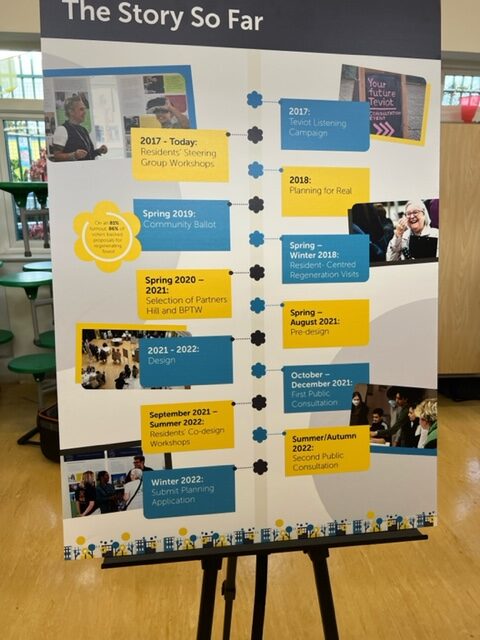
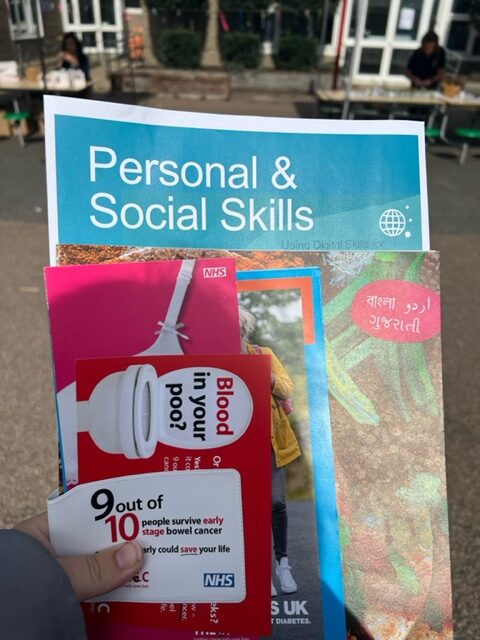
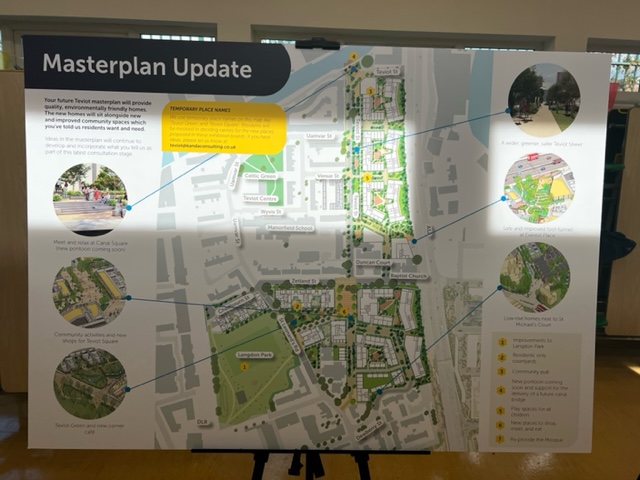
4in10 Newsletter 15.09.22
Read the latest newsletter here.
To get this directly to your inbox every fortnight please do join us.
Hello from our new Research and Learning Officer
I am so very excited to have joined 4in10 as Research and Learning Officer . My name is Emily Barker and I look forward to ensuring that 4in10 continues their amazing work of bringing together and providing support to London’s brilliant network of charities and individuals who are working to reduce the impact of child poverty across the city.
It’s a privilege to be part of a team working hard to support all of our members as we fight to end child poverty in London. Sadly, it feels like this winter will be an uphill battle after an already exhausting several years for us all in both our individual professional and personal lives. But in partnership, we can do so much more and our collective voice has the potential to demand permanent change in our capital.
So while this post serves as an introduction, it’s also an invitation. In my role, I want to provide our members with a balanced mix of events that fall under three main categories:
- Capacity building-to equip you with new tangible skills relevant to your work and organisational objectives
- Social Networking-to cultivate an active and supportive network of likeminded people working to respond to the growing inequality and demanding better for the future
- Information sharing-to provide clear, succinct summaries of recent policy changes or emerging research that fosters creative responses to complex problems
In addition, I will be facilitating some collaborative research with a few member organisations to ensure the voices of those with lived experience are centred in our calls to action of local and national leaders. This project is still being developed but would include a small research grant for participating member organisations.
If you would like to suggest future events or learn more about our future collaborative research project, please do get in touch to continue the conversation! Equally, I’d be very keen to visit your offices or attend your own events to learn more about your current work and immediate challenges.
I want to work together and ensure that the opportunities and information 4in10 provides is practical, relevant and not duplicating what’s available elsewhere. If there’s something you need or want to learn more about, you’re probably not the only one, so please share your ideas.
I look forward to meeting you digitally or in person over the coming months and thank you for all the work you do.
4in10 Newsletter 1.09.22
Read the latest newsletter here.
To get this directly to your inbox every fortnight please do join us.
4in10 Newsletter 3.08.22
Read the latest newsletter here.
To get this directly to your inbox every fortnight please do join us.
4in10 Newsletter 21.07.22
Read the latest newsletter here.
To get this directly to your inbox every fortnight please do join us.
Government Holiday activities and food programme 2022

Holiday activities and food programme 2022 across London
The Government has provided local councils with some funding to allow them to fund free holiday childcare and food provision.
Full details about the program can be found here.
Around London each local council has spent the funding in different ways and supported different organisations so here at 4in10 we have attempted to gather them all together in one place.
Levelling Up White Paper: Why using London as a yardstick risks children everywhere

Levelling Up White Paper: Why using London as a yardstick risks children everywhere
In February, this year, the government released their long-awaited Levelling Up White Paper, a 300-page long publication covering everything from the history of the biggest cities in the world to twelve separate missions for the UK. By now, and a few months on from its publication, you may have read any number of analyses or opinion pieces on this unusual document.
At 4in10, London’s Child Poverty Network, amongst the myriad of missions and metrics, there were two key issues stand out as being of great concern:
- Child poverty in London is completely absent from the paper (the phrase ‘child poverty’ does not appear at all).
- London is used a yardstick for success for other regions, despite having the highest levels of inequality and poverty. The White Paper explicitly intends to replicate London’s economic model in other regions despite these facts. This risks the exacerbation of child poverty not just in London but in other areas identified as needing to be ‘Levelled Up’ (Middlesbrough, Blackpool, Newcastle, the Humber etc).
Child Poverty in London and Levelling Up
Although London is discussed in some sections of the Levelling Up White Paper, child poverty levels are not referenced. This is despite four in ten children in London currently living in poverty and nine of the ten local authorities with the highest levels of child poverty being located in London. If children in the capital, or elsewhere in the UK, are going hungry due to poverty – and the White Paper fails to mention – let alone address this – the phrase ‘Levelling-Up’ rings hollow. The White Paper does discuss the deprivation and lack of investment into many regions across the UK. However, it is possible for two truths to be present at once:
- Vast areas of the UK have experienced chronic underinvestment.
- London’s children are experiencing worsening poverty levels and increasingly deep levels of poverty.
It is true that some of London’s children do experience some advantages (but these tend to be limited to social mobility measures); a child on free school meals in London is twice as likely to attend university compared to those in the north of England. In London’s most deprived areas, nearly 90 per cent of secondary schools are either good or outstanding, compared with less than 50 per cent in deprived areas of the north. Transport spend per head has been higher in London for a decade (although this doesn’t always benefit poorer Londoners in outer boroughs); London transport spending per head was £864, compared with £379 in the north-west of England between 2009-2020. All of these facts are little compensation to the 12 children in a classroom of 30 who live in poverty in London. If one of the children in an East London classroom ends up going to Oxbridge, or gets a job at a top law firm, that is little compensation to the 11 others who still live in poverty. Similarly, the ability to get from Hackney (East London) to Thornton Heath (South West London), for as little as £1.65, means very little when the parent to the child pays (on average) £1,650 on rent per month in Hackney.
At 4in10, believe the Levelling Up agenda can, and should, address both regional underinvestment and child poverty rates in all areas of the country, including London. We should not pit children in one area against another (as the White Paper states itself; page xiv)– any child growing up in poverty in the United Kingdom is an avoidable tragedy.
There is a real risk that the high levels of poverty and child poverty, experienced in London and elsewhere, will be overlooked by national policy makers in light of the White Paper.
Replicating London’s Private Sector Productivity Model
“Typically, differences within UK regions or cities are larger than differences between regions on most performance metrics” (Levelling Up White Paper 2022: p27)
A significant part of the reason child poverty is overlooked by the Levelling Up White Paper is due to the fact the main objective of ‘Levelling Up’ is to reproduce the London’s levels of productivity in other regions of the UK, through processes of agglomeration. It is consistently implied, in the White Paper, that living standards will increase once the rest of the UK’s long standing productivity problems are resolved. In London, both as a whole unit and at local authority levels, productivity metrics are higher than other regions. Across the measures selected by the government as indicative of a productive area, Gross Value Added per hour, median gross weekly pay, and proportion of population with a Level 3+ qualification – London scores highly in comparison to other regions. This leaves London’s true picture of poverty somewhat obscured.
Using Gross Value Added (GVA), the favoured productivity measurement of the government, Tower Hamlets is the third most productive region in the country (ONS 2021). Therefore, Tower Hamlets has ‘Levelled Up’, right?
If you were to walk down in a street in Tower Hamlets, in the shadow of Canary Wharf, one in two families (55.8% – End Child Poverty Coalition: 2021) would be living in poverty; if you asked them how high GVA levels or the private sector productivity of the financial district has benefited them, they would struggle to give you an answer.
This gets to the heart of why we at 4in10 are alarmed that this model is being sought to be replicated elsewhere. Living standards, such as child poverty, in Tower Hamlets for example, would not be improved by a further increase in shiny new private sector buildings in the borough.
As a network organisation whose members have seen the impact of child poverty rising over the last decade, the use of London as a yardstick for success or model to be copied is highly concerning. It is not just concerning for children in London, but also for children in places like Leeds, Rotherham, and Middlesbrough, who are the primary focus of ‘Levelling Up’ narratives. Whilst ‘Levelling Up’ certainly means different things to different people, but we would all agree that an area has not levelled up whilst still having extremely high levels of child poverty.
The Equality Trust and New Economics Foundation have already flagged that the Levelling Up White Paper must focus on people, not just places. Research from the NPC (2022) shows that only 2% of the total levelling up funding is going on supporting social infrastructure so far, despite the public’s expectation that will Levelling Up tackle social issues. The public consider the most important aspects to an area being levelled up to be reduced homelessness (36%) and reduced poverty (36%).
However, the problems with the White Paper and child poverty levels in London run even deeper when contextualised against continuous unhelpful narratives:
How Can We Change The Narrative That London Doesn’t Need To Be Levelled Up?
After waiting a few months to see if these concerns would be addressed by policy makers, it is clear that we need an alternative narrative or frame to tell the true story of child poverty in London. Despite years of (sky) high child poverty rates in London, Westminster are simply not listening. No single statistic will provide a silver bullet to this problem, as:
- People outside of London either aren’t aware of the scale of child poverty in London, or they simply don’t believe the scale of inequality and poverty in London when presented with evidence.
- There is a sense of unfairness/grievance felt towards London from some parts of the UK; typically providing London with any public funding is unpopular.
- London is no longer a major political priority for either the national Conservative or national Labour parties
In light of these factors, we need urgently to find an alternative way to make the case for the 700,000 children living in poverty in the capital.
We want to work alongside our members, and anyone who shares our concerns about child poverty in London to help us tell the true story of its impact and challenge the prevailing narratives in the White Paper that prevent us from tackling it.
Fantastic Job Opportunities with 4in10
Job opportunities at 4in10 London’s Child Poverty Network
Child poverty rates in London are among the highest in the country and many families are now facing severe hardship in the face of the cost-of-living crisis. Against this backdrop, 4in10 London’s Child Poverty Network brings together over 450 organisations working to tackle child poverty across the city and campaigns to keep the spotlight on the damage that it is doing to families and the action needed to end it.
We have three exciting roles available for excellent people to come and join us in this urgent work. If you share our vision for a child poverty free London and want to help us to bring it about, one of them might be right for you. The three roles are:
Research and Learning Officer (funded until April 2023)
The holder of this role will use their excellent research and analysis skills to develop learning resources and events for 4in10s members and to support the network’s policy and campaigning work. They will work with member organisations and those with lived experience of poverty to produce hard-hitting and insightful content on a wide range of aspects of child poverty in London.
This is a 35-hour-a-week role The salary is £33,200 plus a 9% employer’s pension contribution.
Job description and person specification
Community Outreach Officer (funded until April 2023)
This pivotal role will engage voluntary and community sector organisations working with families living on low incomes across London to connect them with the 4in10 network and its services, as well as feeding back their knowledge and expertise to the 4in10 team.
The Community Outreach Officer is the initial point of contact for network members and will work to establish and fulfil 4in10s plan for member recruitment and outreach to strengthen the collective voice of those working to tackle child poverty.
This is a 21-hour-a-week role The salary is £33,200, pro-rata, plus a 9% employer’s pension contribution.
Job description and person specification
Communications and Campaigns Intern (fixed term for 9 months)
This is a new post, and the holder will bring ideas and creative communications skills to 4in10’s campaigning and influencing work. They will support the delivery of 4in10’s activities, including London Challenge Poverty Week 2022, by contributing creative ideas and helping to manage activities and events. They will also support 4in10’s members to take part in influencing activities, for example through; developing effective communications to inform them of opportunities, supporting online campaigning and undertaking simple research tasks.
This is a 21-hour-a-week role The salary is £20,111 (London Living Wage) pro rata plus a 9% employer’s pension contribution
Job description and person specification
The closing date for all posts is : Monday 6 June 2022 at 12.00
Interviews will take place between 9 and 16 June 2022
It is envisaged that these posts will include a mix of home/office (central London) working. We are always happy to discuss flexible working to include compressed hours and/or job share. It may also be the possible to do these roles as secondments.
We believe the voluntary sector should be as open and accessible as possible to people with the passion and skill to contribute, so we do not specify a degree, or particular qualification as a requirement for these roles.
If you would like a confidential conversation about any of the roles or have any questions or need more information on how to apply email the Strategic Project Manager, Katherine Hill at katherine.hill@childrenengland.org.uk
4in10 London’s Child Poverty Network is a programme hosted by Children England, a charity created, governed and inspired by other charities. Our mission is to change the world for England’s children by harnessing the energy, ingenuity and expertise of the voluntary organisations that work on their behalf.
4in10 Newsletter 12.05.22
Read the latest 4in10 Newsletter here.
To get this directly to your inbox every fortnight please do join us.
Read the 4in10 Newsletter 31.03.2022
Action needed, news, information, funding, jobs and more. Get it delivered direct to your inbox fortnightly. Sign up here.

London Elections 2022. Influence your candidates NOW!
London Elections 2022.
Influence your candidates to take action on child poverty.
On 5 May 2022 in all 32 London boroughs apart from The City of London, every council seat is up for election.
This presents a once-in-four-year opportunity to grab the attention of those who would represent us, tell them about the impact of poverty on the city’s children and what they must do to tackle it. With child poverty rates in London among the highest in the country and many families are now facing severe hardship in the face of the cost-of-living crisis, it is a matter of urgency that those seeking election to their local council prioritise tackling child poverty in their communities.
4in10, alongside other organisations in the London Child Poverty Alliance, is asking its members to engage with candidates in these elections to encourage them to sign our pledge to work towards a child poverty free London.
We hope that as a result, on 5 May there will be hundreds of local government elected officials who are better informed about how they can tackle child poverty in the local communities and are ready to take action to do so.
Manifesto for a child poverty free London
The London Child Poverty Alliance’s Manifesto for a Child Poverty Free London sets out twelve key ‘asks’ that it believes if put into action, would make a significant contribution towards creating a child poverty free London. The asks are focused on four key areas:
- Action on income
- Action on housing
- Action on childcare
- Action on hunger
The manifesto website provides prospective councillors with good practice examples, local data and further information about how these can be put into practice in their communities. It also contains a signup page where they can publicly commit to work towards a child poverty free London.
Take part in the campaign
First and foremost, we are asking you to share the manifesto with your staff, volunteers and those you work with and ask them to ask candidates they meet to sign up to the pledge via the manifesto website.
If you have the capacity, you could also send manifesto to the candidates in your ward, or across the area where you are based, asking them to sign the pledge.
The easiest way to find out who your local candidates are is to visit the Who Can I Vote For? website and enter your postcode. Alternatively, you could contact the local offices of the main political parties to ask them for their contact details.
Also look out for local hustings events going on in your community and if possible attend one. These will provide an opportunity for you to ask the candidates what they plan to do to tackle child poverty, you can use the manifesto to help you decide what to ask.
If you need any support or have any questions, please contact us and we’ll be very happy to assist.
Register to vote
And finally, don’t forget to register to vote! It is possible to register to vote even without a permanent address. The deadline to apply is 14th April and the deadline for applying for a postal vote is 19th April. Contact your council’s electoral services team for more information.
Useful resources
London Councils Guide to How elections work
Guidance from the Charity Commission on campaigning during election periods
Interesting Blog from New Philanthropy Capital
What Will Spring Statement the Spring Statement Mean for Charities.
Thank you to NPC for allowing us to share this. For more information click here:
Spring is upon us. Flowers are blooming, birds are finally singing—and the sound of tweeting will reach deafening levels this week as the change of seasons also brings a new Spring Statement from the Chancellor. But as new beginnings go, the outlook has looked brighter.
A lot has happened since the somewhat optimistic-feeling autumn budget, and not much of it has been good for the charity sector: a war in Europe, the subsequent economic and social fallout, and spiralling living costs across the country. With this backdrop, ‘levelling up’ has dropped down the agenda, but it cannot be forgotten. More than ever, we need to see the budget deliver for marginalised groups who are most vulnerable to these social and economic shocks.
What will be the big themes of the budget?
In the short term, the overall economic outlook is pretty bleak. Inflation is rising to 30-year highs and may hit double digits, with another spike likely in the autumn. Disposable income is set to see the largest annual fall in 50 years. The government already announced a rise in the National Insurance rate—and although they may be scrapping this for the lowest paid workers, it will provide little salvation to those most affected by rising costs. The Chancellor has teased that rising food and fuel prices are likely to be confronted with a package of support, in addition to the £350 package announced in February—which now seems like a drop in the ocean. However, rumoured defence spending rises and support for Ukraine may limit the Treasury’s ability to ease people’s concerns.
We also have huge labour market vacancies, with around 1.2 million fewer people in the labour market compared to pre-pandemic trends. This is driven both by the young, but also by over 50s who have left the labour market completely. The Treasury will likely be thinking closely about this and an update to the plan for jobs is expected on Wednesday.
What should charities be expecting?
There may be tough times ahead for the charity sector. The combination of rising costs, rising demand and inflation, leading to a decline in value of grants and donations, could be a serious one for charities. What is certain is that as an abstract ‘cost of living crisis’ moves into a desperate ‘can’t heat my home’ crisis, charities will be ever more in need.
Along with the support for household bills already mentioned, there have been some rumoured benefit changes which the Chancellor may employ to try and soften the blow. For example, lowering the taper rate of Universal Credit again, or raising child benefit or pensions, but in the short term this is unlikely to seriously alter the circumstances of many people that charities support.
Charities whose work concerns Ukraine should also expect specific announcements around the crisis—both in terms of more support for resettling people in communities here, and also in terms of increased aid for organisations working closer to Kyiv.
What about levelling up?
With everything else that’s in the news, the mission to ‘level up’ the country has fallen down the agenda. However, the pain people will be feeling over the coming months means that this support is needed more than ever.
The largest levelling up fund yet to be allocated is the UK Shared Prosperity Fund (UKSPF). This is meant to replace EU funding for business support, community infrastructure, and employment and social exclusion support. The prospectus for the UKSPF is due soon, and allocations to lead authorities may be made as early as the Spring Statement. Given the labour market vacancies, this would be welcome.
What may be missing, however, is support for tackling social needs. In the pre-launch guidance for the UKSPF, the government quietly revealed that new funding for people and skills may not be available until 2024 / 25. As we outlined in our recent briefing, this could leave a three-year gap in new funding which will affect the most marginalised in the country the most, and will risk progress on the levelling up agenda.
At NPC, we’re worried this is going to blunt charities’ ability to deliver for communities around the country at a time when they are needed most. Following on from our briefing, we will be running an event on the UK Shared Prosperity Fund next month, focused on how charities and local government need to work together to ensure people don’t lose out on support. This will be vital viewing for anyone trying to tackle social exclusion or improve employment in communities around the country. Further details announced soon.
Longer-term, we are focused on ensuring that the lessons from projects working on social issues around the country are kept at the heart of future levelling up plans. Later this year, the government will be launching its Strategy for Community Spaces and Relationships. We know how much there is to learn from work that’s already happened, and we will be pulling together best practice from community initiatives across the country, along with fresh thinking, to design plans that can genuinely tackle the social needs that people see as key to the success of levelling up.
The Spring Statement is unlikely to bring a new start for the charity sector, but we know many charities have already planted seeds which address the issues communities care about. We want to help them grow and thrive elsewhere.
Get in touch with Theo.Clay@thinkNPC.org if you want to learn more.
Read 4in10's Latest Newsletter Here
News, Campaigns, Data, Funding and More.
To receive our newsletter every fortnight directly to your inbox, join us here.
Spotlight on 4in10 Member Praxis and the NRPF Action Group
How are you helping to tackle child poverty in London?
Praxis is a charity for migrants and refugees. We provide immigration advice, housing and peer support and through all of these ways our work helps to protect children from poverty. We have become a leading expert in finding pathways out of destitution and supporting migrants facing homelessness, and our training and campaign work has national and international impact. Our core purpose is to help migrants in crisis or at risk, ensuring they can live in safety, overcome the barriers they face, and take control of their own destinies. You can read more about our strategy here, find us on Facebook, Twitter and our website here.
As part of this work, we facilitate the No Recourse to Public Funds Action Group, which is made up of campaigners with lived experience of the No Recourse to Public Funds (NRPF) policy, to build campaigns to end this policy. You can find out more about our campaign, and read the NRPF Action Group’s manifesto calling for the end of NRPF here.
Tell us something you are excited about?
We are really excited that the group has decided to focus on campaigning for free school meals. The overarching goal of our campaign is to ensure free school meals for all children living in poverty, regardless of their parents’ immigration status. We’re launching with a specific call to the Government to make permanent the temporary extension of free school meals to some groups of children living in poverty affected by No Recourse to Public Funds, which was brought in during the pandemic.
We are also calling for free school meals for all children in poverty, regardless of immigration status, to take into account the fact that children with insecure immigration status are not covered by the extension of eligibility.
Our policy briefing sets out our campaign asks in more detail – you can find that here;
Additionally, here are some posts you can share if possible:
- Facebook: https://www.facebook.com/PraxisCommunityProjects/posts/325409016299148
- Twitter: https://twitter.com/Praxis_Projects/status/1500765019050500096
- Instagram: https://www.instagram.com/p/CazDWYtoCQa/
- LinkedIn: https://www.linkedin.com/feed/update/urn:li:activity:6906533946969186304
If you can support our campaign on social media, in your email networks and newsletters, this would be hugely appreciated! Please do reach out if you would like to collaborate in any way!. Any support you can offer to our campaign is hugely welcomed and thank you for all you do – Pascale.robinson@praxis.org.uk
Share with our members something positive about your organisation’s achievement or service?
We were one of the organisations that helped to uncover the Windrush Scandal originally and we’re proud to have been part of the work to campaign to change the system.
What can other network members learn from you or find out more about through you?
- We can offer advice for those who need help navigating the migration system: Get Help — Praxis for Migrants and Refugees.
- We are experts in finding pathways out of destitution and supporting migrants facing homelessness. Please reach out to collaborate on this!
- We can offer training on the immigration system for a variety of organisations (depending on our capacity).
What would most help you achieve your goals?
We want to make sure that migrants can live in safety, overcome the barriers they face, and take control of their own destinies. To do this, we campaign for systemic change. We’re building alliances and working in partnership with experts by experience to create positive, long-term changes to the policies and practices that create exclusion and destitution. We’d love to collaborate on work to achieve these goals!
Why did you join 4in10? What do you enjoy about being part of the 4in10 network?
Though we have only been in contact with the 4in10 team for a short while, 4in10 has already provided a brilliant chance to forge connections and collaborate with other amazing organisations working in the capital!
We are so looking forward to working together more, especially on our campaign to make sure all who need them have access to free school meals regardless of their immigration status.
Fantastic 4in10 Coffee Morning on Child Care
4in10 Coffee Mornings are always full of great people and good things. Just to wet your appetite for future ones and to give you some insight into why we chose child care as the issue for today you can find the slides below.
Thanks to Steve Triner from Sutton CAB and Samantha Creme from the London Early Years Foundation.
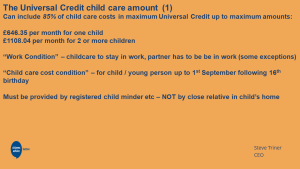
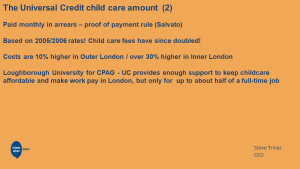
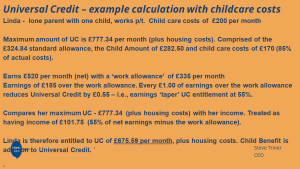
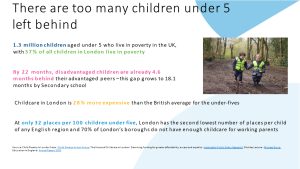

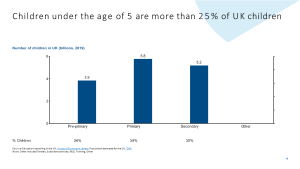
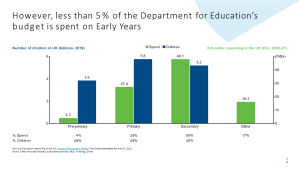
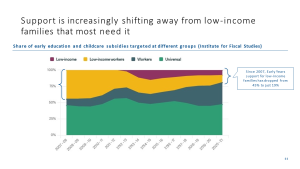
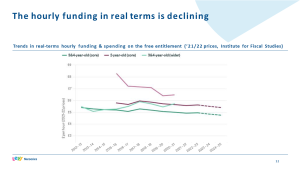
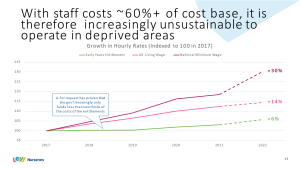
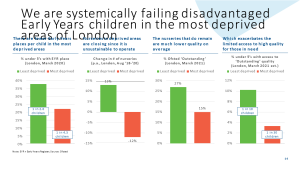
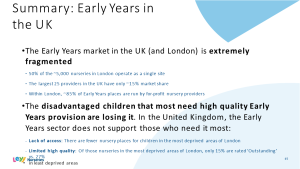
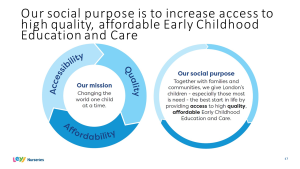
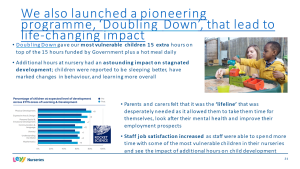
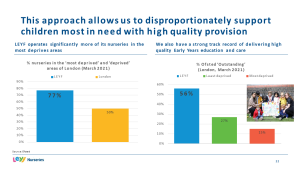
4in10 Newsletter
The latest news, data, jobs, funding and more from 4in10, members and friends.
To get the latest issue directly to your inbox every other Thursday sign up here.
Launch of Sustain’s Good Food for All Londoners Report
Measure Your Borough’s Responses to Food Insecurity.
This is a resource where you can see how every individual borough in London is doing against a range of measures to tackle food insecurity.
Councils in London have been measured against two key themes: tackling food poverty, and how they’re bringing healthy and sustainable food to people living in their borough, in this year’s Good Food for All Londoners report published by London Food Link. London Food Link, a network that strives for a food system that benefits all Londoners and led by Sustain, the food and farming alliance, has delved into council action across the city on fundamental food issues such as household food insecurity, healthy food environments, the wider food economy, and for the first time, climate action and food. Find out what’s happening in your borough and how your council performed on the good food leader board.
Cost of Living Crisis. URGENT action needed.
With the spring budget fast approaching 4in10 are calling on the Chancellor to uprate benefits in line with the Bank of England's February 2022 Monetary Policy Report forecast of 7% inflation.
We know this is not a solution to all poverty by any means and that there needs to be major changes to economic systems and social security in the longer term but it is what we can do to support many of our families now.
We have written to all our members and asked them to take action with tips for engaging local MP's and a sample email for adapting locally.
Please do feel free to use these to contact London MP's in time for them to understand how the cost of living crisis is impacting on their constituents from your experience.
A copy of the letter, tips for engagement and sample email are available here.

Read our latest newsletter 17/02/2022
This issue includes a link to the GLA statement on the cost of living crisis with a quote from 4in10 Strategic Manager Katherine Hill:
“A perfect storm of exorbitant rents, sky-high childcare costs, imminent fuel price hikes and surging food prices, means that across London families are struggling to meet their children’s basic needs for healthy food, a warm home and decent clothing. The impact of poverty will limit these children’s opportunities and have an impact for the rest of their lives. The Government must act to ensure that those being hit hardest by the current cost of living crisis receive immediate help to prevent further harm.”
To receive our fortnightly newsletter direct to your mail box sign up here.

Proposals for a new Bill of Rights: what would it mean for children living in poverty in London?
Katherine Hill, 4in10’s Strategic Manager, takes us through the issues:
The story of Human Rights Act (HRA) reform has been a long and somewhat torturous one. Governments of various guises have been consulting on what changes might be needed since the mid-2000s, only a few years after the Act came into force. While the content of these proposals has changed over time the one constant has been that those who have made the effort to respond diligently to each round of consultation have almost unanimously concluded that there is no solid case for reform; the Act is doing the job it was intended to do, effectively defending ordinary citizens against the exercise of excess power or neglect by the state.
Most recently the Independent Human Rights Act Review (IHRAR) set up by the Government to take (yet) another look at the Human Rights Act reported that, “[t]he vast majority of submissions received by IHRAR spoke strongly in support of the HRA.” And the separate but concurrently running inquiry carried out by the cross-party Joint Committee on Human Rights concluded: “[t]o amend the Human Rights Act would be a huge risk to our constitutional settlement and to the enforcement of our rights”. Why, then, has the Government now published proposals for wide-ranging and significant changes to the way the Act works? We all know that evidence-based policy is out of fashion, but this seems to have gone one step further. It is embracing policy in that is in direct contradiction with the evidence. This is policy driven by ideology pure and simple.
At this, the temptation may be to throw up our hands and leave the beleaguered Human Rights Act to the hands of fate. What is the point of repeatedly making the case for it, only to be ignored? There are two reasons. Firstly, we must recognise that the case for effective human rights is one that needs to be constantly remade, it will never be a case of job done. Human rights, if they are to mean anything, must be a statement of collective values, an expression of our shared commitment to freedom, respect, equality, dignity and autonomy for all humans. For these to be transmitted from generation to generation there needs to be ongoing dialogue about them and what they mean in our modern world. Shying away from that conversation leaves the legal mechanisms we have for defending our rights vulnerable to attack.
Secondly, and more pragmatically, if we do not argue and win the case for the Human Rights Act, and these current proposals for reform come into force, ordinary citizens may lose the means to enforce their rights effectively. For those 4in10 exists to advocate with and for, families and children experiencing living in poverty in London, the consequences are potentially very serious indeed.
The proposed reforms aim in multiple ways to make it harder for people to enforce their rights. These include a proposal to introduce of a new step in the legal process requiring individuals to demonstrate that they had experienced “a significant disadvantage” before their case can go to court. Legal action can already only be taken if the individual is the “victim” of a human rights breach, so it is hard to view this as anything other than an attempt to deter people from enforcing their rights by adding a further legal hurdle to the process. This will disproportionately affect those experiencing poverty who are more likely to have their rights breached in the first place. To give just one example, children in the lowest income quintile are 4.5 times more likely to experience severe mental health problems than those in the highest.[1] It follows that some of those are more likely to experience mental health detention too, where their human rights – including the right to respect for private and family life (article 8) and right to liberty and security (article 5) – will be engaged. If children in these circumstances, who already find it very difficult to access justice, have to jump through additional hoops it will further diminish their ability to challenge their detention where they believe it is an unlawful breach of their human rights.
The Government’s proposals would introduce a two-tier system for enforcing human rights by restricting their use in the domestic courts by certain groups, including “foreign criminals” and those accused of illegal migration. This makes a mockery of the values underlying the whole notion of human rights. These are rights that everyone is entitled to enjoy regardless of economic or immigration status, gender, sexuality, disability or anything else. It follows that all should have equal access to the law to enforce them. If they don’t, the impact will be felt most by those on the margins, and especially the poorest children in our society. If the Government is more easily able to deport people without them being able to challenge this on the grounds of right to respect for private and family life (article 8), families may face the sudden loss of their main breadwinner, and children living in already financially precarious situations will be plunged into deeper poverty.
A key issue the Government seeks to address through its plans is that it wants to stop what is termed ‘judicial overreach’, that is the courts getting involved in decisions that are more properly the role of Government and Parliament, accountable as they are to the people. High on the list of things the Government believes it is best placed to make decisions about is the allocation of social and economic resources and it is particularly aggrieved when it thinks the courts seek to interfere in these issues.
The reality is however, that there is little evidence that this is what the courts in the UK are routinely doing. Recent cases that have examined welfare policy have often been unsuccessful, for example a challenge to the two-child limit (which does not allow welfare payments to be made to third and subsequent children) on the grounds that it discriminates against lone parents. The courts found these to be matters on which Parliament has deliberated and struck an appropriate balance. This may be very disappointing for those of us who believe that there should be a wider role for human rights in these matters, and that the right to an adequate income, a safe and warm home and access to healthy food meet basic human needs that should be enforceable whatever the colour of government in town. But it certainly does not support the Government’s argument for the need to curtail the powers of the courts, and the rights of individuals, as is proposed.
Over the longer-term we need to build the case and argue robustly for more comprehensive protection of these important economic, social and cultural in our domestic legal framework, as an essential element of any strategy to eradicate poverty. But first, and most urgently, we need to protect what we already have in the form of the Human Rights Act, as failing to do so will have the greatest impact on those who most need to rely on it.
To find out more about the Government’s plans to reform the Human Rights Act and to find out how you can respond to the consultation visit the British Institute of Human Rights dedicated web pages where you can find lots of easily digestible information and advice.
[1] Gutman, L., Joshi, H., Parsonage, M., & Schoon, I. (2015). Children of the new century: Mental health findings from the Millennium Cohort Study. London: Centre for Mental Health.