Childcare reform and tackling child poverty must go hand in hand
Early education and childcare has not been at the forefront of the last few elections but notably this time around it is a hot topic. All the main political parties seem to recognise, albeit from differing perspectives perhaps, that there is much to be gained from better supporting and investing in children in their earliest years. The Conservatives have re-emphasised their commitment to rolling out 30 hours of childcare a week to working parents with children from nine months old to when they start school by September 2025. The Labour Party have also pledged to deliver this same commitment and plan to open an additional 3,000 nurseries through upgrading space in primary schools to help them do so. The Liberal Democrats for their part say they would close the attainment gap by giving disadvantaged children aged 3 and 4 an extra five hours free a week and tripling the Early Years Pupil Premium to £1,000 a year.
The question we, as London’s Child Poverty Network are asking of all these offerings is whether they will benefit children and families experiencing poverty who at the moment are benefiting less from the system than their wealthier peers. Back in March we published a research report ‘Make Childcare Make Sense for families on low incomes in London’. In it we looked through the eyes of parents of young children living on low incomes in London and found that the current childcare system makes little sense to them. The funding entitlements were often not accessible as they couldn’t be used without having to pay ‘top ups’; they were not flexible enough to meet their individual circumstances; and were not inclusive for their children, those with special educational needs and disabilities and those whose families have no recourse to public funds being especially likely to be excluded. One single mum of a three-year-old told us:
‘You know, you’re kind of making lots and lots of sacrifices to afford what essentially is a basic need to help our economy keep moving. Yeah, [the childcare system] just shuts people out of work.’
Sadly, the Government’s expansion of funding entitlements which began to be rolled out shortly after our report was published in April this year, will do little to improve the situation for these families. Just 1 in 5 (or 20%) of families earning less than £20,000 a year will have access to the planned expansion of funded places for one- and two-year-olds in some working families, compared to 80% of those with household incomes over £45,000.[1] This matters to us because access to affordable, high-quality childcare and tackling child poverty are inextricably linked.
Sky high childcare costs in London are one driver of our high child poverty rate; including childcare costs in the Social Metric Commission’s measure of poverty increases the poverty rate among families with children by 0.4 percentage points.[2] So, at the most straightforward level, bringing down childcare costs, for those that already incur them, has the potential to reduce levels of child poverty. Beyond this, affordable and accessible childcare can contribute to poverty alleviation by supporting parents and carers to access paid work if they do not already or to increase their hours, and so increase their household income. Lastly but certainly not least, we know that high quality early education is critical to a child’s development and later educational achievement.[3]
For all these reasons, it is imperative that whoever forms the next Government deliver an early education and childcare system that benefits all children. We believe that the best way to make sure this happens is for childcare reform to be at the heart of a strategy to address child poverty. The Labour Party has made a very welcome commitment in its manifesto to putting in place a Child Poverty Strategy, it must make sure that its policy on childcare in a key plank of this. If it doesn’t and this synergy isn’t realised is a very real risk that childcare policy rather than reducing inequality, could increase it.
[1] Drayton, E. et al. (2023). Childcare reforms create a new branch of the welfare state – but also huge risks to the market. Institute for Fiscal Studies. Available at: https://ifs.org.uk/ news/childcare-reforms-createnew-branch-welfare-state-alsohuge-risks-market
[2] Poverty Strategy Commission (September 2023) Interim Report: A new strategy for tackling poverty
[3] Melhuish, E. and Gardiner, J. (2023). Equal hours? Sutton Trust


A young person speaks: the Local Child Poverty Statistics 2024
By Layla, aged 19 from London (name changed to protect her identity)
I respond to this news not just as a young person, but as someone who has personally experienced the harsh realities of poverty. The recent findings from Loughborough University for the End Child Poverty Coalition resonate deeply with me, and seeing that over 30% of children across the UK are living in poverty, with two-thirds of new constituencies having at least a quarter of children facing this struggle, brings back vivid memories of my own childhood and the beginning of my own adulthood.
Growing up in poverty meant constant uncertainty and anxiety, and meant watching my care giver struggle to make ends meet, sometimes having to choose between paying bills or buying food. It meant missing out on school trips, new clothes, and being pointed out as the free school meals kid. What I’m trying to say is that these are not just statistics; they represent real lives, real struggles, and real futures at risk.
Hearing the call from the End Child Poverty Coalition for political parties to prioritise this issue fills me with a sense of urgency as it would not just be a policy change, but a lifeline for many families.
The disparities highlighted, especially in areas like the North East, London, and the North West, show that this issue is widespread and deeply rooted. It isn’t enough to just acknowledge the problem; we must act.
As someone who has walked this path, I urge our leaders to listen and to act. the upcoming election is a chance to commit to real, meaningful change, and ensuring that no child has to grow up feeling the weight of poverty, and having the opportunity to thrive is something every party should aim to include in their campaign.

Can a national child poverty strategy be all things to all children?
Well, just as we were drawing breath after the London elections, we find ourselves back in election mode once more. And once again we will be straining every sinew to ensure that child poverty is a central issue of the campaign and one that all the political parties are held to account on. In particular we will be making the case for all parties to pledge to a child poverty strategy that not only makes firm and time-bound commitments about reducing and ultimately eradicating child poverty but also recognises that achieving this aim will require different approaches in different parts of the country.
Of course, some of the key policies that we, along with over 100 other members of the End Child Poverty Coalition, want to see front and centre in a child poverty strategy such as abolition of the two-child limit and benefit cap, are ones that an incoming Government in Westminster alone can implement. But we also need a child poverty strategy that operates regionally and locally so that it can respond to the different contexts that children live in across the country. For example, in the North East child poverty is driven in large part by low pay, insecure work and out-of-work poverty (North East Child Poverty Commission, 2024), whereas in London it is exorbitantly high housing costs along with costs such as childcare that are the major issue. Important new analysis from our colleagues at Trust for London and WPI Economics exploring the possible reasons behind the apparent fall in overall poverty numbers in London in the past few years, suggests that costs are now so high that for many people the only way to escape poverty in our city is to leave it.
A national child poverty strategy that fails to recognise these regional differences and allow for differential responses is not going to have the impact it so urgently needs to. The incoming Government, must engage with and harness the data and knowledge that the Greater London Authority, combined and local authorities have about their regions and localities and establish mechanisms to ensure sustained focus and action on the issue at regional and local level. Moreover, it needs to recognise the impact that the collapse of local government funding has had on children’s services which has undoubtedly affected the poorest children most. It is crucial that a child poverty strategy ensures that local authorities are sufficiently resourced to meet the needs of the children living in their communities.
So, in answer to the question, yes, a national child poverty can and must deliver for all the UK’s children, no child wherever they live should be experiencing poverty, but this will only be achieved if we acknowledge and respond to their different circumstances. From our perspective as the London Child Poverty Network, we will use the coming weeks to champion as loudly as we can the right of the 700,000 children living in poverty in London to live in a poverty free city, a goal that we firmly believe is achievable if the political will is there to achieve it.

Tackling child poverty must be high on the new mayor's agenda
Yesterday Londoners went to the polls to elect their Mayor and members of the London Assembly. As we await the results, it is a good moment to pause and consider what should be at the top of the Mayor’s agenda from day one of their new term of office. From our perspective at London’s Child Poverty Network we are crystal clear that tackling the high levels of child poverty that continue to mar our city must be up there.
The first crucial step towards bringing about a child poverty free London must be to work with those children, families and those organisations who support them in their communities to develop a strategic response to tackling the problem over the next four years. As a network we have been very supportive of Sadiq Khan’s move to guarantee free school meals for all primary school children in the city, which demonstrates that he gets the severity of the situation and the need to take bold action to address it – but we know that on its own, it is not enough. Now is the time to bring everyone to the table to decide what other actions need to be prioritised to address the systemic causes of poverty. And we are not the only ones saying so, just before the election period began back in March a cross-party group of London Assembly Members supported our call and published a report recommending that ‘[t]he Mayor, working in conjunction with local authorities and the voluntary sector, should publish a child poverty strategy for London in 2024-25.’
So, what are the key policies the strategy ought to contain? Well, it is a fact that many of the levers for reducing child poverty lie beyond the direct powers of the Mayor of London; our broken social security system for example, which exacerbates rather than ameliorates child poverty rates by setting benefit payments at levels which are not sufficient to provide families with essentials; discriminates against larger families through the two-child limit; and imposes sanctions that push families into debt rather providing them with the scaffolding they need to escape poverty. These are not policies the Mayor can directly change, although they can add their strong voice to the chorus of cries for reform.
Where the Mayor can take direct action though, they must. Child poverty in London is driven in large measure by the exorbitantly high costs of living in the city, housing first among them. Without access to decent housing, 84,940 children in our city are living in temporary accommodation, often deprived of basics such as access to a hot nutritious meal, a warm comfortable bed and space to play and learn. Whoever emerges victorious from the election count will already be well aware that sorting the housing crisis is going to be one of the biggest challenges they face and indeed all the main candidates have pledged to do so, in various ways, during their election campaigns. What we are calling for now is for these efforts to also be a central plank of a new child poverty strategy for the city. By looking afresh as the problem through this lens we can ensure that the housing that is built truly meets the needs of young families living on low incomes and enables them to live in and contribute to our city, as part of our communities rather displaced to other more affordable parts of the country.
Addressing high childcare costs must be part of a London child poverty strategy too. In our recent report Make Childcare Make Sense we looked at how sky-high childcare fees disproportionately affect families living on low incomes making it next to impossible for them to stay and/or progress in work and how an inclusive, affordable childcare system could vastly improve their and the children’s lives and allow them to contribute to London’s economic well-being. Getting the national childcare and early education policy framework right is essential to achieving this goal but so too is leadership and intervention at the London-wide level and our report sets out a series of recommendations for the Mayor and GLA.
Faced with these high housing and childcare costs, another reason many families in London struggle to make ends meet is a lack of high-quality, well-paid work; in London, almost half of those in poverty are in employment and in 2022, 17% of Londoners in work were paid below the London Living Wage (Trust for London). Many of these also face the issue of insecure work. Recent research from the Living Wage Foundation has found that there are over 800,000 insecure jobs in London. Addressing these twin issues of low pay and insecure work must be another strand of a child poverty strategy.
Finally, is also crucial that a strategy recognises the interaction between poverty and discrimination and has addressing it at its core. We cannot for example, ignore the fact that systemic racism and disablism in the education system often combined with the impact of poverty, is responsible for holding back some of our young people and preventing them from flourishing in the way they should. A child poverty strategy rooted in a human rights-based approach is key to achieving deep and lasting change.
So, once they have had a chance to catch their breath, we hope our newly elected Mayor will engage with us as a network, draw on our members’ rich and diverse experience and work with us to map out and deliver a plan for achieving a child poverty free London; an achievable goal if we all harness our collective determination and belief to make it happen.
London mothers tell the United Nations temporary accommodation violates children’s rights.
4in10 and Little Village have collaborated to write a submission for the examination of the United Kingdom’s 7th periodic report to the United Nation Committee on Economic and Social and Cultural Rights (CESCR). The CESCR committee is currently reviewing the UK Government’s compliance with the International Covenant on Economic, Social and Cultural Rights.
Little Village is a charity that fosters a village of support and solidarity for families on low incomes with children under five in London. Little Village equips families with pre-loved children’s clothes and baby essentials as well as linking them with key services. They also work alongside parents to fix the system that keeps them trapped in poverty.
The research for this report was informed by a human rights-based approach, 4in10 worked in partnership with a small group of mothers who are part of the Little Village community. In this process, the contribution made by the mothers seeks to bring to the attention of the CESCR their experiences of struggling to access safe and affordable housing, a lack of access to basic necessities and difficulties accessing childcare and therefore being able to work. Therefore, this report contains evidence that the rights under Article 11 ICESCR – the right to an adequate standard of living, and Article 6 ICESCR – the right to work are not enjoyed equally in London. The UK government has failed to protect the rights of families with young children under 5 years of age living in London. It’s time to hold the UK Government to account and more than that, it’s time for change.
A few excerpts from the report are illustrated below. To read the report in full click here.
Key findings
Experiences of inappropriate and unsafe housing
The mothers shared their experience of a lack of access to safe, secure housing for themselves and their children as one of the most acute issues they face and an issue that they wished the report to draw the Committee’s attention to. Several of the women were or had previously been placed by their local authority in temporary accommodation. London has an acute homelessness problem, with 10 times more London households in temporary accommodation than in the rest of England[1]. In 2021 nearly 56,500 households were living in temporary accommodation, including 75, 580 children. Furthermore, research on the crisis of family homelessness in the UK shows that temporary accommodation is harmful to families. For example, research commissioned by The Cardinal Hume Centre and Home-Start Westminster, Kensington & Chelsea and Hammersmith and Fulham and published last week into the experience of families living in temporary accommodation in Westminster found that temporary accommodation is more than just a housing problem, the impact spans many areas including health, education, child development and a family’s financial situation.[2]
Similarly, the mothers had found the housing their families where places in to be inadequate for their needs and damaging to their mental and physical health as well as that of their children. One mother shared:
“When I had a studio flat with my son, it was so damp. Every time I called they just say you have to wash it [the walls]…but it would keep coming back. My son has an inhaler because of living in mould.”
Inadequate housing can have a detrimental impact on a child’s mental health. A mother shared that their children were showing signs of depression due to overcrowding:
‘Children are depressed because of sharing bedrooms. So, they may act out at school because their needs are not being met at home.’
While temporary accommodation is intended to house homeless families only for short periods of time, this was not the case for the women and other families across the UK. A combination of cuts to local government funding, an inadequate welfare system and a lack of permanent social or affordable housing has driven this increase. Consequently, children in London are growing up in substandard and unsafe temporary accommodation and the effect this is having on children’s rights cannot be understated. If the government is committed to its pledge to the international covenant, then giving families a safe, secure and decent home to live in must be the foundation of this.
Lack of access to childcare as a barrier to work
Another issue that the women highlighted as a priority for the Committee to examine was the barriers that prevent them from exercising their right to work.
When families are housed, especially in temporary accommodation, this is often far away from existing connections including employers and wider families and other sources of support. One mother told us how she was moved from south to north London, which meant, she would have to travel up to 2 hours each way to drop off her child with a family member who could provide childcare while she worked. The high costs of travel and subsequent lost work-time mean that this is not financially viable. Unable to make work pay this mother must rely on a small maternity payment: “I receive £626 a month and that is it. I have to buy nappies, electric every week… the money goes like that.”
Additionally, the women expressed their desire to work to increase their incomes to support their children, but this was impossible given the lack of affordable and accessible childcare available to them. Another woman, reflecting on the very high costs of childcare, asked “How can I work with 3 kids?’ Childcare in the UK is amongst the most expensive in the world according to the Organisation for Economic Co-operation and Development. In London, the cost of childcare is 30% higher than elsewhere is the country. [3] The consequence of the failure of the government to uprate the childcare element of Universal credit and the universal credit system not being set up to pay childcare fees in advance means parents are unable to make work pay and are being blocked from the workforce. Hence, polling commissioned by 4in10 in 2021 among a representative sample of Londoners found that childcare costs were felt to be the biggest driver of poverty in the city[4]. While childcare is the infrastructure that allows parents, particularly mothers, to enter or re-enter the workforce, we also know that early years is crucial to for enhancing life chances for children living in poverty.
These experiences shared by the group of mothers are shocking to read and sadly have been a reality of many low income families living in Londoners for too long. The report concludes that despite the UK Government’s assertion in its 7th periodic report to the Committee on Economic, social and Cultural Rights that it is “committed to a sustainable, long-term approach to tackling poverty”, the evidence in the report shows the UK Government is in fact failing to protect young children and their families in London from the damaging effects of poverty and is breaching their rights under ICESCR, specifically Article 11 (1) The right to an adequate standard of living and Article 6 the right to work. We urge the United Nations to listen to the voices of the women who share their experiences and call on the UK government to uphold their commitment to protect and implement these rights.
[1] Centre for London (Sept 2022) Temporary Accommodation: London’s hidden homelessness crisis
[2] The Cardinal Hume Centre and Home-Start Westminster, Chelsea and Hammersmith and Fulham (Feb 2023) The Experiences of Families Living in Temporary accommodation in Westminster.
[3] Child Poverty Action Group (June 2021) ‘THE COST OF A CHILD IN LONDON: HELP WITH CHILDCARE FEES ‘WOEFULLY INADEQUATE’
[4] 4in10 London’s Child Poverty Network (October 2021) Flying Against Gravity: the lived reality of poverty in London

Newham Nurture roundtable
4in10 Manager Katherine reflects on the Newham Nurture roundtable event she attended this week
Earlier this week I had the great pleasure of attending an event that showcased and celebrated the work of the Newham Nurture project. Newham Nurture is a community partnership with NCT, Alternatives Trust, The Magpie Project and Compost London. The programme supports women through pregnancy and up to two years after birth from low income, migrant and marginalised backgrounds experiencing financial hardship and disadvantage. It does this by providing drop-in pregnancy sessions, Baby & Me sessions for mums with babies from newborn up to 2 years, peer support and counselling.
A few reflections…
The project shone out as an example of what good partnership working and co-production ought to be, but all too often isn’t. The women from the project steering group, many of whom also deliver its work as volunteers and staff members, spoke eloquently and movingly about their own experiences of struggling to access the support they needed as pregnant and new mothers, about how the partner organisations were a lifeline for them and how passionate they are about making sure that help is now available to other women who so desperately need it. It was also clear from the discussion that there was a high level of mutual respect between the project partners and local statutory services, with a clear acknowledgement that unless services really listen to and act on what women are telling them then they will remain inaccessible to many.
There is a lot for others to learn from the experience of the project. While Newham’s challenges may be distinctive, there is no doubt that in many other areas of London there are families who would benefit enormously from the support of a project like Newham Nurture. The experience of having a baby can be a daunting and isolating experience for any woman, and if you add to that experience of loss and trauma, very low income, insecure housing, language barriers and discrimination, then this is magnified many times. The event concluded with a powerful audio recording of women who come to Newham Nurture talking about it and what it meant to them. The message that came over loud and clear was that they valued the project not only for the accessible, practical advice and support it gave them but also a place where they and their children could come, feel welcomed and enjoy the friendship of others who have trod similar paths ahead of them. Compost London are evaluating the work and I look forward to reading and sharing their findings with all the other organisations in the 4in10 network so that they can learn from the excellent work that Newham Nurture has planted, grown and is now blossoming in their community.
While the overwhelming feeling I had on leaving the event was one of hope; gained from witnessing the deep commitment that the women who lead this programme have to supporting one and another and working tirelessly to improve the lives of their young children, it was also tinged with anger. Anger that the choices of our politicians are wreaking such damage on these families’ lives and withholding the resources needed to ensure their children’s rights to food, health and education. With no end to the cost-of-living crisis in sight and further cuts to services on the cards, it is alarming to think that the situation for these families will get worse. Drawing on the hope and belief that change is possible, as the project so clearly demonstrates, we must redouble our effort to challenge these systemic injustices and demand better for children and families.

Hello from our new Research and Learning Officer
I am so very excited to have joined 4in10 as Research and Learning Officer . My name is Emily Barker and I look forward to ensuring that 4in10 continues their amazing work of bringing together and providing support to London’s brilliant network of charities and individuals who are working to reduce the impact of child poverty across the city.
It’s a privilege to be part of a team working hard to support all of our members as we fight to end child poverty in London. Sadly, it feels like this winter will be an uphill battle after an already exhausting several years for us all in both our individual professional and personal lives. But in partnership, we can do so much more and our collective voice has the potential to demand permanent change in our capital.
So while this post serves as an introduction, it’s also an invitation. In my role, I want to provide our members with a balanced mix of events that fall under three main categories:
- Capacity building-to equip you with new tangible skills relevant to your work and organisational objectives
- Social Networking-to cultivate an active and supportive network of likeminded people working to respond to the growing inequality and demanding better for the future
- Information sharing-to provide clear, succinct summaries of recent policy changes or emerging research that fosters creative responses to complex problems
In addition, I will be facilitating some collaborative research with a few member organisations to ensure the voices of those with lived experience are centred in our calls to action of local and national leaders. This project is still being developed but would include a small research grant for participating member organisations.
If you would like to suggest future events or learn more about our future collaborative research project, please do get in touch to continue the conversation! Equally, I’d be very keen to visit your offices or attend your own events to learn more about your current work and immediate challenges.
I want to work together and ensure that the opportunities and information 4in10 provides is practical, relevant and not duplicating what’s available elsewhere. If there’s something you need or want to learn more about, you’re probably not the only one, so please share your ideas.
I look forward to meeting you digitally or in person over the coming months and thank you for all the work you do.
Fantastic Job Opportunities with 4in10
Job opportunities at 4in10 London’s Child Poverty Network
Child poverty rates in London are among the highest in the country and many families are now facing severe hardship in the face of the cost-of-living crisis. Against this backdrop, 4in10 London’s Child Poverty Network brings together over 450 organisations working to tackle child poverty across the city and campaigns to keep the spotlight on the damage that it is doing to families and the action needed to end it.
We have three exciting roles available for excellent people to come and join us in this urgent work. If you share our vision for a child poverty free London and want to help us to bring it about, one of them might be right for you. The three roles are:
Research and Learning Officer (funded until April 2023)
The holder of this role will use their excellent research and analysis skills to develop learning resources and events for 4in10s members and to support the network’s policy and campaigning work. They will work with member organisations and those with lived experience of poverty to produce hard-hitting and insightful content on a wide range of aspects of child poverty in London.
This is a 35-hour-a-week role The salary is £33,200 plus a 9% employer’s pension contribution.
Job description and person specification
Community Outreach Officer (funded until April 2023)
This pivotal role will engage voluntary and community sector organisations working with families living on low incomes across London to connect them with the 4in10 network and its services, as well as feeding back their knowledge and expertise to the 4in10 team.
The Community Outreach Officer is the initial point of contact for network members and will work to establish and fulfil 4in10s plan for member recruitment and outreach to strengthen the collective voice of those working to tackle child poverty.
This is a 21-hour-a-week role The salary is £33,200, pro-rata, plus a 9% employer’s pension contribution.
Job description and person specification
Communications and Campaigns Intern (fixed term for 9 months)
This is a new post, and the holder will bring ideas and creative communications skills to 4in10’s campaigning and influencing work. They will support the delivery of 4in10’s activities, including London Challenge Poverty Week 2022, by contributing creative ideas and helping to manage activities and events. They will also support 4in10’s members to take part in influencing activities, for example through; developing effective communications to inform them of opportunities, supporting online campaigning and undertaking simple research tasks.
This is a 21-hour-a-week role The salary is £20,111 (London Living Wage) pro rata plus a 9% employer’s pension contribution
Job description and person specification
The closing date for all posts is : Monday 6 June 2022 at 12.00
Interviews will take place between 9 and 16 June 2022
It is envisaged that these posts will include a mix of home/office (central London) working. We are always happy to discuss flexible working to include compressed hours and/or job share. It may also be the possible to do these roles as secondments.
We believe the voluntary sector should be as open and accessible as possible to people with the passion and skill to contribute, so we do not specify a degree, or particular qualification as a requirement for these roles.
If you would like a confidential conversation about any of the roles or have any questions or need more information on how to apply email the Strategic Project Manager, Katherine Hill at katherine.hill@childrenengland.org.uk
4in10 London’s Child Poverty Network is a programme hosted by Children England, a charity created, governed and inspired by other charities. Our mission is to change the world for England’s children by harnessing the energy, ingenuity and expertise of the voluntary organisations that work on their behalf.
4in10 Newsletter 12.05.22
Read the latest 4in10 Newsletter here.
To get this directly to your inbox every fortnight please do join us.
Read the 4in10 Newsletter 31.03.2022
Action needed, news, information, funding, jobs and more. Get it delivered direct to your inbox fortnightly. Sign up here.

London Elections 2022. Influence your candidates NOW!
London Elections 2022.
Influence your candidates to take action on child poverty.
On 5 May 2022 in all 32 London boroughs apart from The City of London, every council seat is up for election.
This presents a once-in-four-year opportunity to grab the attention of those who would represent us, tell them about the impact of poverty on the city’s children and what they must do to tackle it. With child poverty rates in London among the highest in the country and many families are now facing severe hardship in the face of the cost-of-living crisis, it is a matter of urgency that those seeking election to their local council prioritise tackling child poverty in their communities.
4in10, alongside other organisations in the London Child Poverty Alliance, is asking its members to engage with candidates in these elections to encourage them to sign our pledge to work towards a child poverty free London.
We hope that as a result, on 5 May there will be hundreds of local government elected officials who are better informed about how they can tackle child poverty in the local communities and are ready to take action to do so.
Manifesto for a child poverty free London
The London Child Poverty Alliance’s Manifesto for a Child Poverty Free London sets out twelve key ‘asks’ that it believes if put into action, would make a significant contribution towards creating a child poverty free London. The asks are focused on four key areas:
- Action on income
- Action on housing
- Action on childcare
- Action on hunger
The manifesto website provides prospective councillors with good practice examples, local data and further information about how these can be put into practice in their communities. It also contains a signup page where they can publicly commit to work towards a child poverty free London.
Take part in the campaign
First and foremost, we are asking you to share the manifesto with your staff, volunteers and those you work with and ask them to ask candidates they meet to sign up to the pledge via the manifesto website.
If you have the capacity, you could also send manifesto to the candidates in your ward, or across the area where you are based, asking them to sign the pledge.
The easiest way to find out who your local candidates are is to visit the Who Can I Vote For? website and enter your postcode. Alternatively, you could contact the local offices of the main political parties to ask them for their contact details.
Also look out for local hustings events going on in your community and if possible attend one. These will provide an opportunity for you to ask the candidates what they plan to do to tackle child poverty, you can use the manifesto to help you decide what to ask.
If you need any support or have any questions, please contact us and we’ll be very happy to assist.
Register to vote
And finally, don’t forget to register to vote! It is possible to register to vote even without a permanent address. The deadline to apply is 14th April and the deadline for applying for a postal vote is 19th April. Contact your council’s electoral services team for more information.
Useful resources
London Councils Guide to How elections work
Guidance from the Charity Commission on campaigning during election periods
Interesting Blog from New Philanthropy Capital
What Will Spring Statement the Spring Statement Mean for Charities.
Thank you to NPC for allowing us to share this. For more information click here:
Spring is upon us. Flowers are blooming, birds are finally singing—and the sound of tweeting will reach deafening levels this week as the change of seasons also brings a new Spring Statement from the Chancellor. But as new beginnings go, the outlook has looked brighter.
A lot has happened since the somewhat optimistic-feeling autumn budget, and not much of it has been good for the charity sector: a war in Europe, the subsequent economic and social fallout, and spiralling living costs across the country. With this backdrop, ‘levelling up’ has dropped down the agenda, but it cannot be forgotten. More than ever, we need to see the budget deliver for marginalised groups who are most vulnerable to these social and economic shocks.
What will be the big themes of the budget?
In the short term, the overall economic outlook is pretty bleak. Inflation is rising to 30-year highs and may hit double digits, with another spike likely in the autumn. Disposable income is set to see the largest annual fall in 50 years. The government already announced a rise in the National Insurance rate—and although they may be scrapping this for the lowest paid workers, it will provide little salvation to those most affected by rising costs. The Chancellor has teased that rising food and fuel prices are likely to be confronted with a package of support, in addition to the £350 package announced in February—which now seems like a drop in the ocean. However, rumoured defence spending rises and support for Ukraine may limit the Treasury’s ability to ease people’s concerns.
We also have huge labour market vacancies, with around 1.2 million fewer people in the labour market compared to pre-pandemic trends. This is driven both by the young, but also by over 50s who have left the labour market completely. The Treasury will likely be thinking closely about this and an update to the plan for jobs is expected on Wednesday.
What should charities be expecting?
There may be tough times ahead for the charity sector. The combination of rising costs, rising demand and inflation, leading to a decline in value of grants and donations, could be a serious one for charities. What is certain is that as an abstract ‘cost of living crisis’ moves into a desperate ‘can’t heat my home’ crisis, charities will be ever more in need.
Along with the support for household bills already mentioned, there have been some rumoured benefit changes which the Chancellor may employ to try and soften the blow. For example, lowering the taper rate of Universal Credit again, or raising child benefit or pensions, but in the short term this is unlikely to seriously alter the circumstances of many people that charities support.
Charities whose work concerns Ukraine should also expect specific announcements around the crisis—both in terms of more support for resettling people in communities here, and also in terms of increased aid for organisations working closer to Kyiv.
What about levelling up?
With everything else that’s in the news, the mission to ‘level up’ the country has fallen down the agenda. However, the pain people will be feeling over the coming months means that this support is needed more than ever.
The largest levelling up fund yet to be allocated is the UK Shared Prosperity Fund (UKSPF). This is meant to replace EU funding for business support, community infrastructure, and employment and social exclusion support. The prospectus for the UKSPF is due soon, and allocations to lead authorities may be made as early as the Spring Statement. Given the labour market vacancies, this would be welcome.
What may be missing, however, is support for tackling social needs. In the pre-launch guidance for the UKSPF, the government quietly revealed that new funding for people and skills may not be available until 2024 / 25. As we outlined in our recent briefing, this could leave a three-year gap in new funding which will affect the most marginalised in the country the most, and will risk progress on the levelling up agenda.
At NPC, we’re worried this is going to blunt charities’ ability to deliver for communities around the country at a time when they are needed most. Following on from our briefing, we will be running an event on the UK Shared Prosperity Fund next month, focused on how charities and local government need to work together to ensure people don’t lose out on support. This will be vital viewing for anyone trying to tackle social exclusion or improve employment in communities around the country. Further details announced soon.
Longer-term, we are focused on ensuring that the lessons from projects working on social issues around the country are kept at the heart of future levelling up plans. Later this year, the government will be launching its Strategy for Community Spaces and Relationships. We know how much there is to learn from work that’s already happened, and we will be pulling together best practice from community initiatives across the country, along with fresh thinking, to design plans that can genuinely tackle the social needs that people see as key to the success of levelling up.
The Spring Statement is unlikely to bring a new start for the charity sector, but we know many charities have already planted seeds which address the issues communities care about. We want to help them grow and thrive elsewhere.
Get in touch with Theo.Clay@thinkNPC.org if you want to learn more.
Read 4in10's Latest Newsletter Here
News, Campaigns, Data, Funding and More.
To receive our newsletter every fortnight directly to your inbox, join us here.
Spotlight on 4in10 Member Praxis and the NRPF Action Group
How are you helping to tackle child poverty in London?
Praxis is a charity for migrants and refugees. We provide immigration advice, housing and peer support and through all of these ways our work helps to protect children from poverty. We have become a leading expert in finding pathways out of destitution and supporting migrants facing homelessness, and our training and campaign work has national and international impact. Our core purpose is to help migrants in crisis or at risk, ensuring they can live in safety, overcome the barriers they face, and take control of their own destinies. You can read more about our strategy here, find us on Facebook, Twitter and our website here.
As part of this work, we facilitate the No Recourse to Public Funds Action Group, which is made up of campaigners with lived experience of the No Recourse to Public Funds (NRPF) policy, to build campaigns to end this policy. You can find out more about our campaign, and read the NRPF Action Group’s manifesto calling for the end of NRPF here.
Tell us something you are excited about?
We are really excited that the group has decided to focus on campaigning for free school meals. The overarching goal of our campaign is to ensure free school meals for all children living in poverty, regardless of their parents’ immigration status. We’re launching with a specific call to the Government to make permanent the temporary extension of free school meals to some groups of children living in poverty affected by No Recourse to Public Funds, which was brought in during the pandemic.
We are also calling for free school meals for all children in poverty, regardless of immigration status, to take into account the fact that children with insecure immigration status are not covered by the extension of eligibility.
Our policy briefing sets out our campaign asks in more detail – you can find that here;
Additionally, here are some posts you can share if possible:
- Facebook: https://www.facebook.com/PraxisCommunityProjects/posts/325409016299148
- Twitter: https://twitter.com/Praxis_Projects/status/1500765019050500096
- Instagram: https://www.instagram.com/p/CazDWYtoCQa/
- LinkedIn: https://www.linkedin.com/feed/update/urn:li:activity:6906533946969186304
If you can support our campaign on social media, in your email networks and newsletters, this would be hugely appreciated! Please do reach out if you would like to collaborate in any way!. Any support you can offer to our campaign is hugely welcomed and thank you for all you do – Pascale.robinson@praxis.org.uk
Share with our members something positive about your organisation’s achievement or service?
We were one of the organisations that helped to uncover the Windrush Scandal originally and we’re proud to have been part of the work to campaign to change the system.
What can other network members learn from you or find out more about through you?
- We can offer advice for those who need help navigating the migration system: Get Help — Praxis for Migrants and Refugees.
- We are experts in finding pathways out of destitution and supporting migrants facing homelessness. Please reach out to collaborate on this!
- We can offer training on the immigration system for a variety of organisations (depending on our capacity).
What would most help you achieve your goals?
We want to make sure that migrants can live in safety, overcome the barriers they face, and take control of their own destinies. To do this, we campaign for systemic change. We’re building alliances and working in partnership with experts by experience to create positive, long-term changes to the policies and practices that create exclusion and destitution. We’d love to collaborate on work to achieve these goals!
Why did you join 4in10? What do you enjoy about being part of the 4in10 network?
Though we have only been in contact with the 4in10 team for a short while, 4in10 has already provided a brilliant chance to forge connections and collaborate with other amazing organisations working in the capital!
We are so looking forward to working together more, especially on our campaign to make sure all who need them have access to free school meals regardless of their immigration status.

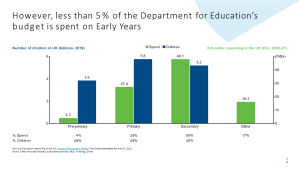
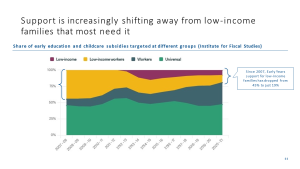
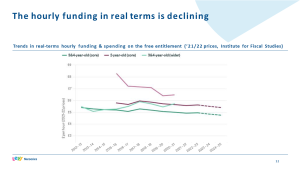
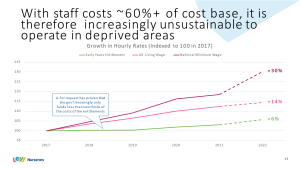
Fantastic 4in10 Coffee Morning on Child Care
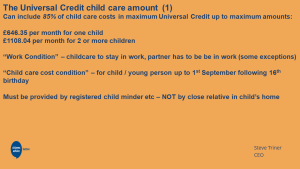
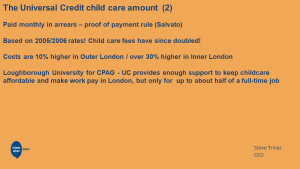
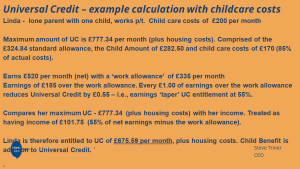
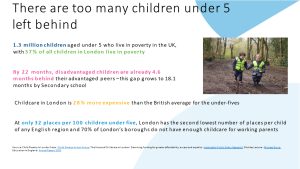
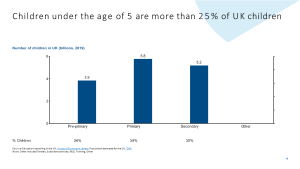
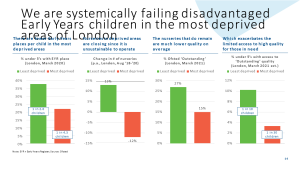
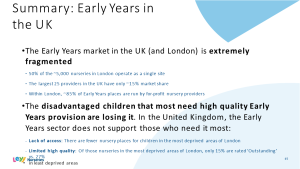
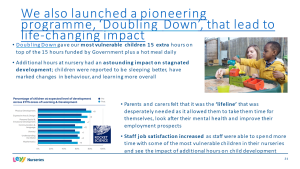
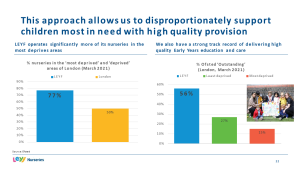
4in10 Coffee Mornings are always full of great people and good things. Just to wet your appetite for future ones and to give you some insight into why we chose child care as the issue for today you can find the slides below.
Thanks to Steve Triner from Sutton CAB and Samantha Creme from the London Early Years Foundation.

4in10 Newsletter
The latest news, data, jobs, funding and more from 4in10, members and friends.
To get the latest issue directly to your inbox every other Thursday sign up here.
Launch of Sustain’s Good Food for All Londoners Report
Measure Your Borough’s Responses to Food Insecurity.
This is a resource where you can see how every individual borough in London is doing against a range of measures to tackle food insecurity.
Councils in London have been measured against two key themes: tackling food poverty, and how they’re bringing healthy and sustainable food to people living in their borough, in this year’s Good Food for All Londoners report published by London Food Link. London Food Link, a network that strives for a food system that benefits all Londoners and led by Sustain, the food and farming alliance, has delved into council action across the city on fundamental food issues such as household food insecurity, healthy food environments, the wider food economy, and for the first time, climate action and food. Find out what’s happening in your borough and how your council performed on the good food leader board.
Cost of Living Crisis. URGENT action needed.
With the spring budget fast approaching 4in10 are calling on the Chancellor to uprate benefits in line with the Bank of England's February 2022 Monetary Policy Report forecast of 7% inflation.
We know this is not a solution to all poverty by any means and that there needs to be major changes to economic systems and social security in the longer term but it is what we can do to support many of our families now.
We have written to all our members and asked them to take action with tips for engaging local MP's and a sample email for adapting locally.
Please do feel free to use these to contact London MP's in time for them to understand how the cost of living crisis is impacting on their constituents from your experience.
A copy of the letter, tips for engagement and sample email are available here.

Read our latest newsletter 17/02/2022
This issue includes a link to the GLA statement on the cost of living crisis with a quote from 4in10 Strategic Manager Katherine Hill:
“A perfect storm of exorbitant rents, sky-high childcare costs, imminent fuel price hikes and surging food prices, means that across London families are struggling to meet their children’s basic needs for healthy food, a warm home and decent clothing. The impact of poverty will limit these children’s opportunities and have an impact for the rest of their lives. The Government must act to ensure that those being hit hardest by the current cost of living crisis receive immediate help to prevent further harm.”
To receive our fortnightly newsletter direct to your mail box sign up here.

Proposals for a new Bill of Rights: what would it mean for children living in poverty in London?
Katherine Hill, 4in10’s Strategic Manager, takes us through the issues:
The story of Human Rights Act (HRA) reform has been a long and somewhat torturous one. Governments of various guises have been consulting on what changes might be needed since the mid-2000s, only a few years after the Act came into force. While the content of these proposals has changed over time the one constant has been that those who have made the effort to respond diligently to each round of consultation have almost unanimously concluded that there is no solid case for reform; the Act is doing the job it was intended to do, effectively defending ordinary citizens against the exercise of excess power or neglect by the state.
Most recently the Independent Human Rights Act Review (IHRAR) set up by the Government to take (yet) another look at the Human Rights Act reported that, “[t]he vast majority of submissions received by IHRAR spoke strongly in support of the HRA.” And the separate but concurrently running inquiry carried out by the cross-party Joint Committee on Human Rights concluded: “[t]o amend the Human Rights Act would be a huge risk to our constitutional settlement and to the enforcement of our rights”. Why, then, has the Government now published proposals for wide-ranging and significant changes to the way the Act works? We all know that evidence-based policy is out of fashion, but this seems to have gone one step further. It is embracing policy in that is in direct contradiction with the evidence. This is policy driven by ideology pure and simple.
At this, the temptation may be to throw up our hands and leave the beleaguered Human Rights Act to the hands of fate. What is the point of repeatedly making the case for it, only to be ignored? There are two reasons. Firstly, we must recognise that the case for effective human rights is one that needs to be constantly remade, it will never be a case of job done. Human rights, if they are to mean anything, must be a statement of collective values, an expression of our shared commitment to freedom, respect, equality, dignity and autonomy for all humans. For these to be transmitted from generation to generation there needs to be ongoing dialogue about them and what they mean in our modern world. Shying away from that conversation leaves the legal mechanisms we have for defending our rights vulnerable to attack.
Secondly, and more pragmatically, if we do not argue and win the case for the Human Rights Act, and these current proposals for reform come into force, ordinary citizens may lose the means to enforce their rights effectively. For those 4in10 exists to advocate with and for, families and children experiencing living in poverty in London, the consequences are potentially very serious indeed.
The proposed reforms aim in multiple ways to make it harder for people to enforce their rights. These include a proposal to introduce of a new step in the legal process requiring individuals to demonstrate that they had experienced “a significant disadvantage” before their case can go to court. Legal action can already only be taken if the individual is the “victim” of a human rights breach, so it is hard to view this as anything other than an attempt to deter people from enforcing their rights by adding a further legal hurdle to the process. This will disproportionately affect those experiencing poverty who are more likely to have their rights breached in the first place. To give just one example, children in the lowest income quintile are 4.5 times more likely to experience severe mental health problems than those in the highest.[1] It follows that some of those are more likely to experience mental health detention too, where their human rights – including the right to respect for private and family life (article 8) and right to liberty and security (article 5) – will be engaged. If children in these circumstances, who already find it very difficult to access justice, have to jump through additional hoops it will further diminish their ability to challenge their detention where they believe it is an unlawful breach of their human rights.
The Government’s proposals would introduce a two-tier system for enforcing human rights by restricting their use in the domestic courts by certain groups, including “foreign criminals” and those accused of illegal migration. This makes a mockery of the values underlying the whole notion of human rights. These are rights that everyone is entitled to enjoy regardless of economic or immigration status, gender, sexuality, disability or anything else. It follows that all should have equal access to the law to enforce them. If they don’t, the impact will be felt most by those on the margins, and especially the poorest children in our society. If the Government is more easily able to deport people without them being able to challenge this on the grounds of right to respect for private and family life (article 8), families may face the sudden loss of their main breadwinner, and children living in already financially precarious situations will be plunged into deeper poverty.
A key issue the Government seeks to address through its plans is that it wants to stop what is termed ‘judicial overreach’, that is the courts getting involved in decisions that are more properly the role of Government and Parliament, accountable as they are to the people. High on the list of things the Government believes it is best placed to make decisions about is the allocation of social and economic resources and it is particularly aggrieved when it thinks the courts seek to interfere in these issues.
The reality is however, that there is little evidence that this is what the courts in the UK are routinely doing. Recent cases that have examined welfare policy have often been unsuccessful, for example a challenge to the two-child limit (which does not allow welfare payments to be made to third and subsequent children) on the grounds that it discriminates against lone parents. The courts found these to be matters on which Parliament has deliberated and struck an appropriate balance. This may be very disappointing for those of us who believe that there should be a wider role for human rights in these matters, and that the right to an adequate income, a safe and warm home and access to healthy food meet basic human needs that should be enforceable whatever the colour of government in town. But it certainly does not support the Government’s argument for the need to curtail the powers of the courts, and the rights of individuals, as is proposed.
Over the longer-term we need to build the case and argue robustly for more comprehensive protection of these important economic, social and cultural in our domestic legal framework, as an essential element of any strategy to eradicate poverty. But first, and most urgently, we need to protect what we already have in the form of the Human Rights Act, as failing to do so will have the greatest impact on those who most need to rely on it.
To find out more about the Government’s plans to reform the Human Rights Act and to find out how you can respond to the consultation visit the British Institute of Human Rights dedicated web pages where you can find lots of easily digestible information and advice.
[1] Gutman, L., Joshi, H., Parsonage, M., & Schoon, I. (2015). Children of the new century: Mental health findings from the Millennium Cohort Study. London: Centre for Mental Health.

4in10 Newsletter 20/01/22
Read the latest 4in10 network newsletter here.
Information, training, resources and much more.
Spotlight on Restorative Justice for All
Spotlight Interview with 4in10 Member RJ4A
- How are you helping to tackle child poverty in London?
The Restorative Justice for All International Institute (RJ4All) is a charitable, user-led NGO with a mission to address poverty and advance community cohesion and human rights. We redistribute power in a more equal way by delivering social justice and poverty relief projects, educational programmes, intercultural dialogue, internships and high-quality volunteering opportunities to the most marginalised groups of society. Child poverty in London is not only a reality, but also a persistent societal failure. That is why we put emphasis on making a difference by providing local direct services from the RJ4All Rotherhithe Community centre, where we are based. It is not possible to achieve equality and community cohesion, if poverty and disadvantage are not rooted out first.
Since COVID19, we prioritized poverty relief and wellbeing projects, focusing on making a change locally and by prioritizing services for groups who are faced with extra challenges. One of these groups are children and young people in the South East London area where we are based. These local services are provided from the RJ4All Rotherhithe Community Centre, which has become a hub of community empowerment and cohesion. It offers a food-bank, a community fridge, free sport classes, a community library, COVID19 tests and educational workshops to children, young people and professionals. It is also a safe place for anyone who wants to pop in for a coffee, use our facilities or just chat with our interns, volunteers and team.
- Share with our members something positive about your organisation’s achievement or service.
Last year, RJ4All was the recipient of the Best Charity Award from the Southwark Business Awards due to its youth-led COVID-19 poverty relief project “You are not Alone”. During the pandemic, children and young people came together and with the support of the RJ4All Director, Dr. Gavrielides, they set up the project to help their peers who were struggling. The project started with a small grant that RJ4All managed to secure, providing food and PPE to children, young people and their families. It then quickly expanded across London, resulting in generating over 500 volunteer placements, a mental health helpline run by children and young people for children and young people, online courses and a bank of online resources, internships and online fitness classes. The project is now under the auspices of the independent youth-led FRED campaign, hosted by RJ4All. Dr. Gavrielides also received the Southwark Civic Award 2021 as a result.
- What can other network members learn from you or find out more about through you?
We encourage members to learn more about restorative justice and its underlying value of power sharing. Restorative justice is not just a justice practice. It is an ethos and a methodology for carrying out projects, or even how to lead our lives. We would be happy to introduce members to restorative justice and we encourage them to take our free CPD certified courses by visiting https://rj4all.uk/online/
- What would most help you achieve your goals?
Our mission is to address poverty and advance community cohesion and human rights. We do this by using the power of education, sports and art, as well as the practices and values of restorative justice including power sharing, fairness, equality, dignity and respect. We start locally and thus any support for our community service provision in SE16 London would be much appreciated. Our food bank and community fridge are always in need for stocking up!
- Why did you join 4in10? What do you enjoy about being part of the 4in10 network?
We were very pleased to join the campaign in October (London Challenge Poverty Week), and we very much enjoyed working with the network given that we share similar values and goals. We often operate in silos making our work harder and our impact smaller. By connecting our minds and hearts, we come closer to addressing power abuse and the inequality that impacts on our children.
4in10 Newsletter 6th Jan 2022
Read our fortnightly newsletter here with news, calls to action, funding, jobs, free training and more. To receive this in your inbox every other Thursday just complete our . Everything is completely free!
4in10 Newsletter 09/12/21
4in10 Newsletter with data, reports, research, job vacancies, funding oopportunities and more. To read this issue click here. To receive the newsletter fortnightly straight to your inbox, join 4in10, London's child poverty network. It is completely free and gives advance notice of training and events and much more.

Timewise Video on Flexible Working
Timewise Webinar
Can flexible working help towards supporting low paid workers to progress and move out of poverty? Presenting the flexible working index and a discussion about flexible working as a real alternative.
https://timewise.co.uk/article/flexible-job-index-2021-a-timewise-roundtable/
Putting the onus on employers to enable all jobs to be flexible and for flexibility not to be a barrier to progression or keep people (mostly women) trapped in low paid work.

Human Rights Perspective on 'Levelling Up'
4in10 sees poverty as an abuse of human rights. As Nelson Mandela put it:
'Overcoming poverty is not a gesture of charity. It is an act of justice. It is the protection of a fundamental human right, the right to dignity and a decent life. While poverty persists, there is no true freedom.'
Equally Ours have published an excellent, evidence based report written by Belinda Pratten, Levelling Up: Firm Foundations.
Written from an equalities and human rights perspective it covers work, social security, social care, civil society and housing as well as the wider issues of public procurement and investment. A great Christmas holiday read.
Fair By Design Blog. Innovation, fairness and a just transition to Net Zero
Fair By Design – The Poverty Premium.
Martin Coppack is Director at Fair By Design and Carl Packman is Head of Corporate Engagement and this article originally appeared on the Social Market Foundation website.”
By their very nature, essential services such as energy, credit, and insurance, are needed by everyone. However, these markets have been designed in a way that results in many people being treated less fairly. As Fair By Design’s research shows, poorer people pay more for products and services than those who are better off – known as the poverty premium.
The University of Bristol found that the poverty premium affects almost every low-income household, costing an extra £490 a year, on average. Low-income households experience the poverty premium in the energy market in a number of ways. They may use pre-payment meters for domestic fuel rather than paying by direct debit, or may prefer to pay on receipt of a bill to help manage a budget. Many low-income households are also not switched to the best fuel tariffs, which is also a poverty premium. These households are less likely to switch sometimes because they have other more pressing issues to deal with, which manifests in less capacity to engage in the market, which is known as the ‘scarcity mindset.’[1] It is not the same as consciously avoiding actions that might upset tight financial control, such as switching providers. They also may not be able to switch because of higher rates of digital exclusion, owing to a lack of ability or equipment to go online.
Research commissioned by Fair By Design found that people with certain protected characteristics are more likely to be paying a poverty premium, even when compared with low-income households as a whole. People from Black, Asian, and other ethnic minority households are more likely to be paying extra costs for energy, and paying on receipt of a bill, rather than by direct debit, which is usually cheaper. Single parents are more likely to pay for energy through more expensive prepayment meters. These groups are more likely to be in low-paid or insecure work and therefore need flexible payment methods to help keep control of their finances. Disabled people are more likely to be paying by either of these methods, than non-disabled people.
The poverty premium is particularly pertinent at the moment since poorer households suffer disproportionately in hard times. There are now millions more people facing economic hardship as a result of the pandemic. The ongoing gas price crisis means that the cost of heating the average home could also double.
Why does the poverty premium exist?
Essential products and services are too often designed for ‘super consumers.’ These are people who never become ill, always have a steady income, are able to understand complex terms and conditions and always have the time and technology to easily find the best deal. This is not a reality for everyone. There is a disconnect between social and regulatory policymakers and people’s lived experiences of poverty and exclusion, and a belief that a market based on competition benefits all consumers. In practice, firms compete for the most profitable and engaged consumers. It means that for many people products and services do not meet their needs or even that they are excluded altogether.
Inclusive Design: Understanding how different groups and consumers experience products
Across essential services regulators, inclusive design is increasingly recognised as a way to ensure markets are fair and inclusive, especially for consumers in vulnerable circumstances and on low incomes.
Inclusive design is a toolbox that helps design products and services that are accessible to as many people as possible. It is different to ‘traditional’ market research in that it is not simply about testing pre-existing solutions and hypotheses. It starts by talking to people with additional needs to understand the problems from their perspective, and designing from there. Rather than shaping the consumer around the product or service, firms start with people where they are, and co-design with them. This is especially important as the energy system becomes increasingly digitised, and we transition to net zero.
Instead of designing for a mythical ‘average’ user, firms should therefore understand people’s actual experiences and how these might put them at a disadvantage. In other words, what are they vulnerable to, and why?
There are huge benefits to firms from adopting an inclusive design approach. By involving customers in the process of product design and development, it increases the likelihood of adoption, and reduces the need for solving problems after they occur, through customer service, for example.
The role of government and regulators
At the same time we know that firms will only design inclusively, to a point. There are always going to be some consumers that are deemed less desirable and for whom competition alone will not help. Markets need to be regulated to serve everybody. This means that Government (BEIS) and regulators (Ofgem) should not only be encouraging firms to design inclusively, they should be applying inclusive design principles to their own work. They should shape their own policies around the consumer, especially those most vulnerable and least heard – rather than trying to make such consumers fit their desired regulatory intervention. It is not enough to rely on competition and the belief that empowered consumers drive the market.
For instance, consumers have a role in designing the appropriate policy steps towards decarbonisation. This is very important, since we need to ensure that the cost of the transition to renewable energy sources is not placed disproportionately and unfairly on low income groups. Although many UK households are reportedly willing to accept some increase in their bills to help finance the future energy transition, this will not be possible for all households – particularly those with little slack in their existing household budgets, or who do not own their own home.
Ofgem and BEIS should adopt an inclusive design approach to understanding the needs of all consumers (particularly those on low incomes) and use this approach to help set their priorities, develop and implement interventions, and assess their effectiveness. This means doing things differently, and engaging with low income people directly – placing them at the heart of decisions.
To help with this, Fair By Design, along with our partners Money Advice Trust, has published a practical guide on what inclusive design means and how it can be incorporated into the work of regulators.
The future of price protections
An inclusive design approach to policymaking will help identify where the limits are for the market serving certain groups of consumers, and for whom additional protections – such as price caps and targeted “social” tariffs – are needed.
In a Fair By Design study of low income households accessing Turn2us’ services, researchers compared the costs of the energy poverty premium in 2016 and 2019 to assess the degree to which the retail energy market has changed. [2] While their findings showed the positive impact of regulation, low-income consumers still face excess costs for their energy.
For example, the gap between the Standard Variable Tariff and the best online-only fixed tariff had reduced from £317 in 2016, to £213 in 2019, a reduction of over £100. [3] The gap between the best pre-payment meter tariff and the best online-only fixed tariff had almost halved, dropping from £227 in 2016 to £131 in 2019.[4] This shows a strong correlation between price protections and a reduction in the poverty premium.
This is very welcome news and shows that sensible regulation and a focus on price to protect consumers is achieving good outcomes. The focus now should be on how to narrow the gap even further, to entirely remove the poverty premium, through a combination of inclusively-designed innovations and policy changes.
About Fair By Design
Fair By Design is dedicated to reshaping essential services, such as energy, credit and insurance, so they don’t cost more if you’re poor. People on low incomes and in poverty pay more for a range of products including energy, through standard variable tariffs; loans and credit cards, because of higher interest rates; and expensive insurance premiums, by living in postcodes considered higher risk. This is known as the poverty premium.
We collaborate with industry, government, and regulators to design out the poverty premium. Our Venture Fund provides capital to help grow new and scalable ventures that are innovating to make markets fairer. The Barrow Cadbury Trust runs our advocacy work, and Ascension manages the Venture Fund.
To download the Fair By Design and the money Advice Trust guides on inclusive design visit: https://fairbydesign.com/inclusive-design/ There is one for regulators (and social policy makers) as well as one for firms.
Notes
- [1] Scarcity: The True Cost of Not Having Enough, Sendhil Mullainathan & Eldar Shafir (2011)
- [2] Although average figures of the poverty premium are not comparable across the two studies, due to differences in methodology, the calculation of the premiums remained the same and so costs are comparable.
- [3] Drawn from the average across Big 6 suppliers and across household size.
- [4] Drawn from the average across Big 6 suppliers and across household size.

Support the campaign to keep London's Public Transport flowing.
Keeping the Wheels On
why fair funding for London’s transport system matters for those living on low incomes
Blog by Katherine Hill. 4in10's Strategic Project Manager.
It has been widely reported that Transport for London is facing a funding crisis which will come to a head this week when its current emergency funding deal expires. The causes of this crisis are complex and contested. But what is clear is that unless agreement can be reached quickly, Londoners will soon feel the impact of cuts to the capital’s transport services - and none more so than Londoners living on low incomes.
Child poverty in London is in large measure driven by the sky-high cost of living in the city. In addition to well documented high housing and childcare costs, Londoners also spend the highest amount in the UK on transport (an average of £137 a month).[1] If fares have to be increased to plug holes in Transport for London’s budget, then this will be yet another additional cost that many families struggle to meet.
As our ‘Flying Against Gravity’ report published during this year’s London Challenge Poverty Week shows, access to affordable transport is essential to ensuring that families can get to work, take children to school and visit hospitals.[2] People told us they were concerned about affordable transport because it is an enabler, without it they miss out on things such as jobs, social interaction, and education. One young man explained how not being able to afford to use the transport network leads to a sense of exclusion:
“London is meant to be someone's home, yet you have all of these boundaries and factors that just stop working class people from accessing certain spaces.” Joshua, aged 18-20, Enfield.
Without money or access to transport, people are denied their right to educational opportunities that otherwise might help them break out of the poverty cycle:
“I was...having to travel a bus and a train to get to college. So, if I'm honest, I probably went in a couple of days a week. So as a result, I didn't do very well in my A-levels because I was broke. I rarely went in because the money just didn't really stretch.” Rhiya, aged 25-30, Bromley.
In addition to these direct effects on those who are financially struggling, if public transport services are reduced it will also have repercussions for efforts to cut the number of cars on our roads. As night follows day this will mean that the effects of traffic congestion such as air pollution and road danger increase, and we know that these disproportionately affect some groups including those on low incomes.[3]
So, it is critically important that the Government and Transport for London come together this week to reach a funding agreement that will keep our trains, buses, tubes and trams running at affordable cost. Failure to do so will impact on all Londoners, but without doubt, those living in poverty would feel the effect of cuts to services the most. Without affordable public transport, streets will be dirtier and more dangerous for children, schools and jobs will be less accessible to young people, and poorer families will be constrained to small areas of the city. This would be a huge step backwards when what they deserve is a sustainable, inclusive city.
Take action today and support London TravelWatch’s campaign to #keeplondonmoving by taking their quick, easy action here: https://www.londontravelwatch.org.uk/join-the-campaign-to-protect-londons-public-transport/
[1] Fair access: Towards a transport system for everyone, (2019) Centre for London
[2] Flying Against Gravity, (2021) ClearView Research
[3] Fair access: Towards a transport system for everyone, (2019) Centre for London
4in10 Newsletter 25.11.2021
Read our latest newsletter by clicking here.
To receive the newsletter fortnightly to your inbox please send us an email.
Spotlight Interview with Voices of Hope
4in10 Member, Voices of Hope, share their work.
How are you helping to tackle child poverty in London?
Voices of Hope was established to help restore and rebuild hope in individuals, improving physical and mental health through community based projects. We work with groups across our community including families and individuals at risk of food insecurity, women who have experienced domestic violence/abuse and those with complex physical and or mental health issues. VoH also run a community choir and an innovative breathing support service.
Our BRITE (Building Resilience In Today’s Environment) Box project is a weekly recipe meal kit containing all the ingredients and a step by step, child friendly, illustrated recipe guide to resource and enable families to enjoy preparing and eating a healthy meal. We work closely with the Local Authority, Voluntary Sector and schools to reach families who will benefit most from engaging with the project and each family joins BRITE Box for a school year, receiving a new recipe meal kit every Friday.
Beyond the need to help children in immediate food poverty through providing a weekly balanced family meal at no cost, BRITE Box also addresses the impact of food scarcity on children through increasing skills, confidence and enjoyment in trying new foods and cooking from scratch – a life skill which can have a long term impact on physical, emotional and mental health and wellbeing.
We have also set up The Good Food Co-Op, a not for profit spray free, fresh fruit and vegetable box scheme, with the aim of ‘making healthy, fresh produce accessible to all’. Every box purchased by customers allows us to offer heavily subsidised boxes to referral customers, with community cooking events and courses planned for 2022.
Share with our members something positive about your organisation’s achievement or service.
BRITE Box has grown from 40 boxes a week in May 2020 to 450 boxes delivered to families each week across Kingston, Richmond, Southwark and Elmbridge. We have worked very closely with Local Authorities, schools, businesses, volunteers and VCS partners to create a truly community led project. However, our main achievement is the engagement and feedback we have received from families and schools taking part in BRITE Box.
“It helped me out when I was struggling and shows how cheap it can actually be to buy and make food from scratch”
“It was amazing, I learned new recipes and it created a great task for me and the kids to do together, a weekly treat, it gave the kids something to look forward to”
“I haven’t seen a project so well engaged with and so embraced by staff, children and adults. It is particularly impressive how enthusiastic the children have been through and how engaged they have remained. the collaboration of adults engaging with and talking to the children has been fantastic. It has built confidence, communication and self-esteem”. (School Head)
What can other network members learn from you or find out more about through you?
Effective partnership and working across the statutory, VCS and private sectors has been vital to the continued development and funding of BRITE Box. We place a high value on working relationally – listening, learning and sharing experiences.
What would most help you achieve your goals?
In order to allow more families to take part in BRITE Box we are keen to develop diversified sustainable funding streams and partnerships with like-minded community partners in other areas. We predominately serve Kingston, Richmond, Southwark and Elmbridge but are keen to work with others to serve other parts of London as we grow.
Why did you join 4in10? What do you enjoy about being part of the 4in10 network?
4in10 provides a fantastic opportunity to be part of a network to learn, share insights and work together with a collective voice to reduce inequality across London.
For more on VOH go to https://www.voh.org.uk/index.html and if you are interested in partnering with us please get in touch.
4in10 Newsletter 11.11.2021
4in10 Newsletter with events, training, news, data, funding, history and much more. For this issue click here.

Camden Federation of Tenants Briefing for VCS's
Background
There is a greater focus on the private rented sector (PRS) than ever before, but because of the media’s excessive interest in so-called “Generation Rent” there is a misconception that most people who live in it are mostly students and highly paid young professionals.
While a significant number of both of these groups rent privately across London, it would be wrong to assume that all of them are well off. Increasingly, the PRS is now made up of a mixture of household types and recent research carried out by the University of York* identified these six as being the most “vulnerable to harm” in the PRS.
1. With dependent children
2. With someone registered as disabled or who is unable to work due to a long-term sickness or
disability
3. With someone aged 65 or older
4. In receipt of a means tested benefit or tax credit
5. On a low-income but not receiving any means tested benefits or tax credits
6. Headed by a recent overseas migrant
*Vulnerability amongst Low-Income Households in the Private Rented Sector in England (David Rhodes and Julie Rugg, University of York Centre for Housing Policy, 2018)
The impact of Covid-19
According to the Greater London Authority’s “Housing in London 2020” report:
“The onset of the Coronavirus pandemic highlighted and exacerbated existing inequalities in London's housing market, including stark differences in the prevalence of housing problems between Londoners of different ethnicities.” The report also highlighted private renters increased financial vulnerability compared to homeowners, and the lack of access to private or shared gardens.
We would also add to this the difficulties of social distancing in shared housing arrangements, particularly in HMO (Houses in multiple occupation) type accommodation, the behaviour of landlords/agents, and because of a power imbalance, the inability of renters to challenge or influence this.
Some private rented sector facts
1. In 2019, 29% of London’s households were private renters and 23% were social renters, making it now the smallest housing tenure in the city. This trend will continue as the housing crisis only gets worse
2. A bigger proportion of homes rented privately (35%) have children living in them than in the social rented sector
3. Average private rents in London have risen by 43% since 2005, and in 2015/16 around a quarter of privately renting households in the capital spent over half of their income on rent.
4. The average rent for a 1 bedroom flat in London is more than a 3 bedroom flat anywhere else in England
Tenants or renters ?
For many years, any discussion about the private rented sector was on issues solely relating to tenants, but recently this has changed to focus more on what are now called “renters”. This is largely due to the much broader range of terms that people rent properties under e.g. a licence rather than a tenancy for a lodger or property guardian, a holiday let or lettings club arrangement or no formal agreement at all. It should also be pointed out that these sorts of practices tend to proliferate in the more marginal (and often hidden) parts of the sector, where the households more vulnerable to harm tend to live.
In what ways are social renters and private renters different ?
Private renters do not have a designated housing officer that can inform or signpost them to the appropriate local organisations, services and projects
Private renters do not live in clearly identifiable estates or blocks (unless they are living in an ex-Council property) and are much more dispersed across an area than social renters
Private renters are unlikely to be aware of the tenant halls on Council estates and the events/activities that take place in some of them
Research has shown that private renters don’t tend to do the things that more settled parts of the community do such as register to vote, sign up to doctors and dentists etc
What kind of issues are private renters currently facing ?
Poverty/fuel poverty – Due mainly to unaffordable rents, Covid-19, and energy inefficient homes.
This can also be due to the inability to choose their own energy supplier, benefit changes and a reluctance to claim benefits amongst certain groups e.g. older renters
Isolation/loneliness – Is also a particular problem amongst older renters and is made worse by the often individualised nature of renting in the PRS
Physical/mental health issues – Can be pre-existing or new conditions that are either made worse or caused by poor a relationship with landlords/agents and the lack of adapted homes in the PRS
Digital exclusion – Is a particular issue for those who cannot afford a smart phone or broadband and/or don’t understand how to get online
Lack of knowledge of rights – Is an ongoing problem amongst most renters, but can be a particular problem for certain groups e.g. those from other countries who are not familiar with how “the system works” here
What does this mean for the voluntary and community sector in London ?
We believe that the rapidly changing nature of who lives in the private rented sector has implications for voluntary and community sector organisations across the capital when it comes to both running and promoting existing projects and services, and planning new ones. It should also be noted that the disadvantaged households described here are those that local groups/organisations usually focus on.
How should the voluntary and community sector respond to this ?
We believe that when planning, running and promoting projects and services it is helpful to:
Think about housing tenure and understand the range of issues that private renters currently face
Understand the differences between social and private renters and not just view them as generic
“residents”
Understand how they find out about, access (or not, as is often the case) local projects and services
Produced by: Camden Federation of Private Tenants (CFPT)
Tel: 020 7383 0151 Email: admin@cfpt.org.uk Website: www.cfpt.org.uk
4in10 Newsletter 28.10.2021
4in10 Newsletter with data, information, reports from London Challenge Poverty Week, other events, calls for action and much more. For this issue click here.
Hunger Still Here - Magic Breakfast Campaign
Levelling-up School Breakfast
Please demand sustainable funding for school breakfasts, email your MP now.
A plan to improve the life chances of pupils hardest hit by the Covid-19
The levelling-up agenda is about healing some of the great social divides in our country and giving everyone a chance to climb the ladder of opportunity.
This proposal offers a bold new intervention with a proven track record that would enable the Government to take the levelling-up agenda further, faster, by comprehensively addressing child morning hunger. It would enable schools to reach 893,000 of the most disadvantaged children and their families with a nutritious school breakfast, costing the Department for Education an additional £75 million annually.
This spending proposal builds on the original work of the charity Magic Breakfast and the Department for Education delivering school breakfast provision in 2014 and 2018-2021[i].
The Proposal
The proposal is modestly costed, with expenditure raised from existing tax revenue. It would apply to all eligible state funded primary, special schools, and pupil referral units, with an option for later expansion to state funded secondary. It should replace the Department for Education’s current National School Breakfast Programme (NSBP), which reaches only 30% of eligible schools and doesn’t offer these schools the support they need to reach children most at risk of hunger. This proposal improves on current NSBP provision by making school breakfast provision permanent, sustainable, and available for all schools with high levels of disadvantage. The proposal will apply to England only, as education is a devolved issue.
The proposal will give schools with significant evidence of need support to provide a free nutritious breakfast, that meets School Food Standards, to all children. ‘Significant evidence of need’ will be defined within existing DfE guidance as schools with at least 50% of pupils in IDACI bands A-F. IDACI, The Income Deprivation Affecting Children Index, estimates the number of children living in low-income households and bands A-F signify the highest levels of deprivation. Schools will be guaranteed additional funding to cover the costs of breakfast food and delivery. Schools will also benefit from dedicated staff support in the form of an expert ‘school partner’, who are proven to play a key role in improving the uptake of the hardest-to-reach families and the effective implementation by schools of the breakfast provision[ii].
The proposal will also place a requirement on the Department for Education (DfE) to offer funding for the food and delivery costs of school breakfasts for the estimated 7300 schools with 50% or more of pupils in IDACI bands A-F.
All schools receiving funds to provide free school breakfasts would be required to adhere to a set of terms and conditions, designed to ensure funding reaches children at risk of hunger. Schools would be held accountable and required to report on pupils helped and funds spent annually by submitting a report to DfE and publishing it on their website.
Benefits/Impact
Reducing food insecurity:
2.3 million children are currently living in a household experiencing moderate to severe food insecurity, where families are compromising on the quantity and quality of the food they consume[iii]. This proposal would reach 893,000 primary age children in households of multiple disadvantage with a hunger focused intervention.
Closing the attainment gap:
School breakfast hunger contributes to the educational attainment gap. Children from disadvantaged backgrounds are more than 9 months behind their wealthier peers by the time they leave primary school, limiting further education and employment opportunities.[iv]
An Institute for Fiscal Studies evaluation found that Year 2 pupils in schools with universal free school breakfast provision made two months additional academic progress over the course of a year, compared to children in schools with no breakfast provision[v]. The study also reported that the pupils’ concentration and behaviour improved too. Additionally, teachers surveyed by a Kellogg’s report noted that children arriving at school hungry missed out on one hour of learning each day.[vi]
Benefits to life chances and future earning potential
A study by Leeds University found that children who regularly ate breakfast achieved an average of 2 GCSEs grades higher than children who rarely ate breakfast[vii]. Research by Pro Bono Economics found that for every £1 invested by government in school breakfast provision, there is £50 of returns in the economy in the longer-term due to increased lifetime earning potential[viii].
Cost
This proposal would benefit 893,000 children and involves additional Department for Education expenditure of £75m per year, replacing existing breakfast provision with an intervention that reaches children in a hunger-focused and stigma-free way.
Costings and assumptions have been developed from work with Magic Breakfast, Heinz and Pro Bono Economics, as well as known costs from the NSPB delivered by Magic Breakfast and Family Action for the DfE, which ended in 2021. Full workings can be supplied on request.
Funding sources
The Soft Drinks Industry Levy (SDIL): The SDIL raises approximately £340m annually and was intended for programmes benefiting school children’s diets and physical activity.
We are proposing £75m could be allocated using existing unallocated monies within the SDIL. Additionally, the Children’s Food Campaign have estimated that £50m in revenue could be raised to the SDIL via adjustments to the threshold for high-sugar products.[ix]
[i] National School Breakfast Programme | Magic Breakfast
[ii] Education Endowment Foundation. The National School Breakfast Programme: Scale-up Evaluation Report. September 2021, https://d2tic4wvo1iusb.cloudfront.net/documents/projects/NSBP-evaluation-report.pdf
[iii] The Food Foundation. The impact of Covid-19 on household food insecurity. January 2021, FF_Impact-of-Covid_FINAL.pdf (foodfoundation.org.uk)
[iv] Education Policy Institute. Closing the gap? Trends in educational attainment and disadvantage. August 2017, Closing-the-Gap_EPI-.pdf
[v] Educational Endowment Fund report, with the Institute for Fiscal Studies acting as the independent evaluator. January 2017, Magic Breakfast | EEF (educationendowmentfoundation.org.uk)
[vi] Kellogg’s. A lost education: The reality of hunger in the classroom. September 2013, R2_Kellogg_A_Lost_Education.pdf (kelloggs.co.uk)
[vii] The University of Leeds. Associations between habitual school day breakfast consumption frequency and academyc performance in British adolescents. November 2019, Frontiers | Associations Between Habitual School-Day Breakfast Consumption Frequency and Academic Performance in British Adolescents | Public Health (frontiersin.org)
[viii] Pro Bono Economics. The Magic Breakfast model of school breakfast provision. February 2021, The Magic Breakfast model of school breakfast provision | Pro Bono Economics
[ix] Sustain. Five Actions for government spending review to increase children’s access to healthy food. September 2021, https://www.sustainweb.org/news/sep20-csr20/
4in10 Newsletter 14.10.2021
4in10 Newsletter with news, data, events featuring London Challenge Poverty Week, funding and much more. For this issue click here.
4in10 & GLA Poverty Research Published 11/10/21
Flying Against Gravity
A dynamic piece of new research into the lives and aspirations of those on low income and living in London. The research is a joint initiative between 4in10 and the GLA commissioned to coincide with start of London Challenge Poverty Week 2021. View the full report here.
LONDON CHALLENGE POVERTY WEEK - EXCITING UPDATES.
LONDON CHALLENGE POVERTY WEEK.
WHAT, WHERE AND WHEN.
Excitement is building as London Challenge Poverty Week approaches. Running from the 10th to the 17th October this is the annual opportunity to bring the dreadful impact of poverty to the fore in London.
The Launch Event on the 11th October will feature the findings of research carried out by 4in10, The GLA and ClearView Research on Londoner’s Attitudes to Poverty. Flying Against Gravity.
There is an in-person Child Poverty Summit organised by The Childhood Trust and London Child Poverty Alliance and so much more.
It is fantastic to see the hard work that goes on all year round being highlighted. Events happening locally could not be more diverse, which reflects the strength of our network and the determination of our sector:
- Adanna Women’s Project in Redbridge are running an event for black girls aged 13-16, aimed at building confidence and improving skills.
- ATD 4th World are running two poetry events one live in Brixton and one online.
- Barking and Dagenham Youth Dance have written and choregraphed a 3 minute video about their feelings about the impact of poverty on families.
- Bin Knives Save Lives, Ilford are holding an awareness event highlighting the link between poverty and knife crime.
- Brite Box Project/Voices of Hope, Kingston are hosting a Sunday ‘banquet’ to draw attention to their food delivery programme and to gain more local support.
- Broad Bikez Hackney are running a session of free bike DIY helping people learn how to mend their own bikes
- Commission on Social Security are presenting their report on what is wrong with the current system and how to put it right.
- Gingerbread are producing some beautiful infographics about the impact of poverty on lone parents.
- Home Start Ealing are running a food and nutrition event for some of the many young families they support
- Jade Mutua Foundation in Brent are running two events one to attract local businesses and volunteers to support their work and the other a family fun day to promote their services.
- Just Fair and the Social Rights Alliance are running an online session on using human rights as a tool to tackle poverty.
- Lewisham Local with Afril, Wild Cat Wilderness and other community gardens in the borough are running 5 workshops on gardening, foraging, campfire cooking, and pizza making, with a focus on Holiday Hunger.
- Poplar HARCA are promoting a food drive in Tower Hamlets during the week.
- Red Roots Incubator in Hackney are running a young people’s event, ‘Unite4Change’ involving young people’s local focus groups, showcasing creative talents and solidify pathways to empower future success.
- Resources for Autism are hosting a webinar on the hidden costs of bringing up a disabled child.
- Restorative Justice for All in Southwark will be running online youth-led campaigning activities focusing on young people, mental health and health inequalities and a linked ‘youth walk.’
- Solace Women’s Aid are holding art activities in all of their London refuge’s to highlight children’s feelings about poverty and inequality.
- St Michael’s Fellowship in Lambeth are creating a podcast specifically about young fatherhood and poverty, and asking parents to produce some poetry or artwork and create some social media content.
- Sustain are running two food poverty online events. One on the Healthy Start scheme and the other on how local collaboration can help tackle food poverty and move towards food justice for all.
- Universal Ease to Redress in Islington are holding a week of open days focussing on volunteering and food provision.
Local Authorities, The GLA, Trust for London and London Councils are all involved in supporting events and it is great to see that some local MPs are taking the time to visit participating organisations to learn more.
New events are being listed all the time so keep an eye on the LCPW website for more updates and please do try to sign up for anything that interests you.
4in10 Newsletter 30.09.2021
4in10 Newsletter with events, training, news, data, funding and much more. For this issue click here.

Universal Credit Cut. A Letter to MP's
Sutton Voluntary Sector have sent a jointly signed letter to their MP's to detail exactly what the cut to Universal Credit will mean locally. They have suggested sharing it for anyone to adapt to their locality. Thank you to Steve from Sutton CAB for this:
Dear MP's Name
Universal Credit
As you will recall, we have previously exchanged correspondence and had a useful meeting about the ending of the Universal Credit Coronavirus uplift. Over the last few weeks, there has been a lot of media coverage and commentary about the issue. There is a lot of concern among staff and volunteers in Sutton voluntary sector organisations about how the ending of the uplift will impact on Sutton residents. I am writing on behalf of the Sutton voluntary sector organisations listed at the bottom of this letter. We all have concerns about the £20.00 per week reduction in Universal Credit; concerns that recently have been exacerbated by the impending increases in fuel costs and food price inflation.
We would be grateful if you would consider asking the government to reconsider its decision to end the uplift. We hope that the information below, about the impact of the reduction in Sutton and the Universal Credit regulations will be helpful to you.
There were, according to official DWP figures, 15,493 Sutton households ‘on’ Universal Credit as of May 2021..
The government increased the Universal Credit ‘standard allowances’ in 2020 in response to the Coronavirus pandemic. A monthly ‘standard allowance’ is included in the calculation of every UC claim. There are different standard allowances for people for single people, couples and people under and over the age 25. The standard allowances are, as you can see from this table, quite low.
| Standard Allowance | Current Rate | Rate from 6th October 2021 |
| Single under 25 | £344 | £257.33 |
| Single 25 and over | £411.51 | £324.84 |
| Couple under 25 | £490.60 | £403.93 |
| Couple aged 25 or over | £596.58 | £509.91 |
We can illustrate the impact of the Universal Credit reduction with an example calculation. The client is an illustration, but the calculation is based on actual Universal Credit amounts.
The claimant is a lone parent with one daughter aged 14. Her current ‘maximum amount’ of UC for is £694.01 per month (plus housing costs). This maximum amount is comprised of the £411.51 standard allowance and the Child Amount of £282.50.
The claimant works part time. She earns £520 per month (net). The calculation of her UC includes a ‘work allowance.’ She can earn £293 per month without her UC being reduced. She has earnings of £227 over her work allowance. Every £1.00 of earnings over the work allowance reduces Universal Credit by £0.63 – i.e., earnings ‘taper’ UC entitlement at 63%.
The calculation of her UC entitlement compares her maximum UC - £694.01 (plus housing costs) with her income. She is treated as having income of £143.01 (63% of net earnings minus the work allowance). She is therefore entitled to UC of £551 per month, plus housing costs. Child Benefit is paid in addition to Universal Credit.
From 6th October, the claimants maximum Universal Credit is £607.34. This is comprised of £324.84 standard allowance and Child Amount of £282.50. She will then be entitled to UC of £464.33 (plus housing costs). This is a reduction of £86.67 per month.
As you can see from this example, Universal Credit is reduced by £0.63 for every £1.00 of earnings over the work allowance. Only people responsible for a child or people with a limited capability for work have a work allowance. Other people such as those without dependent children and carers (who do not otherwise qualify) do not have a work allowance.
Most claimants cannot therefore make up the £86.67 per month shortfall by working additional hours. If the claimant in the above example increased her working hours and therefore her net pay by £86.00 per month, she would lose £54.18 from her Universal Credit, meaning that she would, despite earning £86 more per month, only gain £31.82 per month - so the claimant can clearly not make up the £86 per month reduction in benefit by earning an additional £86 per month.
Many people in receipt of Universal Credit do not have any realistic way of making up for the £86 per month reduction at all. Some 60% of people in receipt of Universal Credit are not in employment. People may for example have a limited capability for work, be caring for a severely disabled child or adult or be a lone parent with a young child. Some people in receipt of Universal Credit are working full time (and need the benefit to help with rent), so cannot further increase hours and therefore cannot, in any way, make up the reduction. We would like to stress, that even if people can increase their earnings, those earnings will reduce Universal Credit by £0.63 for every £1.00 of earnings.
You can see, from the above table, that the Universal Credit standard allowances are quite modest. The standard allowances are the basic entitlements for single people or couples. Although these allowances are not designed to cover rent or council tax and claimants may also receive amounts for children, caring responsibilities and having a ‘limited capability for work- and work-related activity,’ the amounts are very low when compared to the ‘Standard Financial Statement’ ‘Trigger figures.’
Debt advisers, such as the Citizens Advice Sutton debt team use a Standard Financial Statement. The Standard Financial Statement includes ‘trigger figures’ The trigger figures are pre-agreed levels for certain areas of discretionary household expenditure. The trigger figures help identify levels of monthly expenditure deemed reasonable when completing the statement. Debt advisers do not need to explain the financial statement to creditors unless the trigger figures are exceeded.
The Universal Credit amounts are inadequate to allow claimants even the trigger figure amounts of discretionary expenditure. The Standard Financial Statement ‘allows’ a single adult to spend a total of £666 per month on ‘discretionary’ items – communications / leisure and groceries etc. However, the Universal Credit Standard Allowance for a single adult (over 25) is currently only £411.51 per month and is due to decrease to only £324.84 per month.
The Standard Financial Statement ‘allows’ a single adult with a dependent child to spend a total of £885 per month on ‘discretionary’ items. However, a single parent with one child could receive Universal Credit of no more than £648.59 per month (due to decrease to only £562.92 per month) plus Child Benefit of £21.15 per week. Even including Child Benefit, the family’s income would total only £740.24 per month, decreasing to only £654.57 per month in October.
Furthermore, many people in receipt of Universal Credit have a shortfall between their rent and the amount of housing costs included in their UC calculation – the Local Housing Allowance only covers the 30th percentile of local rents.
A very high proportion of Citizens Advice Sutton debt advice clients are in receipt of Universal Credit and have a ‘deficit budget’ – in other words, their incomes are inadequate to cover even essential expenditure such as rent, utilities and food.
We understand that the government introduced the £20 per week uplift as a temporary measure, in response to the pandemic. However, many people need to claim Universal Credit for the long term. As we have said above approximately 40% of Universal Credit claimants are in employment and need Universal Credit to help pay rent. Many of these people have not seen any improvement in their situation since the introduction of the uplift – in fact their financial positions may have deteriorated due to rising food costs and will deteriorate further with increases in fuel costs. The Citizens Advice Sutton debt team has seen an increase in demand in recent months.
We hope that this information is helpful to you. We would be grateful if you would ask the government to reconsider their decision to end the Universal Credit uplift – a decision that will have significant adverse financial consequences for over 15,000 London Borough of Sutton households.
Yours sincerely
LONDON CHALLENGE POVERTY WEEK: WHAT'S ON
Between the 11th and 17th October 4in10 hosts London Challenge Poverty Week.
There are events and activities planned all over London and online. Check out the LCPW website for full details and get involved!
Examples include:
The London Poverty Summit talking place in person on Thursday 14th October .30 - 5.30.
Barking and Dagenham Youth Dance - Interpreting what poverty means to families and young people. Online throughout the week.
JustFair and Social Rights Alliance Webinar – Using Human Rights As A Tool To Tackle Poverty. Monday 11th October 13:00 – 15:00
Newham Social Welfare Alliance and Anti-Poverty Alliance and the Commission for Social Security both have online events planned for Wednesday 13th October.
During London Challenge Poverty Week, Lewisham Local are running five online food-growing related workshops for families to tackle holiday hunger and encouraging visits to some of the wonderful community gardens in the borough.
And on Monday 11th and Sunday the 17th Join ATD 4th World in both in person and online poetry events.
For a full list of what is on and to keep updated visit https://londonchallengepovertyweek.org.uk/whats-on/
4in10 Newsletter 16.09.2021
4in10 Newsletter with data, information, training, funding and much more. For this issue click here.
4in10 Newsletter 02.09.2021
Welcome back after the summer to a bumper 4in10 Newsletter with information, training, funding and much more. For this issue click here.

#KEEP THE LIFELINE - Day of Action 17th August
Let's make as much noise as we can to show opposition to the cut to Universal Credit and what it will mean.
One Conservative MP has said he has heard no concerns about this from his constituents. Let's change that. They should not be able to say they don't know of any impact from this decision.
Save the Children Fund have come up with some really useful resources:
- Web page with info for UC & WTC claimants & writing to their MP
- Web page with info for legacy benefit claimants & writing to their MP
- Web page for supporters with write to MP instructions
- A ‘Campaign guide’ - a guide for smaller organisations or leaders who are keen to get involved. It has details of the campaign, links to assets, write to MP guidance and suggested tweets.
The aim on the day is to:
- Raise awareness of the cut & how it will impact families
- Create a twitter buzz that ideally trends
- Create a space for claimants and people working with them to share how the cut will affect individuals
- Encourage MPs to show their public support
- Generate media coverage
To generate as much social media and media action as possible it would be great if we could all tweet our support and share with others about the day and call to action.
With that in mind it would be great to let as many people in your networks know about the day of action and encourage and raise as much awareness of the planned cuts.
The more people make a fuss then the more pressure on the Government to U-turn.
Suggested tweets below but please do feel free to use your own their own with the hashtags #keepthelifeline
Tweet One
The £20 increase has been a lifeline for those both in and out of work. If this is cut, even more children will be pushed into poverty and hardship. #KeepTheLifeline
Tweet two
Millions have relied on the £20 UC top up to buy food and essentials. If this is cut, even more children will be pushed into poverty and hardship. UK government to listen to the growing number of voices expressing support, and abandon plans to cut UC. #KeepTheLifeline
Tweet three
Millions of key worker families who have kept the country going throughout the crisis will be hit very hard by the forthcoming cut to Universal Credit. This isn’t right! join the growing number of voices urging the Government to #KeepTheLifeline
What can you do?
- Tweet on the day about the KTL campaign using the hashtag #keepthelifeline
- Ask your networks (members, allies, supporters) to tweet on the day using the hashtag #keepTheLifeline
- Ask Conservative MPs and high-profile supporters to tweet out their support using the hashtag #keepthelifeline
Thanks to Joseph Rowntree Foundation for coordinating the campaign and to all the organisations involved. Let's get this stopped!
Book Your Place - 4in10 Coffee Morning. Health Inequalities. 5th August 10am.
| Book A Coffee Morning Place! |
Thursday 5th August 10 - 11am
|

4in10 Newsletter 22.07.2021
Enjoy our newly designed Newsletter with information, training, data, funding and much more. For this issue click here.

Have coffee with 4in10!
We are delighted to announce the launch of our new ‘4in10 Open Coffee Mornings’!
4in10 Open Coffee Mornings provide a free space for us all to listen, learn, connect, network, and voice concerns on a variety of topics related to child poverty in London.
4in10 Open Coffee Mornings are open to everyone. This includes 4in10 members, voluntary community sector organisations in London, those with lived experience, public sector workers and anyone who shares concern on issues relating to growing child poverty in our capital.
Launching with ‘Health Inequalities in London’ (5th August 2021 | 10:00 – 11:00), Open Coffee Morning sessions are thematic, meaning there is one overarching area in which frames the discussion. However, the sessions are truly flexible; attendees can contribute, participate, and engage in ways and on areas that matter to them.
4in10 is nothing without its membership. Some of our proudest moments at 4in10 have stemmed from shared ideas, cross-organisational collaboration and issue discussion amongst our members and voluntary community organisations. Our Coffee Mornings will provide a regular informal space for this to occur organically and more frequently.
The first Coffee Morning (Health Inequalities in London) is on 5th August, 10:00 – 12:00: sign up here
Sign up to the event to receive email notifications for the session, the ZOOM link, and information on future coffee mornings.
4in10 Coffee Mornings are held roughly every six weeks. Sign up to future sessions:
- 4in10 Open Coffee Morning: Benefits and Income – Wednesday 15th September (11am – 12am): https://www.eventbrite.co.uk/e/162051573619
- 4in10 Open Coffee Morning: Housing and Homelessness – Tuesday 30th November (10am – 11am): https://www.eventbrite.co.uk/e/162053060065
The following session will be at the end of January and the theme will be Family and Child Poverty in Outer London.
We look forward to seeing you there!
4in10 Newsletter 08.07.2021
Exiting new design 4in10 Newsletter with events, news, data, training and much more. For this issue click here.

Members Spotlight: West London Zone
SPOTLIGHT INTERVIEW
West London Zone
- How are you helping young people in London?
We help children and young people build the relationships and skills they need to get on track Socially, Emotionally and Academically. We call this creating a SEA change.
We believe that by targeting these key areas of development we can empower children to fulfil their potential.
We work in West London - an area of deep inequality where 1 in 5 children and young people aren’t getting the support they need to thrive. Our research shows that there are 12,000 children and young people currently living in our community that need additional support.
- Share with our members something positive about your organisation’s achievement or service.
During the COVID-19 lockdowns we adapted quickly to provide online support to children and young people. In the first lockdown, between 23 March - 17 July, we provided on average 3 Link Worker interactions per child per week. We also delivered remote support, working really closely with our partners to adapt to this way of delivering.
Now that we are able to provide face to face support, we are extending it for those who would normally be finishing their two-year programme in July to provide experiences and opportunities until the end of August.
Our aim is to offer children the opportunity to participate in sport, drama, music, art and crafts and a range of trips and visits - as well as accessing some additional support from where needed.
These activities will support them with much needed social interaction with their peers, to promote positive emotional wellbeing and have the chance to take part in some fun-filled activities after a very challenging year.
We raised £21,135 this month to go towards funding these activities throughThe Childhood Trust’s Champions for Children campaign!
- What can other network members learn from you or find out more about through you?
We have a funding model that sees each child supported by their local council, central government, their school and philanthropy. This means we are not reliant on one source of funding alone and can provide more support with these parties together than any one of them on their own.
We work to ensure that every child gets on track socially, emotionally and academically – and we have designed our funding model in a way to help us deliver this. Our commissioners pay us in instalments over the course of a child’s two-year programme, when we provide evidence of their participation in the programme and their progress at the end.
With payment explicitly tied to each individual, we are driven to achieve for every single child on our programme.
Our funding model means we work really collaboratively with our funders and partners - we have learnt a lot about how to do this effectively over the years. You can find more about our insights on this in our most recent Impact Report.
- What would most help you achieve your goals?
We are continuing to be purposeful and strategic with our aims for growth so that we can reach more of the 12,000 children in our Zone that could benefit from our support. We are growing so we can be truly 'deep' in our place - supporting children across the community and working together to impact a generation of young people in West London. We’ve grown quickly, and aim to support 3,000 children and young people a year by 2025.
We have a big ambition - and we are focused on one place. By working with local organisations and people, we think it is possible to enable all children in our community to have access to the support they need to thrive in adulthood.
- Why did you join 4in10? What do you enjoy about being part of the 4in10 network?
4in10 is a really important network, and we believe it’s important to constantly share our insights and learn from other organisations. We really enjoy receiving 4in10’s newsletter filled with details on events and opportunities for organisations. 4in10 do a brilliant job of bringing together organisations to unite to tackle inequality in London.
4in10 Newsletter 24.06.2021
4in10 Newsletter with information, data, training, news and much more. For this issue click here.

Blog Post from Alketa Hystuma of The Shpresa Programme
The Shpresa Programme works with Albanian nationals in the UK who have mainly migrated from Italy, Greece and Bulgaria. Their dual nationalities make them EU citizens.
The 23rd of June 2016 marked a seismic change for a country, which for 47 years was a member state of the European Union and its predecessor, the European Communities (EC). Assisting with the completion of online applications has been challenging since the Brexit process as many service users have difficulties with the language or have no English skills. Others have difficulties using computers and online services, like not understand the confirmation emails or calls they receive to provide further evidences as part of their EUSS applications. Many of the people we work with have completed wrong applications, equally many are not aware of their rights on public funds including housing and homelessness assistance. A general problem is that many do not yet fully understand what Brexit means and why having a Settled or Pre-Settled status is important in protect their future immigration status, as well as their rights and entitlements to family reunions, work, benefits, and access to the NHS.
Since COVID-19 we witnessed a rise of applications for universal credit. We’ve noticed indirect discrimination when an EU citizen has only arrived to the UK a few months ago and is working a limited number of hours per week. Most of the claims made resulted in refusals, not once, but 2-3 times. We have previously requested reviews and have appealed decisions to highlight that the EU citizens have the same rights as a British passport holder or someone with refugee status.
Our other immense concern is for groups or people who are isolated and have no contact with us or any other organisations who promote and do campaign work around the EU Settlement Scheme. If vulnerable members of our community fail to apply before June 30 2021 their immigration status will inevitably be compromised, no matter how long they have resided in the UK.
Our partnership with New Europeans UK started in September last year. Since then, we have jointly delivered more than 5 events and information sessions tailored for the Albanian community. New Europeans UK have advised and trained our staff, as well as a cohort of our Albanian speaking volunteers. We have found a valuable partner that is keen to hear the challenges our service users face and offer free professional advice.
It has been a highlight of Shpresa’s activity, to work intensively with the many EU citizens part of the Albanian community in the UK and raise awareness of their rights in the UK during and after Brexit. With the continuous support from New Europeans UK, the Shpresa Programme has campaigned extensively through social media, our digital work and information sessions, as well through our advocacy “Be the change” project. This will ensure effective support continues to reach our community, so that no EU citizen gets left behind. We will continue to assist anyone who needs help to integrate and become self-sufficient once they chose to make the UK their home.
Shpresa Programme
020 7511 1586
Refugee Week. Some Great Links
WE CANNOT WALK ALONE: REFUGEE WEEK EVENTS
‘no one leaves home unless
home is the mouth of a shark’
Warsan Shire, Home
In recognition of Refugee Week the following online events and exhibitions may be of interest:
- The Joint Council for the Welfare of Immigrants are hosting a fantastic online exhibition, Beyond Labels
- Croydon Voluntary Action and 40 local organisations are hosting a week of activities celebrating work by and with refugees.
- Barnet New Citizens Gateway is celebrating Refugee Week with an online event where members of their community will share their stories. Join their celebration of humanity and culture for stories of refugees experiences and hopes for the future. The event will feature a packed schedule of inspirational talks, art, and singing from renowned Palestinian artist, Nancy Hawa. Mon, June 21, 5:00 – 6:00 PM
- Refugee Education UK are sharing stories of their work with young refugees.
- HOME? curated by actor and refugee-child Noma Dumezweni, brings together global voices, stories and experiences across three new commissions, created in collaboration with refugee artists and the Old Vic Theatre.
- Counterpoints Arts and Schools of Sanctuary present authors Michael Rosen and Sita Brahmachari in conversation with Sanchita Basu De Sarkar sharing poems and stories suitable for children aged 9 and over and their families. June 17th 4.30-5.15pm.
- The National Archives share a series of events linking the history of refugees in the UK via documents held by them.
- UNHCR are asking people to submit their own dictionary definition of the term ‘refugee’.
There are many other events where you can show your support for London’s vibrant refugee communities. Just Google your borough and Refugee Week 2021
4in10 Newsletter 10.06.2021
4in10 Newsletter with information, data, news, calls for action, funding and more. For this issue click here.

No Child Left Behind – new website! Blog by Mari Burton from the NEU.
New data released by the End Child Poverty collation has revealed that even before the pandemic child poverty levels had risen to 4.3 million children – an increase of 200,000 on the previous year, This means that across the UK, 31 per cent of children are now growing up trapped in poverty – the equivalent of 9 pupils in every class of 30.
It doesn’t have to be this way. The Government must take urgent action to right this wrong.
The National Education Union have launched a brand new campaign website which allows visitors to search for the latest child poverty statistics for their area, simply by typing in their postcode. Visitors to the site are asked to email their local MP, asking them to show their commitment to tackling poverty in their area by signing the NEU’s anti child poverty pledge. The pledge reads:
As a member of Parliament, I pledge to do everything in my power so that no child is left behind in East Worthing and Shoreham:
- I call for the development of a cross-Government strategy to eradicate the poverty faced by the 4.3 million children currently growing up trapped in poverty.
- I will use my vote and voice in Parliament to try to stop an expected 730,000 more children being plunged into poverty by 2024.
We must value and invest in all our children, so they are supported to learn, succeed, and go on to have bright futures.
Poverty is not inevitable – with enough political will we can eradicate it. At the time of writing 91 MPs from across the parties had committed to do everything in their power to leave no child behind – check if yours has signed up by visiting nochildleftbehind.org.uk and supporting our campaign!

Keir Lewis, 4in10's Research and Learning Officer writes about the ending of the eviction ban.
A ‘tidal wave’ of evictions are coming.
May 31st 2021 marked the end of the eviction ban following a series of temporary (often last-minute) extensions. This piece of legislation, whilst imperfect, provided the primary source of protection for renters during the pandemic. The eviction ban originally prevented eviction court hearings, temporarily ensuring eviction proceedings did not start. It also extended ‘minimum notice periods’, the minimum time period a landlord could give a tenant if they wished for them to leave the property, to six months.
What Is Changing?
From 1st June, bailiffs will legally be allowed to enter renter’s homes and enforce evictions.
Minimum notice periods will also change. The notice period required to be given by landlords will drop to four months on 1st June and then to two months on 1st October.
Why This Matters
Many London renters face a myriad of housing challenges and the eviction ban simply papered over cracks.
Inadequate social housing supply, employment insecurity, rising rents, unfit housing benefit and accelerating gentrification are all challenges that remained unaddressed by the eviction ban and the governments pandemic response.
Nowhere else in the country does the cost of housing ‘push’ more people into poverty than in London. According to research from End Child Poverty, nine of the ten Local Authorities with the highest levels of child poverty are in London – with housing being a significant driver behind these figures. A recent London School of Economics report projected that 400,000 private tenants in London may be in significant rent arrears by the end of 2021. Whilst these figures in London are alarming, this is unsurprising given that nationally over £360 million has already been accumulated in covid-related rent arrears.
All in all, this means London could be facing a period of evictions and homelessness like it has never experienced before.
How Can We Help
As part of the London Child Poverty Alliance, our manifesto called upon the new London Mayor to take action on housing. We called for legislative action to tackle exorbitantly high rents, urgently deliver new homes at social rent and improve the standards and conditions of temporary accommodation in London.
However, this call for action cannot be seen as separate from our broader manifesto calls. Just like the eviction ban coming to a close in May, at present, the £20 uplift in Universal Credit is due to end at the end of September.
We simply cannot allow our social safety net to be cut further.
Getting Help
If you’re worried about being evicted or supporting someone who is, Shelter offer support regarding the eviction ban and homelessness here.
You can also use 4in10’s ‘Get Help’ support page here.
Volunteer Week Free Resources
Volunteer Week runs from June 1st to June 7th. Download free resources and templates from the Volunteers Week resources page.
4in10 Newsletter 27.05.2021
4in10 Newsletter with information, news, data, training, funding and more. For this issue click here.

Fantastic opportunity to be Gingerbread's new Policy and Research lead?
The Policy and Research Lead will play a crucial part in helping Gingerbread achieve its mission, working towards a world where single parent families are valued and have the opportunity to thrive. The successful candidate will be responsible for managing policy and research projects that achieve positive change for single parent families.
More information here and the closing date is the 27th May
4in10 Newsletter 13.05.2021
4in10 Newsletter with information, data, calls to action, funding and more. For this issue click here.
Public Health England guide for CVS's with great links. The route out of lockdown.
Public Health England have produced an excellent guide to 'the route out of lockdown' for voluntary organisations including some really useful links to advice and up to date information. Current at the 10th May 2021
https://4in10.org.uk/wp-content/uploads/2021/05/04.05.2021-CVS-and-faith-groups-follow-up.pdf

Children and Young Peoples Mental Health Coalition. Letter to Gavin Williamson
4in10 are signatories to a letter to Gavin Williamson regarding the mental health of children returning to school and the government's emphasis on 'behaviour'.
Spotlight on 4in 10 member Art Burst
SPOTLIGHT INTERVIEW
ARTBURST
- How are you helping to tackle child poverty in London?
We are a creative education not-for-profit company, so where we can’t directly tackle child poverty we can help and support families and children who are living in poverty through our workshops and online resources to offer fun, quality time while building their confidence, communication skills, increasing pride in their achievements to help them in their educational attainment and alleviate the effects of poverty. We offer lots of fun online activities for individual families for after school fun, weekends or holiday times which are free of charge. Browse through our Resources page on the website or follow us on Instagram and Facebook, You Tube. There are lots of things to dip in and out of from home. If you’re from a school, Children’s Centre or other community organisation you can access the resources in groups, or signpost them to your parents/children. There are free video, stories, craft and singing resources with downloads of Step-by-Step guides, craft templates, visual timetables - everything you need for your session planning or assemblies. Check out our latest Animal Safari and No Pens Day resources.
We specialise in communication-focussed projects which help all children with their communication skills, whether they have identified Speech and Language Needs, Special Educational Needs and Disabilities or speak English as a second language at home or not. We make the resources accessible with Makaton and BSL where we can.
In May our online ‘Monster Mayhem’ festival launches. This year, after such a difficult one, the festival is designed to support children in their mental well-being after the lockdowns. A specially composed story of 'Marge Monster' takes children on a journey that reflects their experience of COVID through a fictional monster’s eyes, exploring the isolation of lockdown, fears, worries about getting back to playing or going to school with encouraging messages for re-building friendships and importantly, sharing their thoughts and anxieties towards re-building their resilience and mental well-being. This is important for all children and especially children from poorer families who may live in more cramped housing and went through lockdowns with no gardens or outside space. They may have daily said ‘bye mum/dad/sister/brother’ in the early morning or evening to those who were heading off for shift work in some of the most risky jobs in lockdown: Bus Drivers, Frontline Healthcare workers; Cleaners; Postal and Delivery Workers; and may have had very real and difficult fears. We mustn’t forget too that some lower income families have had drastic personal tragedies through continued illness and bereavement of parents or relatives through the pandemic. Our festival hopes to help children to look forward to better times for their play, education and mental well-being. Monster Mayhem launches on May 3rd and is available throughout May.
- Share with our members something positive about your organisation’s achievement or service.
Comments we get from children, parents schools and partners is amazing. It really spurs us on!
When children and families say things like ‘It was VERY, VERY, VERY fun!”; ‘It really helped him verbally’ ‘Fantastic! Artburst listened carefully to what we wanted and the students really enjoyed the project’.
Feedback from teachers and parents shows high percentages (75%-100%) of positive benefits, saying children have boosted their confidence, have improved in their communication skills and felt proud of what they’ve achieved.
- What can other network members learn from you or find out more about through you?
We’d be delighted to hear from network members if they’d like to work in partnership with us or know more about what we can offer. Where there’s an evidence of need we can work together to gain funding to offer tailored creative activities for your group or organisation, to offer creative education for your groups and organisations. Please get in contact with us.
- What would most help you achieve your goals?
In lockdown we got funding through the London Community Response Fund/National Lottery Community Fund to develop online content. We reached so many more families and schools across London. We aim to carry on the online work alongside our in-school and community face-to-face workshops when safe. We need to increase our staff capacity and find ways to support the costs of that to reach as many children who need our projects as possible.
- Why did you join 4in10? What do you enjoy about being part of the 4in10 network?
As a team we’re all aware of the effects of child poverty and what that means for children in their real and everyday lives. It’s really important for us to be part of this network - we’re kept up to date and learn lots from the reports and publications we hear about in the 4in10 newsletters and we read news of what other organisations are doing. The 4in10 network is a ‘must join’ network. Thanks for all you do there, it is really important work.
Contacts:
For general enquiries info@artburst.co.uk
For partnership enquiries jane@artburst.co.uk
Website: www.artburst.co.uk
Follow us on Instagram @artburst
Follow us on Twitter @artburstltd
Like us on Facebook @artburstltd
4in10 Newsletter 29.04.2021
4in10 Newsletter with information, data, campaigns, funding and more. Click here for this issue.

Sector Leaders defend charities right to campaign.
4in10 fully support the joint statement from social sector leaders on the right to campaign, issued following a speech in the House of Commons by Sir John Hayes MP in which he stated that he and 20 other MP’s had written to the Charity Commission to complain about the Runnymede Trust’s response to the report by the Commission on Race and Ethnic Disparities, (The Sewell report). Sir John asked for assurance from minister Kemi Badenoch that she make representations across government to “stop the worthless work—often publicly funded—of organisations that are promulgating weird, woke ideas…” As the statement says, the changes that charities are asking for are not “worthless” or “weird” but focused on solving some of this country’s most enduring challenges.
Mental Health Support for Young Migrants and Asylum Seekers
In light of the dreadful 4th Suicide of a young Eritrean asylum seeker in the UK aged just 19, here are a number of London organisations supporting the mental health of young refugees, asylum seekers and migrants:
- Afghanistan and Central Asian Association based in Hounslow but serves Afghan refugees from across London.
- AFRIL support the children of refugees , as well as young refugees themselves, in Lewisham.
- Body and Soul supports children, teenagers and adults affected by trauma.
- Baobab Survivors in Exile The Baobab Centre is a non-residential therapeutic community that enables child and adolescent asylum seekers who have experienced organized violence, violation, exploitation, threats, rejection, loss and bereavement in their home communities and on their journeys into exile to thrive.
- Black & Asian Therapists Network provides training, resources and information, and an online directory of qualified therapists experienced in working with immigrant population including African, Caribbean and Asian clients.
- Forced Migration Trauma Service work with people who have experienced trauma and/or forced migration. This is an NHS service, so referrals are required for treatment. Referrals are available from a care co-ordinator, GP/local doctor, or a specialist mental health service.
- Freedom from Torture provides direct clinical / therapeutic services to survivors of torture who arrive in the UK.
- Ghanaian Welfare Association provides the Ghanaian community in London advice including mental health support.
- Helen Bamber Foundation works with survivors of genocide, torture, trafficking and rape by providing them with practical support and treatment to deal with their pasts and build new futures.
- Nafsiyat Intercultural Therapy Centre offers culturally sensitive psychotherapy/counselling to ethnic minorities including refugees and asylum seekers in a variety of languages.
- NAZ Black Asian and Minority Ethnic run sexual health support agency that are offering free online counselling as well as other practical support for the LGBTQ+ minority ethnic and black communities.
- New Citizens Gateway serve Barnet and north London with specific young refugee projects and support.
- No Panic Helpline Helplines for anxiety disorders, panic attacks etc. 0844 9674848 Youth Helpline 0330 606 1174 (for 13 to 20 year olds open Mon to Thurs 4pm-6pm)
- Refugee Council. Offer specialist mental health support to help refugees to rebuild their lives using the resilience, strength and skills acquired on their journey.
- Social Workers Without Borders offers voluntary support to asylum seekers, refugees and those impacted by borders, independently of government and local authorities, using its members’ social work skill and expertise.
- South London Refugee Association specialist advice for vulnerable young migrants.
- The Chinese Information & Advice Centre offers support and information including mental health support, to disadvantaged Chinese people living in the UK.
- The Refugee Therapy Centre offers expertise in the delivery of an integrated and user-friendly mental health service for people who have endured considerable trauma and forced displacement. The Centre provides psychotherapy, counselling and associated treatments to refugees and asylum seekers in their own language.
- Traumatic Stress Clinic provides specialist mental health care for post traumatic stress syndrome (PTSD) to children, adolescents and adults. Refugees and asylum seekers account for over half of the referrals to the Clinic. This is an NHS service, so referrals are required for treatment. Referrals are available from a care co-ordinator, GP/local doctor, or a specialist mental health service.
- Vietnamese Mental Health Services offers culturally sensitive mental health services to Vietnamese people with mental health problems including refugees and asylum seekers. Services provided are drop in day services, outreach and counselling services.
- Waterloo Community Counselling helps people resolve emotional issues, reduce anxiety and depression, and gain self-confidence. Individual and group counselling is offered in English and a range of other languages.
- Young Roots help young refugees and asylum seekers aged 11 - 25. Their 1-to-1 casework service supports young people with issues like housing, immigration and emotional support
4in10 Newsletter 15/04/2021
4in10 Newsletter with news, data, calls to action, funding and more. To read this issue click here.
4in10 Newsletter 01.04.2021
Nothing Foolish about this 4in10 Newsletter. Just news, data, calls to action, funding and more. To view click here.
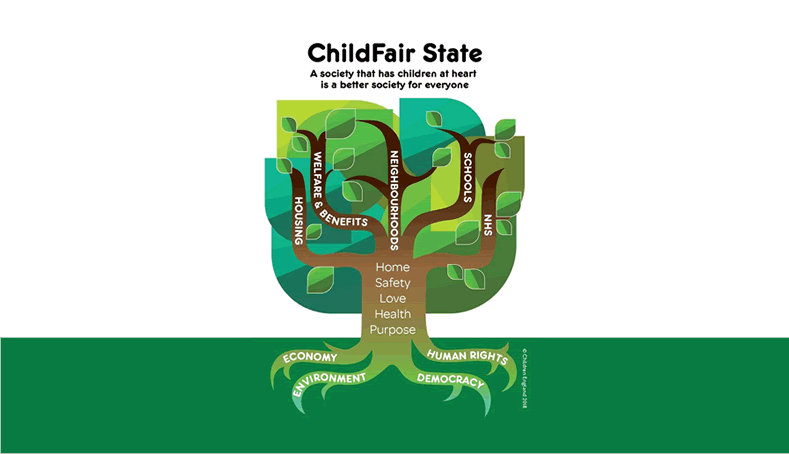
4in10's new Strategy Manager, Katherine Hill writes her first blog on why poverty is a human rights issue.
The right time for rights
The modern international human rights framework was born out of the chaos and trauma of the second world war. In the 1940s when the global community stood at a crossroads asking itself which way next, one response was the UN Declaration of Human Rights which sought to codify a set of universally held values: freedom, respect, equality, dignity and autonomy.
Over the past year this human rights framework, which to many in 21st century Britain had felt remote and was perceived by some as only benefitting groups at the margins of society, has become central to all our lives. The Government has been forced to take decisions which have curtailed our rights. The right to private and family life, the right to protest, the right to practise religion, have all been restricted in order to protect the right to life. Opinions about whether the correct balance has been struck between these rights have varied and many will argue that at points it has been wrong but the widespread acceptance of human rights as the right language for having the conversation has been striking. It has put those universal values centre stage once again.
As we look to the future, the challenge is shifting from protecting the right to life to the question of how we rebuild lives and livelihoods. That conversation again needs to be conducted firmly in the language of human rights and be rooted in the values they embody. It must be not only about civil and political rights, but also about how to protect the right to food, the right to work, the right to an adequate standard of living, the right to health, the right to education and the right to play. These rights are referred to as economic, social and cultural (ESC) rights and they are protected in international law in treaties such as the International Covenant on Economic, Social and Cultural Rights (IESCR). Protection for them in our domestic law is weaker although that has begun to change in some parts of the UK; Scotland has recently become the first country in the UK to directly incorporate the United Nations Convention on the Rights of the Child, which includes many ESC rights.
What has been clear for a long time and has been brought into even sharper focus by the pandemic is that our economic and welfare systems are not upholding these rights for everyone. The shocking child poverty figures published this week (25th March) are testament to the fact that too many in work do not receive a wage that provides an adequate standard of living and that the safety net which should protect this right for those not in work and in low paid work is broken. The result of this failure is that children and their families are denied the freedom and dignity that others enjoy.
The good news is that in some quarters the language of values and rights are already very much part of the conversation. Children England's Child Fair State young leaders are well ahead of the game and have done inspirational work, reimagining the welfare state in a way that put values back at the heart of the system. The original welfare state was developed in the same era as the international human rights framework but was not an overtly rights-based system. If we are to emerge from the pandemic a more equal society, free from child poverty, it is time to put that right.
Spotlight on 4in10 member organisation, Rainbow Money Advice
Interview with Stuart from 4in10 member organisation Rainbow Money Advice
SPOTLIGHT INTERVIEW
RAINBOW MONEY ADVICE, BARNET
- How are you helping to tackle child poverty in London?
Rainbow Money Advice, established in 2015, is a service provided by Barnet Community Projects, and affiliated with Community Money Advice. We are based in the Rainbow Centre in a deprived part of the London Borough of Barnet.
Our aim is to give help and hope to people with money problems. This is achieved by providing a free of charge money advice service that helps people deal with their debts, budgeting, and welfare benefits issues. The service provides advice by appointments on Tuesdays. We work closely with our colleagues Sarah and Jeanette, who run the Dollis Valley Angels emergency food delivery service at the Rainbow Centre, and with Anne and her team running a Lunch Club with activities for local school children in the school holidays.
- Share with our members something positive about your organisation’s achievement or service.
As at the end of February 2021, we had held over 800 interviews, and helped 180 clients/families. There have been cash successes of over £176,000 in annual awards (mostly welfare benefits, and savings in expenditure) – and over £130,000 in one-off gains, which include having debts cancelled and grants awarded. Other successes include obtaining white goods and furniture for those who cannot afford them. Several people who had been sleeping on the floor now have beds. We have also helped make successful applications for Blue Badges, and Disabled Persons’ Freedom Passes. We were delighted to be recently chosen to be Winner of the Barnet Group’s Community Group of the Year.
A memorable case, which highlights the work we do, concerns a woman diagnosed with a personality disorder, who had attempted suicide. She incurred substantial rent arrears. A successful application to Barnet Council for a Discretionary Housing Payment cleared the arrears and fortunately avoided eviction for our client and her four-year-old child.
- What can other network members learn from you or find out more about through you?
Small agencies like ours do not have numerous volunteers and staff to discuss issues and share experiences. It’s important, therefore, to build relationships with advisers in other agencies, and to participate in shared events, such as those provided by Money Advice Groups. It’s also important to forge links with local charities providing mutual sources for signposting and referrals.
The Coronavirus pandemic has of course created many challenges for advisers and our clients. We postponed our face-to-face appointments and replaced them with a remote service. Some success has been achieved holding interviews by video, using Zoom and What’s App. Being able to see your clients works best, as non-verbal clues can be missed over the phone. Unfortunately, not all clients can afford, or are able to use, this sort of technology. Many clients seeking debt advice invariably brought large bundles of letters from creditors (often in unopened envelopes). Some clients have now been able to scan and email documents to us; whilst others have learnt to take photos with their mobile phones and send them to us by What’s App.
One positive from the pandemic is that it created the time and opportunity for money adviser Stuart to study online for the Certificate in Money Advice Practice. This was provided by the Institute of Money Advisers with Staffordshire University (and kindly funded by Barnet Community Projects and the Thames Water Trust Fund). The course is excellent, highly recommended, and the knowledge gained helps us to provide a much-needed service.
- What would most help you achieve your goals?
More time and more volunteers = more money! We are a small charity with limited resources, and there is a huge demand for appointments. Our service has been a victim of its own success as the word has spread. What started with helping people living across the road in the local estate has grown beyond expectations. Clients are being signposted/referred by numerous organisations, including local GPs and schools. Our aim is to expand, to provide a service on several days of the week with a presence in other parts of the Borough. We have started training new volunteers, and trainee Fanta (with experience gained at the Barnet Refugee Service) has already helped to advise clients. More funding will enable us to train more volunteers and achieve our goals.
- Why did you join 4in10? What do you enjoy about being part of the 4in10 network?
As already mentioned, networking is very important. 4 in 10 is a great organisation, with a shiny new website providing access to hundreds of great organisations, many of which have shared information and contacts with Rainbow Money Advice. We always look forward to 4 in 10’s emailed Newsletter. This is packed with essential information about events, surveys, campaigning, reports, job opportunities – and the all-important details of grants for clients, and funding for organisations. It was through 4 in 10 that we experienced the inspiring London Child Poverty Week conference. We are grateful to 4 in 10 for bringing together the organisations and resources which will help us all tackle child poverty in London.
Contacts
For more information about Rainbow Money Advice, email Stuart Goodman on moneyadvice@barnetcp.org.uk or phone 07981 760 399 (Tuesdays and Thursdays).
For further information about Barnet Community Projects, our Dollis Valley Angels Project, or Lunch Club, email Steve Verrall on steveverrall@barnetcp.org.uk or phone 07946 728515.
4in10 Newsletter 18.03.2021
4in10 Newsletter with data, news, funding, calls to action and more. For this issue click here.
4in10 Newsletter 03.03.2021
4in10 Newsletter with news, data, calls to action, funding and more. For this issue click here.

My views on inequality and the upcoming London Mayoral Election by Alex Bax
Alex Bax, Chair of My Fair London has written a personal blog with his views on inequality and the upcoming London Mayoral Election.
Inequality in London almost doubled in the 1980s. It has stayed at this high level for the last thirty years.
We now have more billionaires than any other city in Europe, and more than another point in our history;
5% of Londoners own 50% of the wealth of our city. 50% of Londoners share only 5% of the wealth between them;
Homelessness has increased by 150% in the last ten years;
Child poverty has tripled in the last 40 years.
With the impending London election, now is the time to ask our mayoral candidates to make a commitment to reduce inequality.
In the foreword to his last manifesto, Sadiq Khan, London’s current mayor, said ‘For a child growing up on a council estate today, London is not the city of opportunity that it was for my brothers, my sisters and me.’ He is absolutely right, and the biggest underlying change that has made today’s London a much, much harder place for young people to get on, is the incredible increase in inequality that we have seen since 1979. To create a London that works for ‘all Londoners’, we must begin to reverse that 40 year drift to the extreme levels of inequality we all live with today, and the many small, medium and large insults that such an unfair society inflicts on every one us.
What we achieve in life is partly a function of our personal ambitions and interests, our capabilities and enthusiasms. But all our personal endeavour takes place in a context. The harsher the context in which we live the harder it is for personal qualities to overcome circumstance. A very unequal society, where money has become the defining characteristic of worth, is a very harsh environment for us all. Gross inequality makes it harder for every Londoner to live a full, free and fulfilled life. It makes life harder for the middle classes and for the poor, it most harms the chances of people at the very bottom, and even the rich are not immune from its impacts, as they retreat behind gates and security guards. If London’s mayor is to deliver on that promise to young Londoners growing up today, they must tackle inequality.
A wealth of international evidence shows that more equal societies have more social mobility. This is partly because the shape of more equal societies, the steepness of the social and economic gradient, is less. Each step up, or down the ladder is smaller, and because status anxieties are less, moves up or down are less psychologically difficult. We only have to look at the make-up of the current British cabinet to see how easily privilege begets privilege. The London housing market is a great illustration of how the ladder of advantage is being pulled up behind those lucky enough to have bought their home in the past. Today a young Londoner without the ‘bank of mum and dad’ faces a far harsher future than the young Sadiq Khan. Inherited wealth is back, and the privilege it brings is back too.
When Sadiq Khan was growing up in the seventies and early eighties London was a far more equal city. His formative years came at the end of a 60-year period during which Britain had become ever more equal. Since 1979 the gap between rich and poor has returned to levels not seen since before the First World War. 1970s London was not a perfect society, racism was endemic and gay rights non-existent. However lower levels of economic inequality meant young people were more likely to feel they could get on. With narrower economic gaps between people mutual respect and a sense of belonging was stronger. As inequality grew through the 1980s these ‘felt’ possibilities diminished, and at the same time the practical supports that any fair society should offer to people lower down the social scale were gradually eroded. Today, a family like Sadiq’s, with a bus driver as the main earner, would be incredibly fortunate to get a council flat. They would more likely live in private rented accommodation on an insecure lease, and little Sadiq’s education would have been interrupted by his family having to move house several times, and probably change school. His bus driver father’s pay has stagnated over 40 years. The increased wealth and productivity of the economy has been taken by the top 10 and top 1% of earners. Today Sadiq’s family would be in receipt of tax credits to help them make ends meet and would probably claim housing benefit to bridge the gap between their household income and the rent. As the children grew up and moved away the bedroom tax might force Sadiq’s parents to move again. Instead of the rent the Khan family pay going to a local authority, to invest in more housing or other services, today that tax payers’ money most likely goes to a private landlord through housing benefit. Frequent moves will have stressed Khan family relationships, and may also have made it difficult for his parents to send young Sadiq to the school of their choice, especially if richer neighbours have used their housing equity to move closer to a school that claims better results.
At school, status anxiety and a more competitive environment will have increased Sadiq’s chances of developing a mental health problem in his adolescent years, and the growing ‘social distances’ between social groups have made it less likely that young Sadiq has a group of friends from a range of backgrounds. Youth clubs, libraries, other public services accessible to all, but most useful to those with the least, have gradually been cut. For a young man from an ethic minority living on a council estate in south London to stay out of the way of gangs (where poor young people attack each other over the pettiest of sleights or perceived threats to social status) is a real challenge. One bright spot is that sustained investment in London’s state education system, with a focus on leadership and the quality of teaching, that started in the late 1990s, means that London’s schools do buck the trend nationally in raising the attainment of lower income children. However, if young Sadiq does well at school and wants to go on to university to pursue his dream of becoming a lawyer he and his family will face the prospect of a mountain of student debt.
Of course, for the real Sadiq his late teenage years and early adulthood played out during the 1980s, the decade that saw what was probably the most rapid increase in inequality that Britain has ever seen. The most corrosive, pernicious effects of inequality take time to have an impact so perhaps the young Sadiq Khan, his family and community in South London, continued to benefit from the high point of equality that was Britain before 1979.
Today’s young Londoners, especially those living on council estates, face a world far less generous, and far more unequal than those of Sadiq Khan’s generation. Living in a highly unequal society exposes young people to chronic social stress. This in turn acts to dysregulate key biological systems in our bodies (cortisol levels for example) leading to increased life-time chances of a wide range of long-term health conditions and psychological problems. Being exposed to high levels of inequality is seriously toxic, and just like air pollution it is all around us.
The deep inequalities in our society set the scene for the lives of today’s young Londoners. Fairer societies have lower levels of crime, greater social mobility, lower levels of obesity and mental illness, higher levels of trust and higher and more fairly distributed life expectancy. But high inequality is also a political choice. The UK has been far more equal in the recent past, and is far less equal than many other successful developed economies. I challenge the new mayor to recognise the harm inequality does to the city and put economic fairness at the heart of their programme.
4in10 Newsletter 18.02.21
4in10 Newsletter with news, data, funding opportunities, training and more. To read this issue click here.

Spotlight Interview - Little Village
https://littlevillagehq.org
- How are you helping to tackle child poverty in London?
Little Village is like a foodbank, but for clothes, toys and equipment for babies and children up to the age of 5. In 2021 we’re marking our 5th Anniversary, and we’ve grown to become of the largest ‘baby banks’ in the UK, supporting over 11,000 children since we launched in 2016. Families are referred to us via a network of over 1,800 professionals such as midwives and social workers. As a volunteer-led movement of parents committed to alleviating child poverty, Little Village’s vision is that every child in the capital has the essential items they need to thrive. The families we help are facing a range of challenges – homelessness, unemployment, low wages and domestic violence. 1 in 3 of the families we support are homeless or living in temporary accommodation. In normal times, we support families from all over London, and currently have sites operating in Battersea and Camden.
- Share with our members something positive about your organisation’s achievement or service.
Despite the constraints of lockdown, we supported 7000 children in 2020, the highest ever number, which we think is a huge achievement. In normal times, families would visit us at our sites around London. However, with the advent of coronavirus, we’ve had to temporarily close our doors to families and completely re-design our whole operation to become what we’re calling a #VirtualVillage. We are currently operating a delivery service to families, using a mix of volunteer drivers and bicycle and van couriers to help us get the items to families. As well as providing practical support, we are also keen to support families emotionally, which is particularly crucial with lockdown as families feel more socially isolated than ever. For example, our volunteers are calling over 100 families each week to build and deepen our relationships with them. In addition, we are connecting with families virtually and we recently hosted a virtual coffee morning with 30 mums where families had an opportunity to connect, chat and share their lockdown experiences.
- What can other network members learn from you or find out more about through you?
As well as supporting families in the short term, we are working hard to tackle child poverty in the long term by continuing to raise awareness of the issue. For example, last week to mark our 5th Anniversary, we published a new report, supported by the Joseph Rowntree Foundation, looking at the rates, persistence and depth of poverty in families with young children. The research found 1.3 million of the 4.2 million children in poverty in the UK are babies and children under the age of 5. It also highlighted the impact of the Covid pandemic on low-income families with young children. Our new research led BBC 2’s Newsnight programme, which featured a report by Katie Razzall, it’s UK Editor who interviewed our founder Sophia Parker and Vicky Jones, a mum we have supported. The next day, the PM Boris Johnson was asked a question about our report in PMQ’s by Ian Blackford MP, the SNP Leader in Westminster (10.48 in). We also shared the results of the survey in a webinar with over 180 participants. The webinar will be available to watch on our website soon.
- What would most help you achieve your goals?
We strongly believe in the power of collaboration to make change happen. There are a growing number of baby banks around the UK and we’re keen to work with them to amplify the voices of families we’re supporting. You can find out more about how you can get involved with our work here or please do get in touch directly with our new CEO Sophie Livingstone via sophie@littlevillagehq.org.
- Why did you join 4in10? What do you enjoy about being part of the 4in10 network?
We think the 4in 10 network is a great way of continuing to engage in advocacy work by keeping across important information about research and advocacy in the area of child poverty. It also provides a collaborative platform in which to connect with other organisations working to end child poverty. Thank you for all the work you are doing to bring organisations together!

Poverty Reports and Data, Funding Opportunities and News
Dear All
This issue has information about the Mayoral elections, the Select Committee Enquiry into child poverty and a Spotlight Interview at the end with Little Village. A very happy 5th birthday to them. They have done so much to help families over their 5 years while exposing the root causes of poverty, we are proud to have them as members. Read on for new reports and useful data as well as funding opportunities and an interesting job vacancy.
But first, 4in10 have a new Strategic Project Manager starting on March 8th. Her name is Katherine Hill and she comes with a wealth of campaigning and policy experience. She joins us after serving for several years as a clerk to the Joint Committee on Human Rights in parliament, and before that she has had a number of human rights policy and campaigning roles at Age UK, Scope and The Children’s Society. We are excited to welcome her to the team.
Other 4in10 staff news is that Keisha is expecting a baby soon and has decided not to return after her maternity leave. We all wish her and the new baby the very best of luck and much love.
Work and Pensions Select Committee Inquiry into child poverty – deadline for submissions 25th Feb. It is important that organisations make submissions if you can. If you would like some guidance as to what could go in a submission, CPAG have put together a briefing based on the main questions posed by the Committee.
The London Elections are planned for 6th May this year for the London Assembly and London Mayor. People must be on the electoral register to vote. It is simple to register online and applications for postal votes are available but people must be on the electoral register before applying for a postal vote. This is a good opportunity to ask candidates questions about poverty and inequality in London. If your organisation is contacting candidates please let us know the questions you are asking them and if you get a response that we can share. (Questions suggested in the link below for the End Child Poverty campaign might spark ideas.)
Candidates are:
Sadiq Khan Labour Contact
Shaun Bailey Conservative Contact
Sian Berry Green Party Contact
Luisa Porritt Liberal Democrats Contact
Also standing are the Women’s Equality Party, UKIP and a number of Independents.
From members and friends:
- ACEVO, NCVO and the Lloyds Bank Foundation have published their final report on Rebalancing the Relationship between small and large charities and how the culture of commissioning impacts on this.
- Be Gamble Aware and Expert Link have joined forces to develop a user led network of those affected by gambling.
- Big Issue reports that government is proposing a new strategy to help people on low incomes heat their homes, but warn that people will still struggle to stay warm without a stronger benefit system and help getting out of problem debt. The proposals will extend the £140 Warm Home Discount to an extra 750,000 households, including working-age households earning less than £16,190. This would mean a total 2.7 million people paying £140 less on their fuel bills every winter.
- Beyond the Box are looking for young people aged between 14 and 25 and living in East London to attend a series of workshops on cultural programming, leading to possible work on the Peoples Pavilion events and programming. Applications closing shortly.
- The Bike Project is looking for a new Trustee with lived experience of the asylum system.
- Bromley By Bow Centre the Working Well Trust and the Work Rights Centre have joined forces to run a free webinar on employment and employability in Tower Hamlets. 4th March from 1-2pm.
- Centre for London is working with the Mayors Office and others to produce a ‘shared vision for London 2050’. They have created a survey with a wide variety of options as to what matters to you and for London. Please do share the survey with your networks and those who use your services.
- Children England, Lloyds Bank Foundation and others are hosting a webinar on the government’s procurement green paper as it impacts on the voluntary sector. 25th February 2.30 – 4.
- Debt Free London have extended their 24 hour a day service throughout February. For debt advice and support call 0800 808 5700. Video advice session online debtfree.london/video WhatsApp message on 0800 808 5700 or live web chat online at debtfree.london.
- Digital Candle is a free service matching voluntary organisations up with a volunteer expert for an hour of free digital advice. Submit your question and within 48 hours you will receive an email matching you with an appropriate expert. No question is too broad or too niche; whatever you need to know, they will find someone who can help.
- Doctors Of The World have published information on entitlement to the Covid vaccine.
- End Child Poverty Campaign have a template email you can send to your local MP and ideas of questions to ask and how to phrase them. This can be linked to both the upcoming budget and the #NeverMoreNeeded campaign
- Expert Link are recruiting a panel of people with lived experience of disadvantage and the benefit system to develop a strategy for long and short-term policy change, and lead monthly online forum with local and national influencers such as DWP Partnership Managers, national charities and Government officials. They are running a 2 part training session for anyone interested on Thursday 25th February (2-4pm) and Thursday 4th March (2-4pm).
- Feeding Britain and Emma Lewell-Buck MP have published a briefing paper on Stemming the Rise of Child Poverty with some clear recommendations for immediate action.
- Gingerbread and StepChange have published a report on lone parent debt.
- Homeless Link are running a survey until the 21st February for organisations providing homelessness services if they have used Homeless Link in any way.
- Huffington Post have published a piece on the rise in Tuberculosis, a direct result of people living in poverty.
- Juniper Education Dataset Report unsurprisingly shows it has been the youngest children whose learning has had the most significant drop during Covid, particularly those in last year’s Year 1, current Year 2s. Certain groups have been disproportionately affected by the disruption to their learning with disadvantaged pupils and those with special educational needs showing greater gaps than their peers.
- Lime Bikes are offering all London key workers – from NHS and emergency service staff to carers, teachers and supermarket staff unlimited free Lime e-bike rides to help commuting in a safe and socially distanced way during lockdown.
- Little Village have published their report on the rates, persistence and depth of poverty in families with young children. (See their Spotlight interview below)
- Magic Breakfast are continuing their campaign to get the school breakfast bill through parliament. This is running until the end of February and there are many ways you can show your support.
- Maternity Action and the Women’s Budget Group are hosting a webinar on reforming shared parental leave. 19th February 1-2.15
- Migrant Rights are running a series of workshops for migrants on NRPF and everyday rights each day from Feb 22nd to 24th from 1-3.
- Money and Mental Health report the findings from the Mental Health and Income Commission that there is a significant gap in average income for those with mental health conditions and that this has worsened during Covid.
- NCVO, Nottingham Trent and Hallam Universities have published their latest report on the impact of Covid on the voluntary sector. They welcome new participants in this ongoing study. It involves completing a survey and the information is important to evidence the fact that our sector is Never More Needed.
- Refugee Council, Coram Children’s Legal Centre and six other organisations have written to the Children’s Minister calling for every unaccompanied child to receive the specialist care they need.
- Revolving Door have compiled a collection of eight essays titled The Knot, that explore how poverty, trauma and structural disadvantage create and perpetuate multiple disadvantage. To launch its publication there is an event on the 25th February from 11-12.30 featuring contributors and those with lived experience.
- Runnymede Trust have published a paper on ethnic inequalities in Covid 19 mortality.
- Small Charities Coalition have launched a new mentoring service for organisations looking for peer to peer support. They also run events all year to support smaller organisations including governance issues, finance support and events in community languages on setting up a charity. The next ones are for health and wellbeing charities on the 22nd February from 10 – 11 and Poverty, Housing and Homelessness Small Charities Meet-Up with the ASA on the 23rd February from 10-11.
- Sound Connections host the Music and Social Justice Network and welcome new members. Anyone working with children and young people in London through music is invited to join.
Local Authority and Health Statutory Updates:
- The Care Quality Commission (CQC) – have set up a web page where disabled people and their families can provide feedback directly, and anonymously to the CQC to help them plan future services that take the needs of disabled people seriously. Evidence shows that disabled people and their families have suffered more than most during the current pandemic.
- Census 21 will take place online on March 21st. The ONS are offering help to those who cannot access the census digitally and will send out a paper copy. They are advertising a range of temporary jobs linked to the census. The online version and information about the census is available in a range of community languages. It is worth noting that it is compulsory for households to complete the census and fines may be issued to anyone not completing it.
- Department for Digital, Culture, Media and Sport are hosting a webinar on VCSE’s Winning Central Government Contracts and the New Social Value Model. 17th March, 2-4pm.
- Her Majesty’s Inspector of Prisons has published a report on What Happens to Prisoners during A Pandemic including a stark warning about what is happening to children in prison.
- London Councils have published a report on how the pandemic may widen entrenched disadvantage by reducing access to early years provision as well as take up and what needs to be done for early years education post Covid.
- NHS Doctors and Nurses and other Frontline Staff have recorded reassuring vaccine information in community languages. Videos are available in 14 languages with more to follow.
Funding Opportunities:
- Ashworth Charitable Trust fund smaller organisations in a range of humanitarian fields. Closing date for this round is the 28th February
- Austin Hope Pilkington Trust offer grants for organisations working with homelessness and those working with refugees and asylum seekers. This funding round closes on the 28th February.
- Barnet Community Innovation Fund closes on the 1st March. Small grant: up to £2,000, Start-up grant: up to £10,000, Big idea grant: up to £65,000. This round will fund projects that can support unpaid carers and residents who have lost or are at risk of losing their jobs.
- GLA Details were in last newsletter but a reminder that there are 3 funding streams due to close shortly.
- Homeless Link will be managing a new fund provided by the GLA for organisations supporting rough sleepers to provide immigration advice.
- Lambeth Wellbeing Fund closes for applications on the 3rd March. Priority will be given to Black, Asian and Minority Ethnicity (BAME) groups across the borough.
- MSE Charity fund organisations providing financial education and resilience in money management. Application deadline 26 February.
- Lady Neville Charitable Trust funds small organisations with a turnover of less than £100,000.00 with a particular interest in Camden, Enfield, Hackney, and Hounslow. Deadline 12th March
- Rosa and Smallwood Trust have partnered to launch a new fund for specialist women’s and girls’ organisations in the UK. Grants of up to £40,000 are available for organisations supporting women and girls to build financial resilience and/or improve mental health and wellbeing. Deadline for applications is March 25th. Organisations can also apply for an additional 25% of their grant request for work which will strengthen their organisation. ‘How to Apply’ webinars on, February 25th, March 8th and March 18th to learn more.
Job vacancy at Save the Children:
Senior Policy Adviser and Advocacy Adviser (UK Child Poverty), will lead Save the Children’s UK child poverty policy work targeting the UK government.
Keep an eye out for announcements about 4in10’s new website. The plan is for test runs to start on the 22nd February with the site going fully live on the 1st March. The site is planned to be very interactive and to include the work started during London Challenge Poverty Week, creating a searchable and useful list of the many wonderful voluntary organisations working directly with child poverty in London. We still welcome your photos or videos to share on the site, which we intend will visually reflect our members work. All material will be credited.
Finally, thank you to Little Village for their Spotlight interview below and if you would like to be our Spotlight organisation in March or April or if you have information to share with our network, please do get in touch.
Very best wishes and stay safe.
Liza
4in10 Newsletter 03.02.21
News, Data, Training and Calls to Action for 3rd February 2021. Click here to read.
4in10 Newsletter 21st January 2021
Fortnightly Newsletter with News, Data, Calls for Action and More. Click here for issue 21/01/21
Spotlight Interview - Westminster Befriend a Family
https://www.befriendafamily.co.uk
- How are you helping to tackle child poverty in London?
Westminster Befriend a Family (WBAF) enables people to break out of cycles of poverty, and mitigate its impact with the support and accompaniment of trained and supervised volunteers. We runs mentoring programmes for parents and young people in Westminster and the surrounding boroughs. ‘Mentoring for Mums’ is a programme we’ve just launched, that supports mums of children aged five who are facing challenges and who want to make positive changes in their lives with the support of a volunteer mentor. With support to build confidence, identify and achieve goals, find the specialist support needed and get unstuck, our programme helps mums into employment and education, as well as providing practical, emotional and social support. Similarly, ‘Broadening Horizons’ our mentoring programme for young people aged 10 – 24 offers regularly one-to-one support on a weekly basis from trained volunteers, with a goal-focused approach to setting aspirations, building connections and reducing loneliness.
- Share with our members something positive about your organisation’s achievement or service.
With the onset of the Coronavirus pandemic, since the first lockdown in March 2020, we managed to not only continue our services, but to massively increase our provision, tripling the number of people we supported in the last year as we expanded and introduced new programmes. We took everything online and after a few lumps and bumps, we’d got into the swing of things by April. Our brilliant volunteers were the linchpins in our success: they’ve helped us with volunteer recruitment drives, adapting to online working and their commitment to supporting families experiencing challenges has been unstinting, despite difficulties with communication and a hugely unpredictable environment. Because of the trusting relationships they built up, they were able to identify when families needed additional support with food, financial advice or IT equipment, and we were able to rapidly connect them to the right organisations so that their needs were met within days.
- What can other network members learn from you or find out more about through you?
Our volunteers have their fingers on the pulse of the community – because of the relationships they build up, they often get to hear about problems people might be experiencing before others are aware of them, which means we can respond quickly to individual or collective issues. With our signposting and referral system, we can make sure people are connected to the right services. We’re always keen to hear from organisations who support families and young people, so that we can connect them to the support they need, as well as taking referrals from them too.
- What would most help you achieve your goals?
We’re growing, and we’re always looking for more mentors – compassionate people with time to give, as well as an understanding of the challenges that some disadvantaged parents and young people are managing: Volunteers can apply here! We offer full training and ongoing support and supervision, as well as Tempo Timecredits so you and your mentee can grab a coffee together when you’re able to meet!
- Why did you join 4in10? What do you enjoy about being part of the 4in10 network?
As a small organisation, we don’t have much capacity to independently engage in policy and advocacy work, but we know that our experiences and the voices we can channel need to be heard. Being part of the 4in10 network enables us to contribute to the systemic change that tackles the root causes of the challenges that our families and young people face. The information I get from 4in10 is really relevant for me and helps me stay abreast of a vast and rapidly changing field of research and advocacy so that our programmes and funding applications are well-informed – thank you!
UK Poverty 2020/2021
UK Poverty 2020/2021: Why decisive action from central government matters now more than ever for our low-income London families.
“While we have all been in the same storm, we haven’t all been in the same boat.”- JRF
Reading the latest annual report from Joseph Rowntree Foundation (JRF) we see once again that London has the worst poverty rate within England. Prior to the pandemic low-income families in London were already struggling to make ends meet due to an unfair social security system that failed to protect them from the impact of the high costs of living in London.
This report incorporates pre-pandemic poverty data that reflects the world as we once knew it. It shows that low-income families who were already gripped by the clutches of poverty are the ones being further economically affected by COVID-19.
The JRF polling in May last year showed most low-income families on Universal Credit or working tax credits were forced to go without essentials, falling behind with rent payments and pushed further into debt as a result of the COVID-19 outbreak.
“It’s a damning indictment of our society that those with the least have suffered the most over the past decade and are now being hit hardest once again by the pandemic.” - Helen Barnard, JRF
The report highlights groups that were disproportionately affected; lone parents, who were more likely to be women, low paid and part-time workers, including BAME workers, as well as private and social renters.
All affected were likely employed in the hardest hit sectors (retail, food, accommodation, hospitality) as these jobs did not afford them the benefit of working from home.
For lone parents it was sadly inevitable then, that the lockdown restrictions would have hit them hardest not only because of the sector they work in, but also because of the sudden disruption to their childcare arrangements.
“The government continues to leave decisions on the support available to the worst off in our society to the last minute. It doesn’t have to be this way.” - JRF
It’s clear that central government must act now to alleviate the pressure that low-income families in London face on a daily basis to simply survive. Proactivity on their part is needed to address this unacceptable level of poverty. The report highlights the following solutions:
- As many people as possible need to be in good jobs. Retraining opportunities should be made available to diversify employability for those who have lost their jobs.
- Earnings for low income working families need to be improved.
- The Universal Credit uplift needs to be made permanent.
- The benefit system needs to be viewed as a vital public service, rooted in the shared understanding that everyone is entitled to have a decent standard of living.
- Low-cost housing provision needs to be increased and the gap between LHA and housing rent needs to be revised for low-income families.
We will continue to push for change in these areas with our network of members, highlighting these very pressing issues affecting the lowest income Londoners – particularly ahead of the budget in March. Join us by talking to your MP and letting them know why you want to see action on child poverty. Click here for all the information you need to take part.
4in10 Newsletter 07.01.2021
For 4in10 fortnightly newsletter with news, information, data, opportunities to influence with a new year feel, please click here.
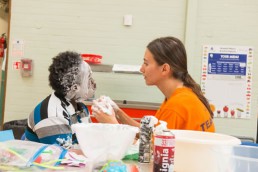
Great Job Opportunity, News, Funding, Reports and More
Dear All
We hope you are well and coping with where we all find ourselves.
You may have seen that sadly, Laura Payne is moving on from 4in10 to a great new post at the end of January. This means we have an exciting new vacancy for our team leader. Can you see yourself running our amazing 4in10 network, championing London's diverse and tireless anti-poverty organisations, maintaining, creating and developing contacts with decision makers and those who influence and inform them while leading a small and diverse team? Do you have excellent people skills and experience of campaigning and collaboration? Job description is here and the closing date is midday on the 18th January. Please do share as widely as you can.
As before a return to full lockdown means the danger of yet another increase in Domestic Violence. This is an updated list of the help available:
- Childline has a 24 hour helpline for children 08001111 and web based support including a dedicated page for deaf children.
- Galop offer specific LGBT+ DV support and advice. Helpline 0800 999 5428 available 10 – 5 Monday – Friday and until 8pm on Wednesday and Thursday.
- Hestia have an app that can be downloaded to a mobile phone and safely hidden. The content is also available on line.
- Ikwro offer DV support for Middle Eastern and Afghan Women. Languages spoken are Farsi, Kurdish, Arabic, Dari, Pashto, Turkish, and English. Mon to Fri 9.30am-5.30pm 020 7920 6460 For out-of-hours emergencies call: Kurdish / Arabic / English 07846 275 246 Farsi / Dari / English 07846 310 157
- Karma Nirvana support victims of honour-based abuse and forced marriage. They run a helpline from 9-5 Monday to Friday on 08005999247
- NSPCC has advice for anyone worried about a child.
- Refuge offer advice and information for both women and men experiencing DV and now include information on dealing with Tech Abuse. They have a 24 hour free emergency number 08082000247.
- Sign Health offer support for deaf people suffering DV.
- Silent Solutions in an emergency Dial 999. Listen to the questions from the 999 operator. Respond by coughing or tapping the handset if possible. If prompted press 55 – this lets the operator know it is a genuine emergency and you will be put through to the police who can trace the call. For more information.
- Southall Black Sisters this is not an emergency help line. Mon to Fri from 9am-5pm 0208 571 9595 or email info@southallblacksisters.co.uk
- Stonewall DV advice and information for the LGBT+ community.
- Surviving Economic Abuse have updated their information in relation to Covid.
- Women's Aid have a covid specific section on their website
From our members and friends:
- Big Issue asked a range of anti-poverty campaigners what progress they thought had been made in 2020, and what must be done in 2021 to lift people out of poverty for good.
- Child Poverty Action Group are collecting evidence on how social security changes have affected the wellbeing of children and families. They are looking for information both from individuals themselves and those providing services or advice.
- Education Policy Institute have published a report finding a positive impact from graduates working in early years setting on children's long term outcomes, the report also demonstrates that their presence is not a "silver bullet" for improving young children's attainment.
- High Pay Centre has published research claiming that by January 6th 2021, the top 100 paid CEO's will have earned as much in the year as the average annual full time worker's wage.
- Home-Start Richmond, Kingston and Hounslow are currently offering support to isolated families with a child under 5. This includes regular telephone support, help with financial worries, housing or relationship issues and guidance on parenting in the early years including Ideas and activities to keep children active at home.
- The IFS Deaton Review of Inequalities New Year Message is a stark reminder of the danger of ignoring inequality.
- Joint Council for the Welfare of Immigrants want to learn about the experience of migrants during the Covid19 pandemic in relation to keeping themsleves and their families safe.
- Joseph Rowntree Foundation have published their 2020 Poverty Report and Findings.
- Red Card are running a free gambling awareness workshops for professionals and parents on 5th February from 6.30 – 8.30.
- Refugee Council are looking for signatures for a petition to allow child refugees parity with adults in sponsoring close family members to join them.
- Right to Remain have added two new sections to their 'tool kit'. The new Asylum Inadmissibility rules and an update to their EU Nationals pages.
- Shelter have updated their Covid19 webpage to take into account housing and rent related changes in relation to the national lockdown.
- TUC are arguing for employers to proactively offer furlough to working parents affected by school closures and for immediate access to SEISS for the self-employed.
4in10 and a group of our frontline medical members are planning a Webinar on the impact of poor housing on children's health and safeguarding and what practical steps that can be taken to change this from a health practitioners perspective. The provisional date for this is the 29th March 1 – 2.30. If you feel you have something you would like to contribute please get in touch. More details will be available next month.
Local Authority and Statutory Updates:
Many London Local Authorities have developed an elibrary service. This gives access to online books, magazines, comics, homework help and more. Examples below of what is available from some individual boroughs but do check your own borough's library website for more details:
- Barnet
- Brent
- Croydon
- Ealing
- Kensington and Chelsea
- Waltham Forest
- Hounslow have launched a swop shop for residents for children's clothes and toys and have created a way for families to give away items and request things they need. Send an email with the items to give away or needed.
- The Department of Culture, Media and Sport are hosting webinars on Winning Central Government Contracts and the New Social Value Model from 2pm-4pm, on the 20th January 2021, 3rd February and the 17th March.
- The Department for Education has confirmed it will go ahead with previously announced plans to increase the number of free laptops and 4G routers made available to disadvantaged children.
- Ofcom estimates that 9% of children in the UK (between 1.1 million and 1.8 million) do not have access to a laptop, desktop, or tablet at home and that more than 880,000 children live in a household with only a mobile internet connection.
- ONS state that only 51% of households earning between £6,000 and £10,000 have internet access.
- The DofE also updated their guidance on safeguarding children on the 30th December. It now includes homelessness or potential homelessness as a safeguarding concern and requires public bodies to refer families to a housing authority.
- GLA have a London Learning from Home resource site for parents and children to access resources and help.
- London Boroughs Faiths Network, the GLA and London Plus are running the pan-London Volunteering Summit 14th January 1.30 – 3.30. Free and online, this will address ways to support volunteers and volunteering in London.
- The Prime Minister stated that children eligible for free school meals would now receive supermarket vouchers similar to those provided during the first lockdown and during the summer and Christmas holidays. There is currently no information on how this is to be administered while schools are closed. Check individual local authority websites for updates.
Funding Opportunities:
- Local Connections Fund. The new round of this Big Lottery funding has just opened and is for projects tackling loneliness.
- Paul Hamlyn along with Comic Relief have launched a new Tech for Good digital development fund.
- Screwfix Foundation quarterly funding round ends in February. Bids should be in over the next two weeks for building or maintenance bids.
- Trust for London funding round ends on the 2nd February. Bids should be in very soon.
- Volant Charitable Trust has launched a new Covid19 response fund.
Very best wishes and as always please keep sharing information with us so we can share on...
Laura, Keisha and Liza
PS: Did you see the Member Spotlight in our last newsletter? Do let us know if you'd like to feature your work here too.
4in10 Newsletter 17.12.20
For 4in10 fortnightly newsletter with news, information, data, opportunities to influence with an end of year feel, please click here.

2021 Mayoral Election
Election for London Mayor and Assembly 2021
The election will be held on 6 May 2021 to elect the Mayor of London. It will be held simultaneously with elections for the 25 London Assembly members and other local elections. The position of Mayor of London is currently held by Sadiq Khan of the Labour Party and he is standing again as the Labour candidate, Shaun Bailey is the Conservative Party's candidate, Siân Berry is standing for the Green Party and Luisa Porritt is representing the Liberal Democrats. A number of other smaller parties are also standing.
Why does that matter to our sector?
The GLA also known as City Hall is London’s governing body and is responsible for implementing the Mayor’s Policies. Although limited in many ways by central government legislation and by financial constraints, these policies cover how London is policed, housing and house building, transport (TFL), the environment, health, culture and sport, fire services and London’s economy. They also support London’s Youth Assembly.
The Mayor is responsible for setting budgets and deciding on the GLA priorities for the four years they are in office. That includes how and if they will attempt to tackle poverty and inequality in our City. 4in10 try to influence these decisions and hold them to account where necessary to ensure low income, inadequate housing, equality of opportunity and of outcomes are on every agenda and at the forefront of the Mayor’s thinking but that can only be effective if you make your concerns heard.
It is worth noting that the Mayor is not responsible for the NHS, council housing, schools, social services, rubbish collection, street cleaning, parking permits and taxation all of which are governed either at local authority or national government level. However, they do have a voice in all these areas and provide a London wide representation.
How can we gain influence?
Getting the attention of the Mayor matters even in areas of government where they don't have direct control. They are regularly contacted by the media for stories and for comments on policy and can raise the profile of issues that may otherwise be ignored. Providing them with the information and detail they need to do this can only come from those of us who see first hand what the main difficulties are for our children and their families and why they matter. In other words, it is up to us to give them that detail in advance, when they are writing their policy documents and to ensure they understand what really matters to those they serve. It is also up to us to challenge broad statements they may release, asking what they see as the solutions to the impact of child poverty and how they will prevent this getting worse during their tenure if elected.
You can write directly to candidates to invite them to talk to groups online. You can look at candidates’ websites and see what they are saying. You can tell us what issues you would specifically like us to raise with candidates and we can try to do so on your behalf and you can ensure your service users know about the elections, are registered to vote and understand that, despite the limitations, who governs London matters to us all.
News, Funding Opportunities, Mayoral Elections and Members Spotlight
Dear All,
Thank you for sharing your work, your energy and your service information with us this year. We’ve have been grateful to share so much of your great work with the hundreds of organisations in the network, and to see so many of you at our online events. A particular warm welcome to the 52 members who joined our network during 2020.
There is no doubt that food poverty hit the headlines in a big way this year so we have pulled together here some work from national players as sources for useful campaign and food provision information:
- ASDA are providing free hot and cold meals for children under 16 at all of its stores until 31st Dec
- Children’s Right 2 Food has a fantastic visual dashboard showing the links at every point between low income, food insecurity and nutrition.
- Independent Food Aid Network with a strong history of campaigning against food poverty they also have an interactive map of their food banks, often part of wider community initiatives, and may have different access criteria.
- Magic Breakfast helped get the school breakfast bill through its first reading and provides breakfasts in schools for children living with food poverty. Please do read our Spotlight on Magic Breakfast at the end of this newsletter.
- Sustain tireless campaigners against food poverty. Read their report on London’s Food Response to Covid and lessons to be learned and their blog on Holiday Food Provision.
- Trussell Trust have announced an update to their strategic goals. They are now, changing communities, changing policy, and changing minds. They continue to have a list of their affiliated and supported local foodbanks all of which use a voucher system to access.
- UNICEF are for the first time in history helping feed children in the UK.
- More locally, Hackney Migrants and North London Action for the Homeless have joined forces with Eat Hackney to produce a Vegan Cookbook to fund their work. For a donation of £8.00 or more this is being made available to our readers with a special later order deadline than the one specified on their website.
Looking ahead to next year we are mindful of the upcoming London Mayoral Elections and what these might mean to London. We have written an explainer for why they matter to our sector and how you can influence policy for the next four years. We will be lobbying the candidates ahead of the elections, if you or any of the families you support would like to raise issues with us – please do let us know. It is worth noting that many of London’s citizens are not registered to vote and unless they are registered they will not be able to take part in this or any election.
We will also be running London Challenge Poverty Week again later in the year, so do confirm if you’d like to be involved in any of the planning or creative projects for the week.
From our members and friends:
- Acting Out in partnership UCL, Pempeople and The Ubele Initiative are looking for young people aged 18 – 25 living in Peckham, the Old Kent Road or Brixton to take part and help create film and creative content that expresses how young people feel about their neighbourhood, changes that are happening and their hopes for the future. The next workshop is on 13th January from 6.30 – 8.30pm. To reserve a place on the workshop please contact Kelsea Sellars.
- ATD4th World and Just Fair have produced a video to mark World Human Rights Day and they are hosting a webinar on January 21st from 11-1.30 with Amnesty UK to illustrate how human rights are a ‘Bridge out of Poverty’.
- Article 39 and a number of other organisations working in the youth criminal justice field have produced a report calling for an end to child imprisonment.
- Children’s Rights Alliance for England have led on and produced a new report from 90 organisations, a submission to the United Nations Committee on the Rights of the Child warning the many ways that children’s rights are “worryingly low” on the UK government’s political agenda. 4in10 contributed.
- CPAG have released another Poverty in the Pandemic report highlighting the impact Covid has had on already low-income families.
- Early Years Sector Coalition have launched a new campaign Birth to Five Matters to develop guidance for the sector, by the sector.
- Health Foundation and the Institute of Health Equity have published Build Back Fairer the Covid-19 Marmot Review on Health Inequalities not just in light of Covid but highlighting how inequalities that were already present have just been exacerbated by the virus.
- Ipsos Mori poll showed that 62% of the public support the £20 uplift to Universal Credit.
- Joseph Rowntree Foundation have published a new report on Destitution in the UK and made the slides of their webinar on the topic available online. Their annual report, UK Poverty 2020, will be launched by a Zoom webinar on January 15th at 11am.
- Maternal Mental Health Alliance has commissioned member the Centre for Mental Health to produce a report on the challenges the voluntary sector is facing and witnessing as a result of Covid. Please complete this 10-minute survey. Deadline 8 January but pre-Christmas would help.
- Renters Reform Collective is a new coalition of 19 organizations dedicated to housing issues; who have come together to campaign for a second reading of the renters reform bill to ensure that legislation improves the safety, security and condition of privately rented homes.
- Revolving Doors have launched a survey looking at the experiences of 18-25 year olds’ experiences of policing. The aim is to inform the National Police Chief Council to develop their strategy for policing and young people. The survey should take participants about five minutes to complete. They will also have the option to enter a prize draw for a chance to win one of four £50 Amazon vouchers. Deadline is 1st January.
- Scope have released new figures showing how families with disabled children have been ‘pushed to the brink’ during this pandemic.
- Shaw Trust has partnered with the DWP to manage JETS (Job Entry Targeted Support). This is a new initiative backed by a £238 million government investment and is dedicated to supporting those left jobless due to Covid-19.
- Young Roots have been chosen to be the recipient of Aoife Hinds participation in BBC1’s Celebrity Mastermind on the 9th January. We wish her the best of luck.
Local Authority and Statutory Updates and Participation Opportunities :
- All Party Parliamentary Group on Poverty is meeting on Zoom on Thursday 14th January at 2pm – 3:30pm. They are calling for submissions on the impact of ending the temporary £20 uplift in universal credit and tax credits in April 2021, as well as the impact of not extending the uplift to legacy and other benefits during the Covid-19 pandemic. They are asking organisations for short written submissions of the key points the APPG should consider to inform its representations to Government. Please send these on email by the 10th January stating whether you would be available and willing to give evidence at the meeting. The Zoom link is here. But you must let them know you plan to attend.
- Barnet Council has received just over £986,000 from the government’s COVID Winter Grant Scheme. Working in partnership with the Young Barnet Foundation, the grant scheme supports families and other households financially affected by COVID-19 to meet food and heating bills. The fund will provide vouchers through a range of local partners, additional supplies to foodbanks and grant awards through the Barnet Community Response Fund.
- Employment allowance scheme. If your National Insurance bill was less than £100,000 in the last year you now need to claim your £4,000 discount. It is no longer being automatically applied.
- Equalities and Human Rights Commission have published their report on how Covid has affected equality in the UK.
- Hackney Have your say on how the borough allocate homes and support people in housing need. Read the proposals in full, find out what they would mean, and give your views. You can also speak to Council officers at Q&A sessions being held on the following dates and times: 12 January 2021 7-8:30pm; 27 January 2021 12 noon-1:30pm; 9 February 2021 6-7:30pm; 24 February 2021 4:30-6pm. You must pre-register to attend one of the sessions. If you would prefer to speak to someone on the telephone, you can call 020 8356 2929.
- Havering Adult Education College are offering a number of free or for £1.00 courses and provide a free laptop loan service for Havering residents taking online courses.
- Tower Hamlets are providing support for children in need during Christmas and February school holidays. Providing vouchers worth £25 to spend on food over the Christmas period. Any child who is eligible for statutory free school meals during term time will receive support. It is worth checking other Local Authority websites to see if they are doing the same or similar.
Funding Opportunities:
- Bailey Thomas have opened a new grant round to support organisations serving those with severe learning disability.
- Family Fund and BBC Children in Need are running an Emergency Essentials Funding Programme to fund items for individual families such as cookers and washing machines. They will also supply toys and other items where needed.
- Justice Together has launched a new strategy and grant rounds to ensure people who use the immigration system can access justice fairly and equally, so that they can get on with their lives. There are funds available for National level influencing projects that connect lived experience, front-line advice and influencing strategies to create lasting change.
- National Lottery Community Fund and The Department for Digital, Culture, Media & Sport have announced a new fund to reduce loneliness by helping people feel more connected. To be eligible, charities and community groups will have to have an income of £50,000 or less. The Local Connections Fund will be split into two rounds of funding – each with its own application window. The first application window will open on the 5th January 2021 and close on 26th January 2021. The second applications window will open in the summer.
- Youth Covid-19 Support Fund, open to grassroots youth clubs, uniformed youth groups, and national youth and umbrella organisations, to help to mitigate the impact of lost income during the winter period due to the coronavirus pandemic, and ensure services providing vital support can remain open.
To end a difficult year on a positive note, we are delighted to feature member organisation Magic Breakfast in our Spotlight feature below. If you would like to be the next organisation to be featured please let us know.
Thank you to all our great readers and remember this network depends on what you would like to share so please do keep information and knowledge coming.
We wish everyone a peaceful, happy and healthy 2021 and we are looking forward to working with you in the new year.
Laura, Keisha and Liza
Spotlight Interview - Magic Breakfast
https://www.magicbreakfast.com
- How are you helping to tackle child poverty in London?
Magic Breakfast partners with schools to provide children at risk of hunger with a free, nutritious breakfast each morning. School breakfasts boost children’s energy, concentration, behaviour and overall readiness to learn and can contribute to closing the educational attainment gap. However, we believe that no charity can end classroom hunger alone. That is why Magic Breakfast is also campaigning for long term, sustainable, Government investment in school breakfast provision, to ensure no child starts the day too hungry to learn.
- Share with our members something positive about your organisation’s achievement or service.
We’re particularly proud of how we’ve continued to provide breakfasts to children throughout the pandemic, including during all school holidays. During COVID-19 school closures, we adapted quickly and began delivering breakfast packs to schools and directly to children’s homes reaching 24,000 children. We know COVID-19 has impacted the communities we work with; 48% of our partner schools surveyed reported that child hunger has increased at their school as a result of the pandemic. So we’re pleased to be able to continue delivering breakfast food through the Christmas holidays – hunger does not take a break for the holidays!
- What can other network members learn from you or find out more about through you?
Our bread and butter is supporting schools to set up barrier free, stigma free, hunger focused school breakfast provisions. We have an amazing team of School Partners with years of experience of supporting and challenging schools to address classroom hunger.
We’re also happy to share more information about our campaigning strategy and tactics. We’re currently focusing on embedding youth led campaigning into our work.
- What would most help you achieve your goals?
Magic Breakfast is campaigning for school breakfast legislation – which would guarantee schools the funding they need to provide breakfasts to children at risk of hunger. In February, the School Breakfast Bill will have its second reading in Parliament.
We will be launching a supporter action that enables members of the public to write to their local MP about the Bill. We would be so grateful in 4in10 members could share this action through their networks and help promote the action on social media.
If your organisation wants to be more involved in supporting the School Breakfast Bill then we’d love to hear from you, please drop Jake an email at jake.atkinson@magicbreakfast.com.
- Why did you join 4in10? What do you enjoy about being part of the 4in10 network?
4in10 is a fantastic network that allows for organisations working across London to share knowledge and best practice to campaign more effectively against poverty. Many organisations and individuals in this network proudly supported the School Breakfast Bill in October and we cannot thank you enough for lending your support to help end child morning hunger. We look forward to working with the network in the New Year to continue our shared fight to end child poverty.
4in10 Newsletter:03.12.20
To read 4in10 fortnightly newsletter with news, information, opportunities to influence and much more please click here,
4in10 Newsletter: 19.11.20
For the 4in 10 Newsletter with all the news, information, data, funding and other opportunities and much more please click here.
4in10 Newsletter: 05.11.20
To access the 4in10 Newsletter with all information, data, reports, funding and other opportunities please click here.